
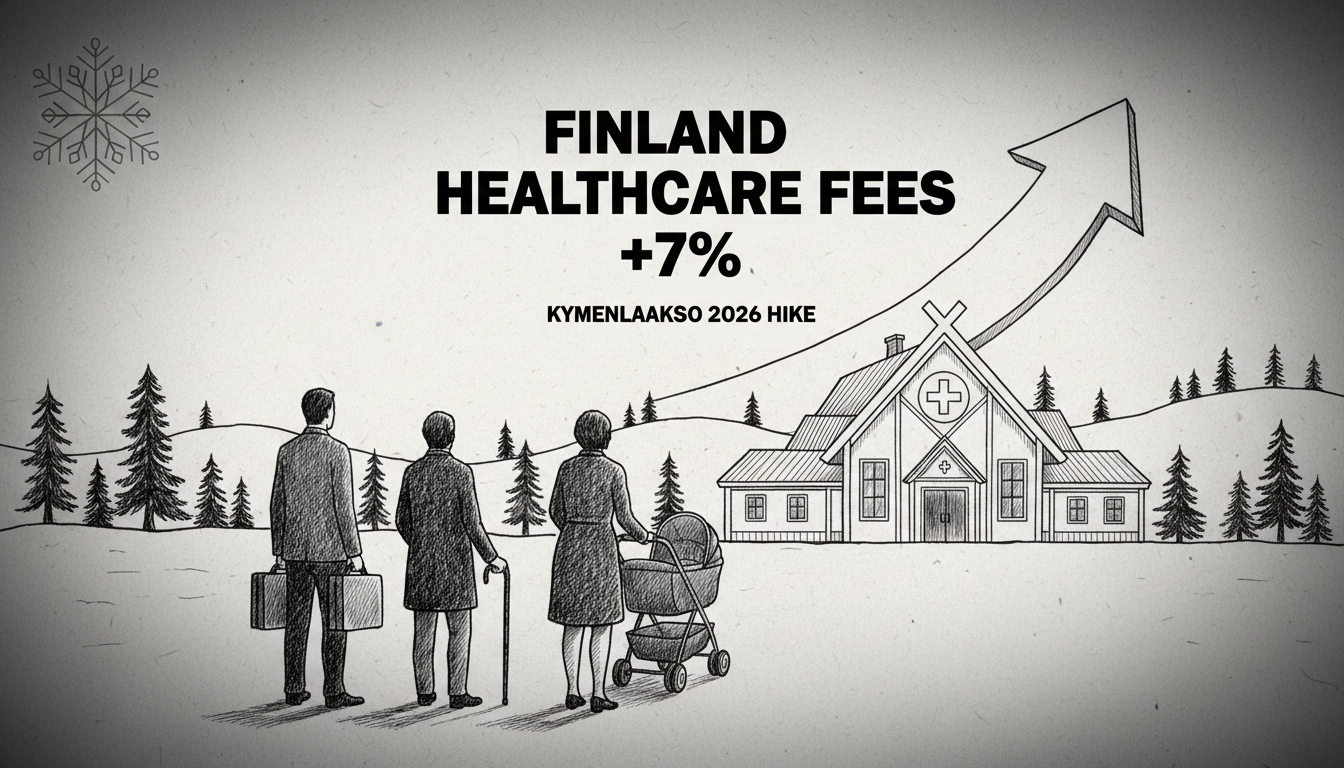
Finland's Kymenlaakso wellbeing services county will increase healthcare patient fees by approximately seven percent starting January 1, 2026. The county council approved the hike this week, aligning with a national biennial adjustment tied to the national pension index. The decision directly impacts the out-of-pocket costs for residents seeking medical and dental care in the southeastern region, reflecting broader financial pressures on Finland's decentralized healthcare model.
"The adjustments are based on government decree and the Client Fees Act," a county official stated. "The euro amounts stipulated in the decree are reviewed every other year in comparison to the national pension index." This legal framework mandates regular updates to keep patient contributions in step with general cost increases across the Finnish economy. The last similar index adjustment occurred in 2024.
For individuals and families managing chronic conditions or requiring frequent specialist visits, the change has tangible consequences. The annual maximum cap on healthcare fees, a critical financial safeguard, will rise from 762 euros to 815 euros. Once a patient's cumulative fees reach this new threshold, most included services become free for the remainder of that calendar year. This mechanism is designed to prevent healthcare costs from becoming catastrophically expensive for any single person.
The Specifics of the Increase
The fee for a missed medical appointment or one cancelled too late will also become more expensive. It increases from 56.70 euros to 60.60 euros. However, a proposed amendment to the law, currently under government consideration, could push this penalty fee significantly higher. If enacted, the charge for an unused or peruuttamaton aika would jump to 73.70 euros. This potential secondary increase signals a stronger policy push to improve clinic efficiency and reduce wasted resources within the system.
These adjustments are not unique to Kymenlaakso but are part of a nationwide process. Each of Finland's 21 wellbeing services counties, established in the 2023 healthcare and social services reform, must implement the same legally-mandated index revisions. The changes apply to standard fees for public health centre visits, specialist consultations, and other municipal healthcare services. The system is designed to be uniform, though the actual impact on residents varies by region based on local health needs and service usage patterns.
Funding Pressures and the Finnish Model
Finland's healthcare system is predominantly funded through taxation and mandatory health insurance payments collected by the Social Insurance Institution (Kela). Patient fees represent a supplementary income stream, estimated to cover only a small fraction of the total service cost. Their primary function is not to fund the system fully but to generate modest revenue and guide patient behavior, encouraging timely cancellation of appointments to free up slots for others.
"These indexed increases are routine, but they occur against a backdrop of serious structural challenges," said Dr. Liisa Mäkelä, a health policy researcher at the University of Helsinki. "The wellbeing services counties are grappling with rising costs from an aging population, workforce shortages, and expensive new medical technologies. While the fee cap protects individuals from ruinous costs, even these incremental rises can feel significant for low-income families and pensioners who are heavy users of services."
The creation of the wellbeing services counties moved operational responsibility and financial risk from over 300 municipalities to 21 larger regional entities. The goal was to improve equity and efficiency. However, many of these new counties, including Kymenlaakso, have reported substantial financial deficits in their early years of operation. The index-linked fee increases provide a predictable, though limited, boost to their budgets.
EU Context and Domestic Policy Tensions
Within the European Union, Finland's model remains notable for its high level of public funding and universal coverage. The fee cap system ensures Finland complies with the EU's broader principle of accessible healthcare while managing domestic fiscal constraints. Unlike some EU members with larger private insurance roles, Finnish patient fees are uniformly regulated, reducing geographic inequality in access.
The proposed hike in the no-show fee, however, points to an active policy debate in Helsinki. The government has signaled a desire to strengthen financial incentives for efficient service use. A higher penalty for missed appointments is controversial; critics argue it may disproportionately affect vulnerable patients with complex lives or cognitive challenges, while proponents see it as a necessary tool to reduce a significant source of waste and lost clinical time.
Parliament will need to approve any change to the maximum no-show fee through an amendment to the Client Fees Act. This legislative process will involve scrutiny from opposition parties and likely draw commentary from patient advocacy groups. The Eduskunta's Social Affairs and Health Committee will play a key role in evaluating the evidence for such a change.
Looking Ahead to 2026 and Beyond
The 2026 adjustment is a fixed event, but the long-term trajectory of Finland's healthcare financing remains uncertain. Politicians from the Social Democratic Party and the Left Alliance frequently emphasize protecting the fee cap and keeping patient contributions low. Meanwhile, parties like the National Coalition Party often discuss the need for broader system reforms and sustainable funding models beyond minor fee adjustments.
For residents of Kymenlaakso, the message is to prepare for slightly higher receipts after doctor visits starting in 2026. Those with ongoing treatment plans should be aware that the point at which they hit the annual safety net—the 815-euro cap—will arrive a little later in the year than under the current 762-euro limit. The county will be required to communicate these changes clearly through its service channels before they take effect.
The biannual index link ensures fees will likely rise again in 2028 and beyond, as long as inflation persists. This steady creep of out-of-pocket costs tests the resilience of a system founded on the principle of strong public provision. The coming years will reveal whether these incremental adjustments are sufficient, or if more fundamental changes to Finland's cherished healthcare model become inevitable.