
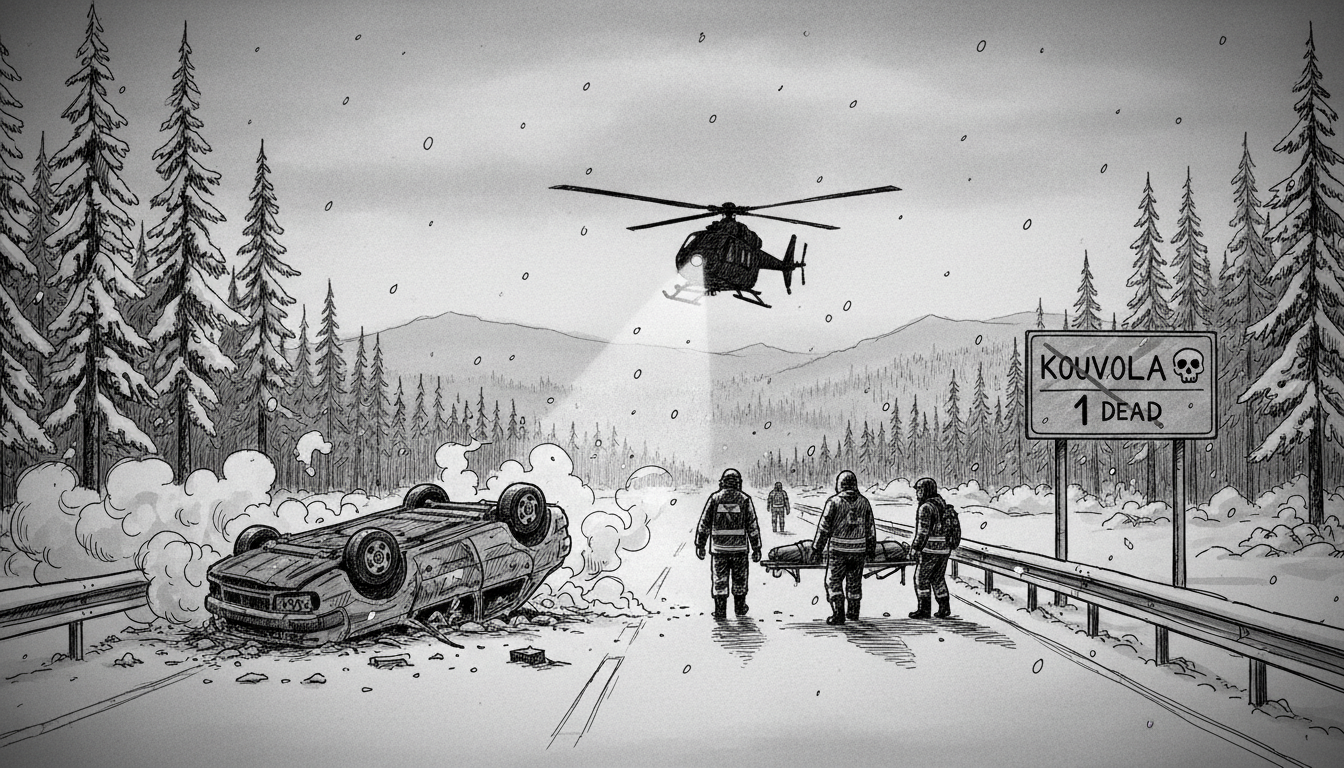
Finland's Highway 6 was the scene of a fatal collision Thursday afternoon that claimed one life and severed a critical transport artery. A truck and a van collided at the intersection of Kuutostie and Karjalankatu, the main eastern entrance to the city of Kouvola, just before 4:00 PM. Emergency services responded immediately, but one person involved in the accident was pronounced dead at the scene. The major east-west highway was completely closed for hours between the Jyrääntie and Tykkimäki junctions to facilitate rescue operations and a thorough investigation by police.
A Major Route Paralyzed by Tragedy
The immediate aftermath of the crash brought traffic to a standstill on one of eastern Finland's most important roads. Highway 6, known as Kuutostie, functions as a primary corridor connecting the Helsinki region to cities like Kouvola, Mikkeli, and Kajaani, extending toward the Russian border. Its closure between the two key junctions effectively blocked the main eastern approach to Kouvola, a major logistics and railway hub. Karjalankatu, the city's eastern entrance road, was also sealed off at the highway intersection, forcing local and long-distance traffic onto lengthy detours. The disruption highlighted the highway's vital role in regional commerce and daily commuting, with heavy goods vehicles and passenger cars alike forced to wait or find alternative routes for the duration of the closure.
Police have not released the identity of the deceased, pending notification of next of kin. The conditions of any other individuals involved in the two-vehicle collision have also not been disclosed. The focus of authorities on Thursday evening was on securing the scene, gathering forensic evidence, and clearing the wreckage to reopen the vital transport link. The sudden, violent interruption on Kuutostie serves as a stark reminder of the inherent risks on high-speed roadways, even at designated intersections designed for controlled access.
Intersection Risks and Heavy Vehicle Safety
The specific location of the crash—a highway intersection—is a point of concern for traffic safety experts. Professor Heikki Liimatainen, a transport safety researcher at Tampere University, notes that intersections on high-speed roads present complex risk scenarios. "Even on controlled-access highways like Kuutostie, intersections and entry-exit points are where conflicting movements occur," Liimatainen explains. "When you combine high speeds with the need to merge, cross, or yield, the margin for error shrinks dramatically. For drivers of large vehicles like trucks and vans, the stopping distances are longer and blind spots are larger, making situational awareness at these junctions absolutely critical."
While the exact cause of the Kouvola collision remains under active investigation by the police, experts typically examine a range of contributing factors in similar accidents. Driver fatigue, especially among professional drivers on long-haul routes, is a perennial focus. Distraction, momentary inattention, speeding relative to road conditions, and visibility issues—whether due to weather, glare, or vehicle design—are all common elements in crash investigations. The dynamics of a collision between a heavy truck and a lighter van often result in severe consequences for the occupants of the smaller vehicle, a tragic pattern seen across Europe.
Finland has consistently ranked among the safest countries in the world for road traffic, a achievement built on decades of sustained investment in infrastructure, strict enforcement, and public education. However, fatal accidents persist, each one triggering a detailed forensic and procedural review. The Finnish Transport and Communications Agency, Traficom, maintains extensive statistics on accidents, using the data to identify high-risk road sections and advocate for targeted safety improvements.
The Economic and Human Ripple Effect
Beyond the immediate human tragedy, an accident of this magnitude on a key transport route sends ripples through the regional economy. Kouvola is a central node in Finland's logistics network, home to a major railway yard and numerous distribution centers. Highway 6 is a fundamental link for transporting goods from the ports of southern Finland to the eastern and northern parts of the country. A prolonged closure disrupts just-in-time supply chains, delays shipments, and incurs significant costs for haulage companies and their clients.
For local residents, the closure meant disrupted routines, delayed journeys home, and a palpable sense of unease. Social media channels in the Kouvola area quickly filled with messages from drivers warning others to avoid the area, sharing alternative routes, and expressing condolences. The sight of emergency vehicles, flashing lights, and a closed highway creates a communal moment of reflection on the fragility of daily life. Each such incident renews public debate about road safety investments, such as improved intersection design, additional lighting, or enhanced speed monitoring on known high-risk stretches.
The police investigation will now work meticulously to reconstruct the events leading to the crash. This process involves examining vehicle telematics if available, studying skid marks and vehicle final positions, interviewing witnesses, and conducting technical inspections of the vehicles involved. The goal is to establish a definitive sequence of events and identify any preventable causes. The findings contribute not only to any potential legal proceedings but, more importantly, to the broader body of knowledge used to prevent future tragedies.
A Sobering Reminder on a Well-Traveled Road
Highway 6 is more than just a number on a map for thousands of Finns; it is a familiar part of the landscape, a road traveled by families heading to summer cottages in the Lakeland, by trucks carrying timber from the forests, and by commuters navigating their daily lives. Thursday's fatal crash on the outskirts of Kouvola is a sobering interruption to that normal flow. It underscores a harsh reality: even on Finland's generally safe roads, a single moment can have irreversible consequences.
As the investigation continues and the community mourns, the incident places a renewed emphasis on the shared responsibility of road safety. It calls for vigilance from infrastructure planners to continuously assess and upgrade risky points, from employers to ensure drivers are not pressured into unsafe schedules, and from every individual behind the wheel to respect the immense power they control. The reopening of Kuutostie will restore the flow of traffic, but the questions raised by the loss of life at the Karjalankatu intersection will, and should, remain open much longer. How can Finland's excellent road safety record be made even stronger, and what must be done to ensure such a report does not come from the same stretch of road again?