
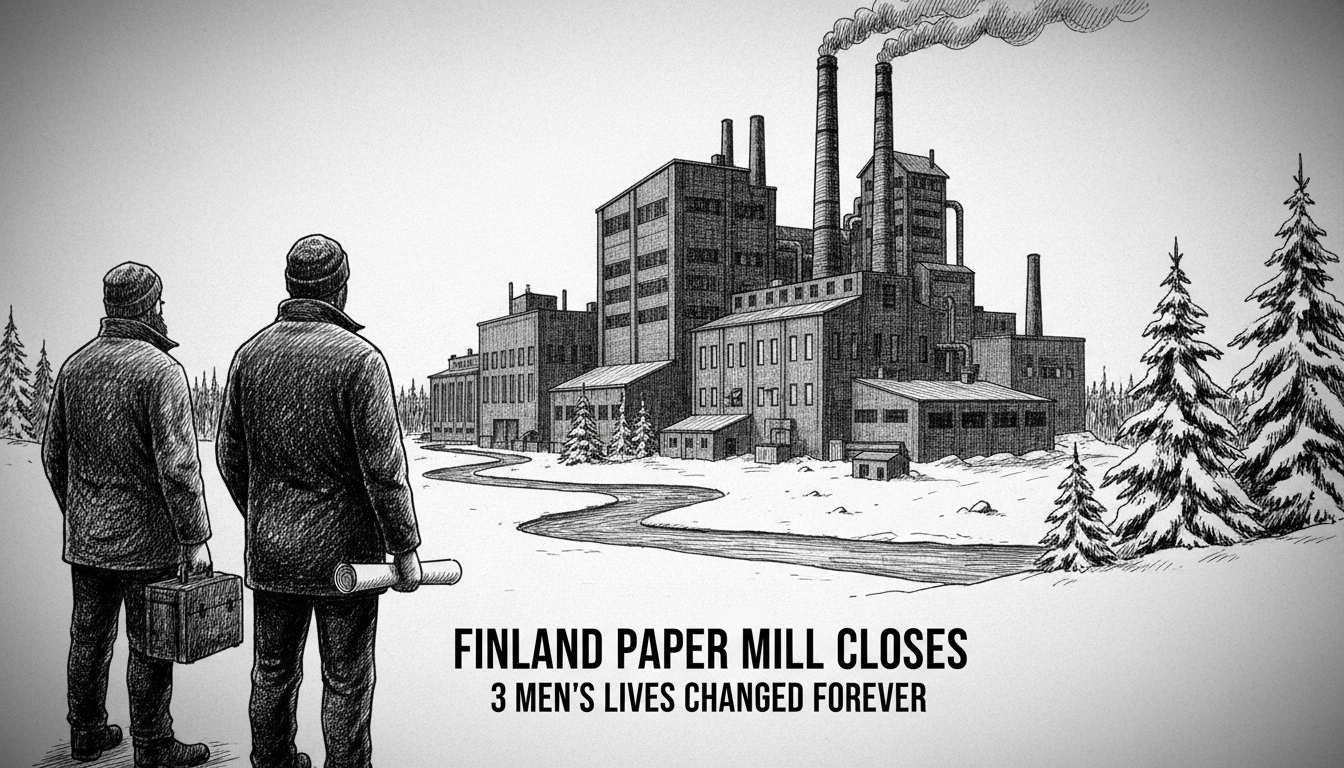
Finland's iconic paper industry decline reached a personal crisis point in 2012 for workers at the Äänekoski paperboard mill. The shutdown of the specific paperboard production line, owned by Metsä Board, severed a traditional career path for men like Pasi Salmelin, Sami Kautto, and Pasi Pyrhönen, forcing a reckoning with a changing global economy.
Pasi Salmelin was in the control room when his foreman entered, sat down, and delivered the news. "Listen Pasi, soon we'll have time to chop that firewood. The factory is being shut down," the foreman said. The announcement was a shock. Salmelin recalls being told just prior that order books were full for the year ahead. For him, the news was simultaneously a blow and a strange stroke of luck. He had been dreaming of turning his sideline farm into a full-time enterprise but couldn't muster the courage to quit his stable industrial job. "I thought, damn, if only I dared to try. But the threshold to resign would have been too high," he said. The closure removed that barrier overnight.
The End of an Era in Äänekoski
The shuttering of the paperboard machine in Äänekoski was not an isolated event but a symptom of a deep structural shift. For decades, the rhythm of paper mills defined communities across Central Finland, providing generations with stable, well-paying union jobs. The industry was a cornerstone of Finnish exports and national identity. Yet, by the early 2010s, pressures that had been building for years—relentless digitalization reducing demand for printing paper, fierce global competition, and rising production costs—came to a head. While the larger Äänekoski bioproducts complex, a massive pulp mill, has since seen billions in investment for new bioeconomy products, the older paperboard line became economically unviable. Its closure marked the end of a specific type of work in the town.
From Factory Floor to an Uncertain Future
The immediate aftermath for the workers was a scramble for direction. For Sami Kautto and Pasi Pyrhönen, the path was less clear than for Salmelin with his farm. They faced the daunting Finnish labor market of the 2010s, where traditional industrial jobs were disappearing faster than new ones were created in the tech or service sectors. Retraining programs, often government-sponsored, became a common but challenging route. Learning new digital skills in one's forties or fifties after a lifetime in mechanical maintenance presented a profound psychological and practical hurdle. The security of the mill, with its predictable shifts and collective bargaining agreements, was replaced by the uncertainty of short-term contracts or entrepreneurship. The social fabric of the workplace, a source of camaraderie and identity, was torn apart.
A National Industry in Transition
The challenges that led to this local closure were national in scope. The Finnish government and large forestry conglomerates like Metsä Group and Stora Enso faced a perfect storm: declining Western demand for paper, global overcapacity, and the need for massive capital investment to pivot production. Their strategic response, evident now, was to accelerate the shift from bulk paper to higher-value bioproducts, like pulp for textiles, biocomposites, and sustainable packaging materials. This transition, however, is capital-intensive and creates fewer direct manufacturing jobs than the old paper mills. The data starkly illustrates the trend: while Finland was a top-three global paper producer in the early 2000s, its production volume has fallen dramatically. The forest industry's contribution to GDP, though still significant, has steadily decreased over the past two decades.
| Production Metric | Early 2000s Peak | Recent Trend |
|---|---|---|
| Annual Paper & Paperboard Production | ~13-14 million tonnes | Approximately halved |
| Industry Share of Finnish Exports | Over 20% | Now roughly 15-18% |
| Primary Driver | Newsprint, magazine paper | Pulp, packaging boards, biomaterials |
Reinvention and Resilience
A decade on, the stories of the Äänekoski workers mirror Finland's own economic adaptation. Pasi Salmelin successfully expanded his farm, representing one form of resilience: a return to a more self-sufficient, localized economy. Others, like his former colleagues, likely navigated the turbulent job market, some finding roles in the very same Äänekoski mill complex but in different, modernized production units, while others may have left the region entirely. Industry analysts, like those from the Finnish Forest Industries Federation, acknowledge the painful adjustments but argue the sector's future lies in innovation. "The decline in graphic paper demand was predictable and severe," said one analyst. "The future competitiveness of Finnish forestry hinges on its ability to lead in bio-based innovations, leveraging our renewable resource base for products beyond paper."
The Human Cost of Economic Change
The closure in Äänekoski is a microcosm of the human cost of industrial transition. Policy debates in Helsinki's government district often focus on macroeconomic indicators and green transition goals. Yet, for the men in the valvomo (control room), the change was measured in personal security and identity. The Finnish model of social security and active labor market policies softened the blow, but it could not replace the deep-seated sense of purpose that came from skilled factory work. As the Eduskunta (Finnish Parliament) continues to craft policies supporting the bioeconomy, the experiences of those laid-off workers serve as a crucial reminder that national strategies are ultimately executed at the individual level. Their resilience is a testament to a particularly Finnish form of sisu—perseverance—but it was forged through necessity, not choice.
As Finland continues to proudly showcase its new billion-euro bio-product mills, a silent question remains: how does a society ensure that its next wave of industrial innovation includes and uplifts the workers of the last one? The answer will define not just economic success, but social cohesion in the decades to come.