
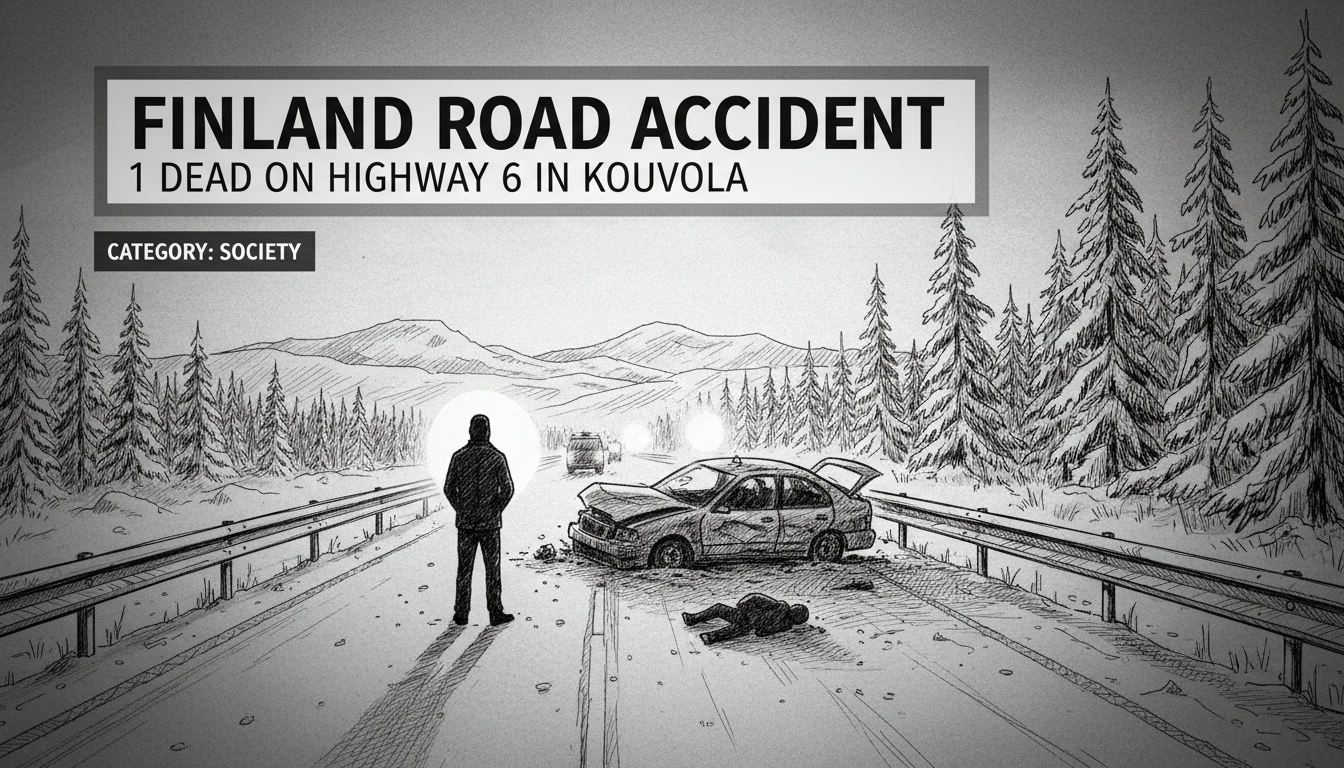
Finland road accident investigators are working to determine the cause of a fatal collision between a truck and a van on Highway 6 in Kouvola on Thursday afternoon. The crash at the intersection with Karjalankatu claimed one life and forced the complete closure of a critical national transport artery for hours, causing significant disruption to freight and passenger traffic across eastern Finland.
Emergency services received the alert just before 4:00 PM local time. Police confirmed one fatality at the scene. The force of the collision between the heavy goods vehicle and the van required extensive rescue and clearing operations, leading authorities to shut down Highway 6 entirely between the Jyrääntie and Tykkimäki junctions. The Karjalankatu entrance to the highway was also sealed.
A Major Artery Severed
Highway 6, known as Kuutostie, is not just any road. It is a principal east-west corridor running from Loviisa on the southern coast to Kajaani in the north. This route is vital for connecting Finland's economic heartland with its eastern and northern regions, transporting timber, goods, and people. Its closure, even for a few hours, creates a logistical headache for the transport industry and detours for countless travelers.
The intersection where the accident occurred, where Kuutostie meets Kouvola's eastern entry road Karjalankatu, is a busy point of ingress and egress for the city. Kouvola, a major railway hub and logistics center, relies heavily on this highway network. The sudden closure disrupted local commuters and long-haul traffic simultaneously, with police diverting vehicles onto alternative routes through the city's other connections.
The Grim Statistics of Finnish Roads
This tragic event adds to Finland's annual road safety tally. While the country has a strong reputation for road safety, every death is a profound loss. Preliminary data for 2023 recorded 225 fatal road accidents in Finland, resulting in 248 deaths. This followed 221 road deaths in 2022. Each number represents a closed investigation file and a grieving family.
Accidents involving heavy vehicles like trucks often have severe consequences due to the immense mass and momentum involved. Road safety experts consistently highlight a trio of critical factors in such collisions: speed, road conditions at the time of the accident, and driver fatigue. The investigation by the police and possibly the Safety Investigation Authority will meticulously examine these elements.
Investigators will look at vehicle data recorders, witness statements, and physical evidence from the scene. They will seek to establish the sequence of events leading to the collision at the intersection. Was it a failure to yield, a misjudgment of speed or distance, or a technical fault? The answers are crucial for both legal proceedings and future prevention.
The Human Cost Behind the Headline
Beyond the traffic reports and official statements lies the human tragedy. One person did not return home on Thursday. Their family and community are now facing sudden, irrevocable loss. The drivers involved, whether at fault or not, will carry the psychological weight of the event. First responders who attended the scene confront the harsh reality of road trauma as part of their duty.
Finland's vision is to have no one die or be seriously injured on its roads. This "Vision Zero" policy, adopted from Sweden, underpins national transport safety planning. It acknowledges that while human error occurs, the road system should be forgiving. Every fatal accident triggers an evaluation: could road design, signage, speed limits, or vehicle safety standards have prevented the outcome?
A Nation's Reliance on Road Transport
The disruption caused by this accident underscores a central tension in Finnish geography and economics. The country is large, sparsely populated outside the south, and dependent on efficient road links. Highways like the Kuutostie are lifelines for industries, especially forestry, and for maintaining social connectivity across vast distances. An accident that closes such a route has a ripple effect far beyond the crash barriers.
Alternative routes during the closure were longer, slower, and less suited for heavy trucks. This delay has a calculable economic cost in fuel, time, and delayed deliveries. For passenger vehicles, it meant unexpected detours through urban areas or smaller roads not designed for high volumes of traffic. The incident serves as a stark reminder of the infrastructure's vulnerability.
The Path Forward from the Scene
As the wreckage is cleared and the highway reopens to traffic, the investigative work continues. The police will complete their technical investigation to determine if any criminal charges, such as negligent homicide or traffic endangerment, are warranted. The findings will also feed into broader statistical analyses and safety research.
Road safety organizations will likely use the case to reiterate calls for continued vigilance, adherence to speed limits, and the importance of rest for professional drivers. The Finnish Transport and Communications Agency, Traficom, monitors such events as part of its ongoing work to improve road safety standards and infrastructure.
For the city of Kouvola, the accident is a local tragedy that briefly captured national attention due to the strategic road involved. The community will move on, but the memory of the accident at the Karjalankatu intersection will linger for those directly affected and for daily commuters who passed the scene.
Finland has made significant strides in road safety over decades, with mandatory winter tires, strict drunk-driving laws, and continuous infrastructure investment. Yet, as Thursday's crash painfully demonstrates, the goal of zero deaths remains a challenging journey. Each accident forces a moment of collective reflection on the price of mobility and the shared responsibility we all carry when we use the roads. How many more times will a routine afternoon on Kuutostie turn into a national news headline before the underlying causes are fully addressed?