
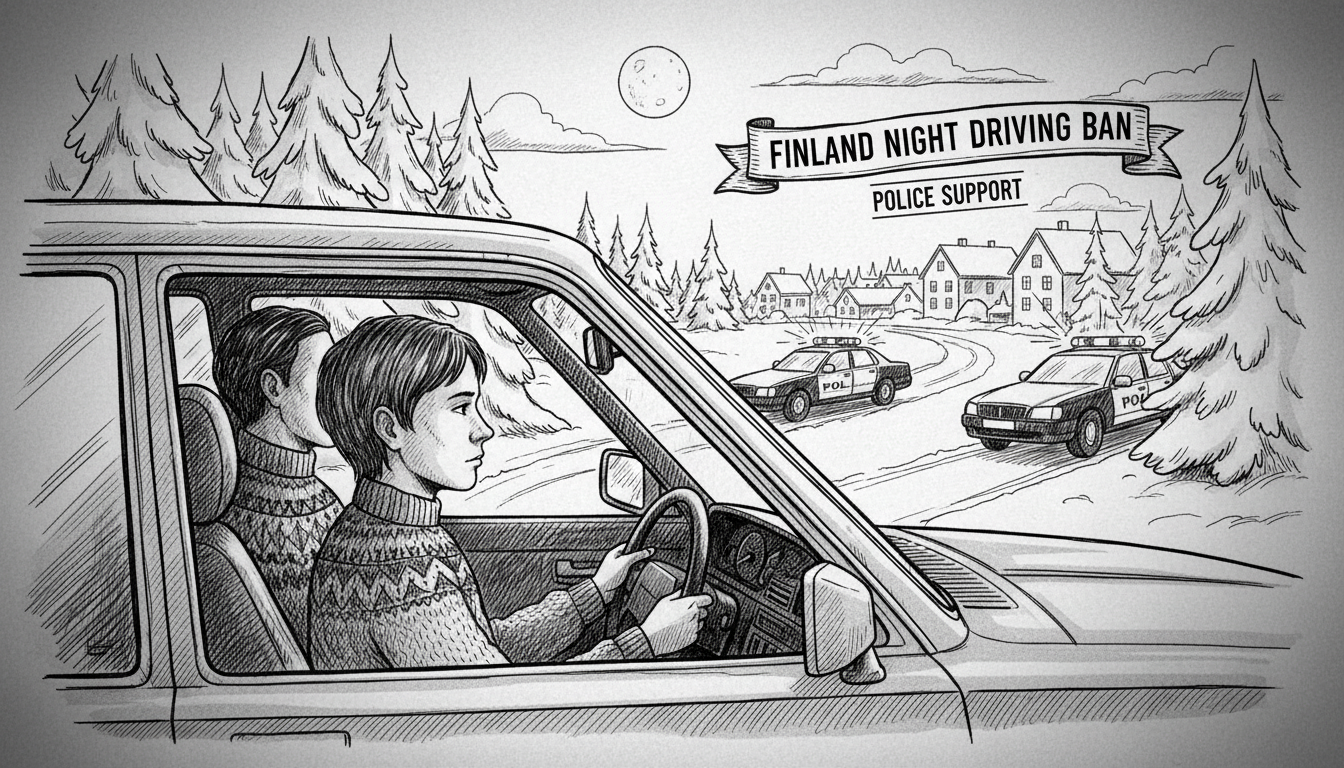
Finland's National Police Board has thrown its support behind a government proposal to ban 17-year-old drivers from the roads between midnight and 5 a.m. The endorsement comes with a significant caveat: effective enforcement of the new night driving restriction will require additional police resources and clear legal frameworks. The proposed amendment to the Driving Licence Act aims to tighten the conditions under which special permits are granted to underage drivers, a move police say is justified by road safety statistics.
Police Endorsement with a Resource Warning
The Poliisihallitus, Finland's National Police Board, issued a statement largely praising the draft law from the Ministry of Transport and Communications. Officials specifically welcomed stricter criteria for obtaining the special permit that allows 17-year-olds to drive passenger cars. "The police consider it important that the conditions for granting a special permit are tightened," the board's statement noted. However, the supportive stance was paired with a practical concern. The board emphasized that monitoring compliance with the proposed night-time ban, particularly verifying the ages of drivers during late-night traffic controls, would place new demands on frontline officers. This underscores a recurring tension in Finnish policymaking, where legislative goals must be reconciled with the operational capacity of enforcement agencies.
The Mechanics of the Proposed Restriction
Current Finnish law sets the standard driving age at 18. The special permit system for 17-year-olds is an exception, typically granted for compelling reasons such as long-distance travel to a school or workplace where no viable public transport exists. The government's draft law seeks to introduce a specific prohibition for these permit-holders, banning them from driving between the hours of 00:00 and 05:00. The proposal is part of a broader revision of the Driving Licence Act. By creating a clear, time-based restriction, policymakers aim to reduce exposure during the riskiest hours for inexperienced drivers. The law would not affect 18-year-olds who hold full licenses, drawing a firm legislative line at the age of majority.
Road Safety Data Informs the Debate
The push for a night driving ban is grounded in traffic safety research. Young, novice drivers are statistically overrepresented in serious and fatal road accidents globally, and Finland's data follows this pattern. Risk factors multiply at night, combining reduced visibility, potential fatigue, and a higher likelihood of social driving situations. "The goal is to prevent accidents. The risk of accidents for young drivers increases significantly in the dark and in the evening and night hours," a ministry official familiar with the proposal explained. While specific Finnish studies on 17-year-old permit holders are limited, broader European research consistently shows a steep learning curve during the first years of independent driving. The proposed ban is a preventive measure, seeking to protect young drivers during the initial, high-risk phase of their driving careers by eliminating late-night exposure.
Balancing Mobility and Safety in a Sparsely Populated Country
The debate touches on a unique Finnish challenge: balancing safety with the necessity of mobility in a large, sparsely populated country. In remote rural areas, where bus services may be infrequent or non-existent, a driving license can be essential for a young person's education or employment. The special permit system was designed to accommodate this reality. Critics of an outright night ban might argue it could disproportionately affect youth in these regions who rely on their cars for shift work or social connections. Proponents, however, contend that the core purpose of the special permit is for essential travel, not late-night recreational driving. The government's draft appears to side with the latter view, aiming to curtail the riskiest use of the permit while ostensibly preserving its functional necessity.
Enforcement: The Critical Next Step
The Police Board's highlighting of resource needs is not a trivial objection. Enforcement of time-based restrictions is more complex than enforcing a blood-alcohol limit or a speed. It requires officers to reliably determine a driver's age during traffic stops, which can be challenging and time-consuming. Without a visible, predictable enforcement presence, the deterrent effect of the law could be minimal. This raises questions about potential technological solutions or adjustments to permit documentation to make age verification swift and foolproof. The success of the policy, should it become law, will hinge on these practical details. Effective communication to the target group—17-year-old drivers and their parents—about the new rules and their consequences will also be crucial for compliance.
A Broader Look at Graduated Licensing
Finland's proposal aligns with a concept known as Graduated Driver Licensing (GDL), which is common in North America and parts of Australia. GDL systems phase in driving privileges, often including night driving restrictions for new drivers regardless of age. While Finland is not adopting a full GDL system, this move to restrict night driving for permit-holders is a step in that philosophical direction. It reflects a modern understanding that driving competency develops over time and that certain high-risk conditions should be avoided during the initial learning phase. The Finnish approach remains distinct by targeting only the specific cohort of underage drivers on special permits, rather than all new license-holders.
The Path Through Parliament and EU Context
The draft law will now proceed through the standard legislative process in the Eduskunta, Finland's parliament. It will undergo committee review, where expert testimony will be heard and amendments proposed. The police resource question is likely to be raised by opposition MPs. While this is a domestic transport policy issue, it exists within the broader framework of EU road safety goals. The European Union has its own road safety policy framework, aiming to halve serious injuries and fatalities by 2030. National measures like Finland's proposed night ban contribute to this collective target. There is no direct EU directive mandating such rules for young drivers, giving member states flexibility, but the bloc encourages evidence-based national actions to improve safety.
A Preventative Measure with Eyes Wide Open
Finland's move to impose a night driving ban on 17-year-olds with special permits is a targeted intervention backed by police and framed by road safety statistics. Its intent is clear: to reduce preventable accidents involving the country's youngest, most inexperienced drivers during the most dangerous hours. The supportive stance of the National Police Board lends the proposal significant credibility. Yet, their simultaneous warning about enforcement resources serves as a crucial reality check. It highlights that a law is only as good as its application. As the proposal navigates the parliamentary process, the challenge will be to craft a final version that is not only safe on paper but also enforceable on the dark, winding roads of the Finnish countryside. The ultimate test will be whether it saves lives without unduly hindering the lives it aims to protect.