
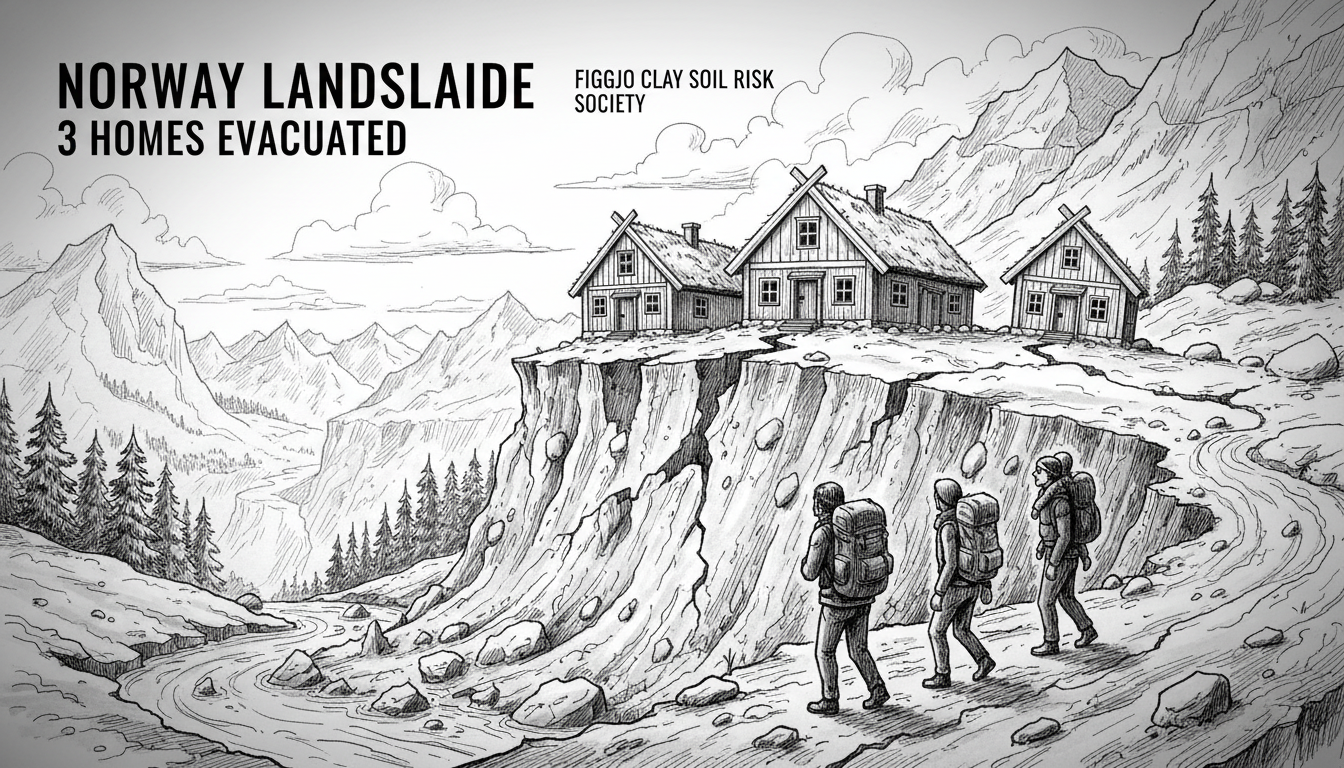
Norway landslide risks have again forced evacuations, this time in Figgjo, Rogaland, where three homes were emptied after a significant ground collapse. No injuries were reported, but police warn the danger is not over. "There has been a lot of building on clay here, and we cannot rule out further slides. Therefore, we are taking no chances," said incident commander Morten Helland of the Southwest Police District.
A Recurring Threat on Unstable Ground
The evacuation order highlights a persistent geological challenge for Norway. Landslides triggered by heavy rainfall or rapid snowmelt are a common natural hazard, particularly in regions with unstable, clay-rich soils known as "quick clay." Rogaland county, where Figgjo is located, contains several areas identified as high-risk for such ground failures. These events cause millions of Norwegian kroner in property damage across the country every year, driving continuous investment in land surveying and preventative engineering.
The Figgjo incident, while limited in scale, serves as a microcosm of a national issue. It forces a community to confront the instability beneath their feet and emergency services to activate well-rehearsed protocols. For the evacuated families, it is a sudden and stark reminder that the ground is not always solid.
The Science Behind the Slip
Geotechnical experts point to water saturation as the most likely trigger for the Figgjo landslide. Clay soil can appear stable until excessive water pressure disrupts its structure, causing it to liquefy and flow. "A landslide like this is often a hydrological event as much as a geological one," explains Dr. Lena Solberg, a geohazards researcher at the Norwegian Geotechnical Institute (NGI). "Prolonged rain or melting snow increases pore water pressure. When that pressure exceeds the soil's shear strength, failure occurs rapidly."
This scientific understanding informs Norway's approach to risk management. Municipalities in susceptible areas are required to conduct detailed soil investigations before approving new construction. Mitigation measures can include installing extensive drainage systems to divert water away from slopes, reinforcing embankments, or in extreme cases, declaring land unfit for building. The goal is to prevent the conditions that lead to liquefaction.
Emergency Response and Resident Safety
The immediate police response focused on securing the perimeter and ensuring no one was in the path of potential further movement. Evacuating the three most threatened homes was a preventative decision, prioritizing human safety over property. Emergency management specialists emphasize that in quick clay scenarios, the risk of secondary, larger slides is significant in the immediate aftermath.
"The first rule is to secure the area and prevent access," says Erik Moe, a former director with the Norwegian Directorate for Civil Protection (DSB). "Assessment by geotechnical experts is needed before anyone can return. It's not just about the visible crack; it's about the stability of the entire slope." Residents are likely to be displaced until such an assessment deems the area safe, a process that could take days or weeks depending on the weather and the complexity of the site.
Living with Landslide Risk in Norway
For Norwegians, the threat of landslides is a part of life in many regions, balanced against the nation's deep connection to its dramatic topography. Historical disasters, such as the 1978 quick clay landslide in Rissa, which was captured on film, are seared into national memory and inform current safety standards. The state, through agencies like the NGI and the Norwegian Water Resources and Energy Directorate (NVE), maintains detailed hazard maps that are publicly available.
Homeowners in designated risk zones face higher insurance premiums and must disclose the hazard when selling property. There is an ongoing public debate about the responsibility for preventative measures—how much should be borne by individual landowners versus the municipal or state government. This debate intensifies after every event, no matter how small.
A Policy Challenge on Shifting Ground
The Figgjo landslide, though localized, touches on broader policy questions for Norwegian authorities. Climate change projections indicating increased precipitation intensity in Norway suggest landslide hazards may become more frequent. This puts pressure on existing infrastructure and planning regimes. Politicians in the Storting periodically review building codes in high-risk areas, often facing pushback from developers and residents concerned about property values.
"We have the technical knowledge to map these risks with high precision," says Dr. Solberg. "The greater challenge is often integrating that knowledge into long-term land-use planning and communicating risk clearly to the public. It's a continuous process of adaptation." The government's long-term strategy involves improving early warning systems and funding for large-scale stabilization projects in the most vulnerable communities.
The Human Cost of Precautions
Behind the geological data and policy discussions are the evacuated families of Figgjo. They face uncertainty, disruption, and the anxiety of not knowing if their homes are safe. While grateful for the precaution, the experience is deeply unsettling. Community support networks typically mobilize in such situations, offering temporary housing and assistance.
The financial implications can also be significant. Even if the homes are ultimately saved, owners may face costly repairs to drainage or foundations mandated by inspectors before re-occupation. Insurance will cover some costs, but deductibles and coverage limits vary, often leaving homeowners with a substantial financial burden.
Looking Ahead: Resilience on Unstable Foundations
As the situation in Figgjo stabilizes, the focus will shift to investigation and potential remediation. Geotechnical teams will take soil samples, analyze drainage patterns, and model the slope's stability. Their findings will determine the future of the three evacuated homes and guide any necessary interventions for the surrounding area.
This event is a quiet alarm. It underscores that in a country celebrated for its majestic, rugged landscape, that same beauty is forged by powerful and occasionally destructive natural forces. Norway's systematic, science-based approach to landslide risk is a model, but as Figgjo shows, absolute safety on a shifting foundation is impossible to guarantee. The nation's resilience is continually tested by the ground upon which it is built. Will the increasing volatility of the climate outpace our ability to adapt and reinforce? The answer, much like the clay soil of Rogaland, remains unsettled.