
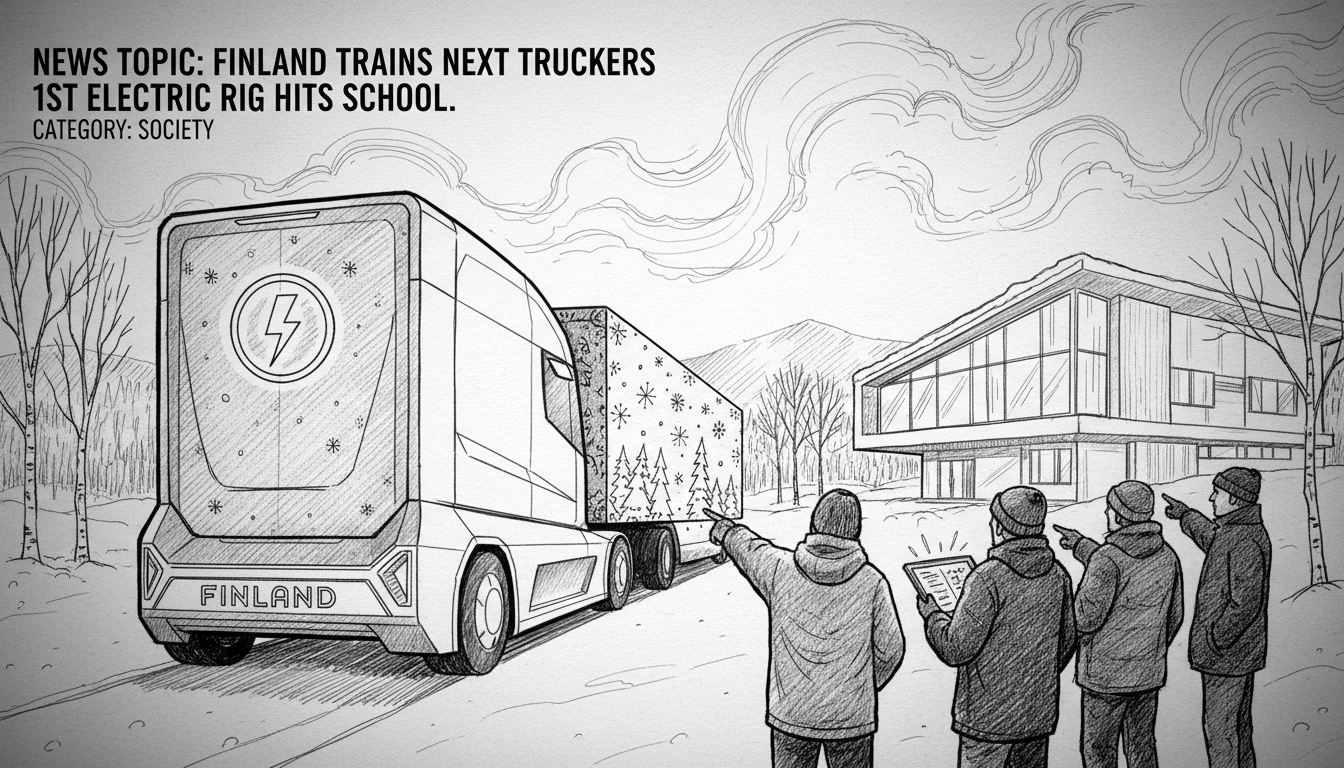
Finland's ambitious 2035 carbon neutrality target is being tested on a quiet road outside Mikkeli. Esedu, the vocational college of South Savo, has integrated Finland's first dedicated electric truck training rig into its logistics curriculum this autumn. This move marks a concrete step in preparing the workforce for the nation's mandated green transportation shift, addressing a critical bottleneck in the heavy-duty vehicle sector's decarbonization.
'Where can you actually go with an electric truck? That's the most common question,' said an Esedu logistics instructor, who requested anonymity as they were not authorized to speak publicly. 'We don't have a single answer for our students yet, as road conditions and load weight affect it so much.' This honest admission underscores the hands-on, practical learning now happening. Students are not just reading manuals; they are calculating real-world range, planning routes around charging infrastructure, and understanding the new dynamics of electric vehicle operation.
The college's existing fleet already includes biogas-powered trucks, positioning it as a hub for alternative fuel training. The addition of the electric truck creates a comprehensive green logistics program. It directly responds to industry signals and government policy, ensuring new drivers enter the workforce fluent in the technologies that will dominate Finnish roads within a decade.
A Classroom on Wheels for a Green Transition
The electric truck at Esedu is more than a vehicle; it's a mobile classroom for Finland's climate policy. The Finnish government's climate law enshrines the 2035 carbon neutrality goal, placing immense pressure on the transport sector, which accounts for roughly one-fifth of the country's emissions. While consumer electric cars gain traction, heavy goods vehicles represent a tougher challenge due to energy density, cost, and operational demands.
Training institutions like Esedu are now critical infrastructure. 'Vocational schools are the frontline of this transition,' said Dr. Elina Saarinen, a transport policy researcher at the University of Helsinki. 'The government can set targets and offer purchase subsidies, but if you don't have trained technicians, mechanics, and drivers who understand these systems, the entire transition stalls. Esedu is building the human capital the market will desperately need.'
The Finnish National Agency for Education (EDUFI) has emphasized aligning vocational training with national strategic objectives, including the green transition. This acquisition likely benefited from state funding channels designed to modernize educational equipment in line with these goals.
Navigating the Real-World Range Anxiety
The core educational challenge, as highlighted by the instructor's comment, is range. Unlike a diesel truck with a predictable fuel consumption rate, an electric truck's range is a variable equation. Finnish winters, with sub-zero temperatures that reduce battery efficiency, combined with long distances between urban centers, present a unique set of complications.
Students at Esedu are learning to factor in these variables. Their training includes logistics planning that incorporates payload, topography, weather forecasts, and the location of high-power charging stations. This skill set is becoming as vital as knowing how to maneuver a 40-tonne vehicle. It shifts the driver's role from simply operating a machine to actively managing an energy system.
'This is the new logistics calculus,' Dr. Saarinen noted. 'The discussion in the cab is changing from 'Where's the next fuel station?' to 'Do we have enough charge to make that detour, and if we plug in there for 45 minutes, how does it affect the delivery window?' Training programs that embed this thinking are essential.'
Policy and Infrastructure: The Road Ahead
The training at Esedu occurs against a backdrop of ongoing policy development in Helsinki and Brussels. The European Union's 'Fit for 55' package includes stricter CO2 emission standards for new heavy-duty vehicles, effectively mandating a rise in zero-emission truck sales. Finland's own national policy mix includes investment aid for companies purchasing electric trucks and support for expanding the charging network.
However, analysts point to a coordination gap. 'The vehicles are coming, and now the trainers have one,' said Martti Honkanen, a senior adviser at the Confederation of Finnish Industries (EK). 'But the charging network for heavy transport is still in its infancy, especially along the less-traveled routes essential to Finnish forestry and industry. We are training drivers for a reality that is still being built. The state must accelerate infrastructure investment to match this educational push.'
The Ministry of Transport and Communications has published a roadmap for transport electrification, which includes targets for high-power charging stations along main highways. The success of programs like Esedu's depends heavily on the execution of these infrastructure plans.
From Mikkeli to the Mainstream
The initiative in South Savo is a localized preview of a national transformation. Other vocational institutions across Finland, from Oulu to Turku, are watching closely and are expected to follow suit. The Finnish Transport and Communications Agency (Traficom) will eventually need to integrate specific competencies for electric heavy vehicles into the official driver licensing curriculum.
This shift also reshapes partnerships between schools and industry. Logistics companies like Posti and DB Schenker, which are building their own electric fleets, now have a direct pipeline for trained talent. They may also provide feedback to schools on the operational skills most needed, creating a feedback loop that constantly updates the training.
For now, the electric truck in Mikkeli symbolizes a proactive approach. Finland is not waiting for the market to fully mature before building expertise. It is preparing its workforce in advance, betting that this human investment will smooth the inevitable technical and operational disruptions of the green transition. The question moving forward is whether public infrastructure investment can keep pace with the skilled drivers now being trained to use it.
As the students at Esedu learn, the ultimate range of Finland's electric truck revolution depends not just on battery chemistry, but on the strength of its policy, the reach of its charging network, and the readiness of its people. The first class is already in session.