
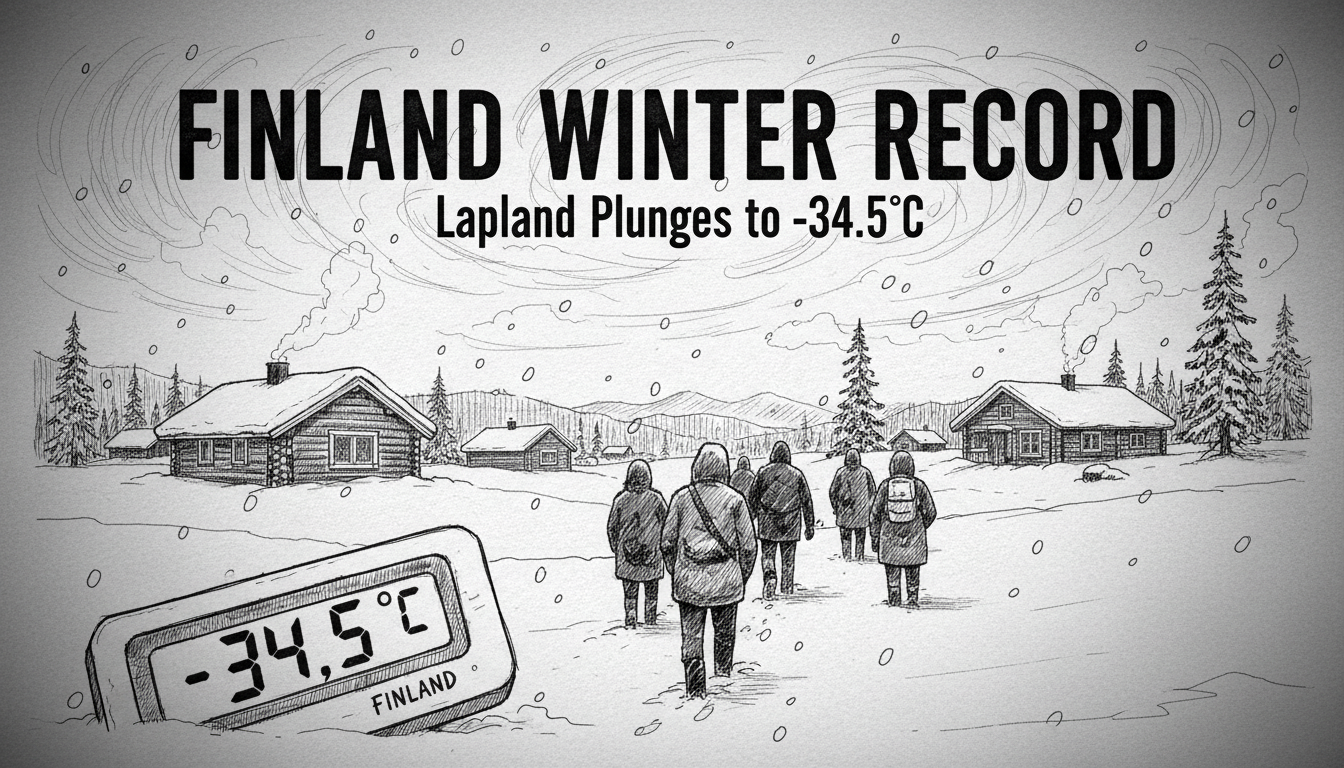
Finland's winter weather has set a new seasonal low, with the mercury plunging to -34.5 degrees Celsius in the far north. The official measurement was recorded at Oustajärvi in Muonio, Lapland, early Saturday morning, confirming the coldest temperature of the current winter season. According to the Finnish Meteorological Institute, freezing conditions blanketed almost the entire nation, with only the far southwestern coast and the Åland Islands hovering near or just above zero. A shift is forecast, however, with cloud cover and precipitation expected to bring a widespread thaw starting Sunday.
A Deep Freeze Across the Nation
The extreme cold was not isolated to the northern wilderness. Meteorological data shows sub-zero temperatures affected communities from the shores of the Gulf of Finland to the forests of Kainuu. This widespread frost is characteristic of high-pressure systems that settle over Finland in winter, bringing clear skies and intense radiative cooling, especially in inland and northern areas. The clear conditions allow daytime heat to escape rapidly into the atmosphere once the sun sets, a process amplified by the reflective snow cover. While severe, such temperatures in late winter are within the expected climatic range for Finnish Lapland, where records often dip below -40°C during the coldest periods.
The national infrastructure and public services are designed to function under these conditions. District heating systems across Finnish cities work at high capacity, and building insulation standards are among the strictest in the world. In Lapland, vehicles commonly use block heaters and special winter-grade fuels, while residents are well-versed in layering clothing. The coordinated response to extreme cold is a routine part of Finnish winter management, involving transport authorities, energy providers, and social services checking on vulnerable populations.
Meteorological Forces Behind the Scenes
This specific cold snap resulted from a confluence of typical winter weather patterns. A stable, high-pressure air mass parked over Scandinavia allowed for prolonged cooling. The absence of cloud cover acted like removing a blanket, letting surface heat vanish into the upper atmosphere. Wind speeds remained low, preventing the mixing of slightly warmer air from higher altitudes. These perfect conditions for extreme cold are often called an 'ice high' in Finnish meteorological parlance. The phenomenon is common in February, which is statistically the coldest month of the year for much of Finland.
The predicted change illustrates the dynamic nature of Nordic weather. A low-pressure system moving in from the North Atlantic is set to disrupt the high-pressure dominance. This system brings clouds, which act as insulation, and often precipitation, which in this case is expected to be sleet or rain as warmer air is advected over the country. "We are seeing a classic pattern shift," a climatologist from the Finnish Meteorological Institute explained. "The dominant high-pressure ridge is being undercut by milder, moister air from the west. This will raise temperatures significantly above freezing in southern and central regions within 24 hours."
Life in the Arctic Chill
For the residents of Muonio and surrounding municipalities, a reading of -34.5°C is a notable event but not a paralyzing one. Daily life continues with adjustments. Schools may shorten outdoor recess periods, and municipal warnings advise extra caution regarding frostbite during extended exposure. The extreme cold tests the limits of machinery and batteries, but local expertise is built around this reality. The cultural relationship with cold in Finland is one of respect and preparation, not fear. Activities like skiing, ice fishing, and even winter swimming often continue, albeit with heightened safety measures.
This deep freeze also has implications for nature and industry. The thick ice cover on lakes and the Baltic Sea strengthens, affecting maritime transport. The energy sector sees a sharp spike in consumption for heating, testing grid stability and highlighting the importance of diverse energy sources, including Finland's significant nuclear power capacity. For winter tourism in Lapland, such cold is a double-edged sword; it guarantees excellent snow conditions and a classic Arctic atmosphere, but extreme lows can occasionally disrupt outdoor tour schedules if safety thresholds are breached.
Historical Context and Future Trends
Placing this measurement in a historical context is instructive. Finland's all-time national cold record stands at -51.5°C, measured in Kittilä, Lapland, in January 1999. The -34.5°C recorded this winter is severe but not exceptional within the long-term climate data for northern Finland. It reinforces the significant temperature gradient within the country; while Muonio shivered at -34.5°C, Helsinki likely experienced temperatures around -10°C to -15°C. This regional variation is a key feature of Finland's climate, dictated by latitude, distance from the sea, and altitude.
Looking ahead, climate scientists monitor these extreme cold events within the broader trend of Arctic amplification, where the polar region warms at more than twice the global average rate. While winters are generally becoming milder and shorter in Finland, the complex dynamics of a warming Arctic can sometimes disrupt polar vortex patterns, potentially leading to temporary but intense outbreaks of cold air southward. This means that even in a warming climate, periods of extreme winter cold remain a possibility, underscoring the continued need for resilient infrastructure and preparedness. The weekend's dramatic temperature swing from a deep freeze to a thaw serves as a potent reminder of the power and variability of northern nature, a force that Finland has learned to navigate with quiet competence.