
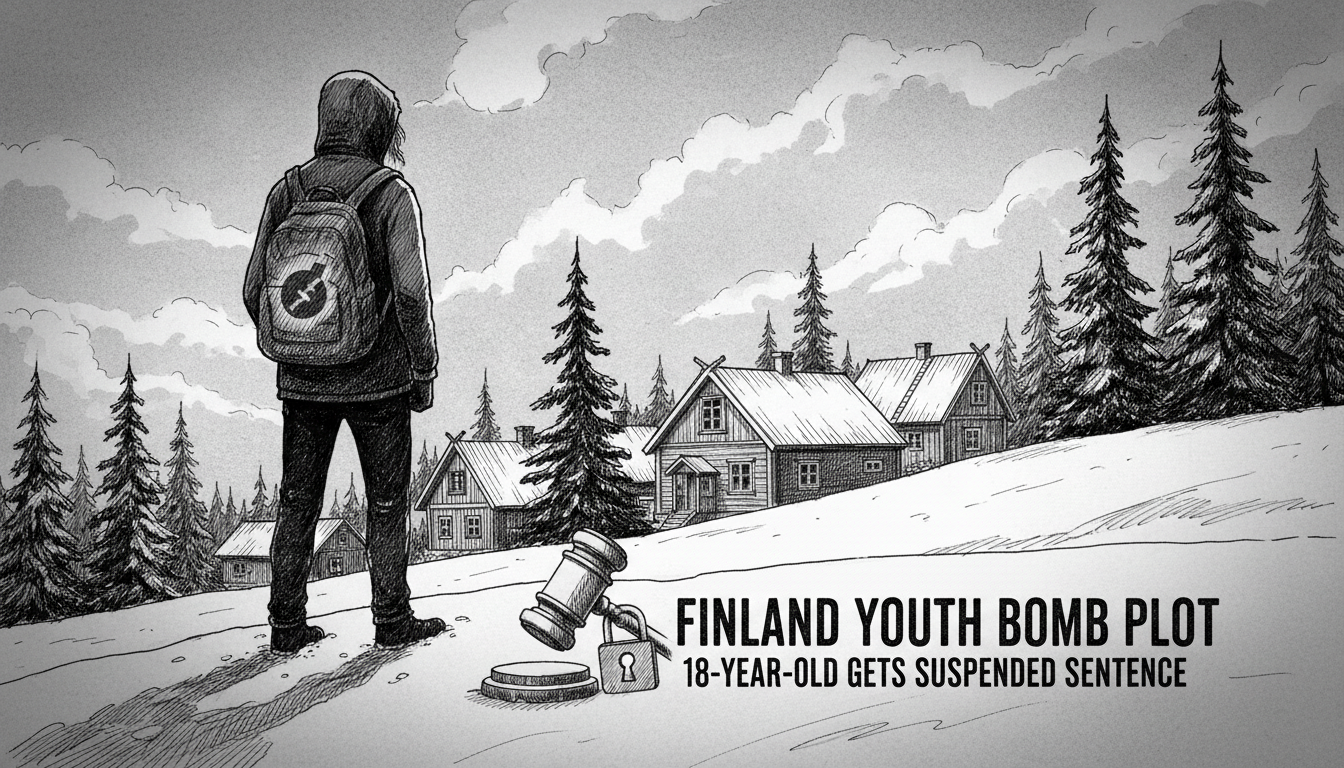
Finland youth crime has taken a disturbing turn with a case from Kouvola, where an 18-year-old man received a 10-month suspended prison sentence for attempting to bomb a schoolmate's home last summer. The homemade device, containing over four grams of gunpowder in a metal pipe, was left at the intended victim's mailbox but failed to detonate only because the adhesive on its tripwire gave way. This near-tragedy, which could have caused severe facial injuries and burns, exposes the dark intersection of online radicalization, school bullying, and Finland's rehabilitative justice system for young offenders.
A Failed Detonation and a Family's Narrow Escape
The Kymenlaakso District Court detailed a chilling sequence of events from June 2024. Then 17, the defendant spent ten days planning and constructing two explosive devices. He placed one bomb inside a cardboard box, attached the name of a schoolmate to the outside, and delivered it to the family's mailbox. The intended teenage victim was away with his girlfriend that day. Instead, two other male family members found the package and were on the verge of opening it. According to the court ruling, the bomb was fully functional and its failure was purely accidental—the glue on the tripwire mechanism failed when the box was handled. The court stated the explosion would have likely caused serious burns and that shrapnel from the fragmenting metal pipe could have injured, particularly, the opener's eyes and face.
Motive Rooted in Schoolyard Dynamics and Bullying
During the proceedings, a troubling motive emerged. The court found the act was rooted in social dynamics between the boys' peer groups. The intended victim was known to have been bullied at school, a fact the perpetrator was aware of. While the defendant himself had no prior direct conflict with the boy, his friends did. The perpetrator claimed his intention was merely to scare the recipient and expressed remorse for his actions. Initially investigated as attempted murder, the charge was reduced to attempted aggravated assault as the investigation progressed. In addition to the suspended sentence, the court ordered the now 18-year-old to pay 6,100 euros in compensation, plus interest, to the four-member family targeted by the bomb. The sentence is not yet legally binding.
Finland's Juvenile Justice Philosophy Under Scrutiny
The case forces an examination of Finland's approach to youth crime, which strongly emphasizes rehabilitation over punitive measures. The country's legal framework typically favors non-custodial sentences, especially for first-time young offenders, focusing on social support and reintegration. A suspended sentence for a crime of this potential severity may surprise international observers. However, it aligns with a Nordic model that seeks to address the root causes of criminal behavior in youth, aiming to prevent a descent into a lifelong criminal career. Experts note that this approach generally correlates with Finland's low recidivism rates, but a case involving a premeditated explosive device tests its boundaries and public acceptance.
The Online Threat and Access to Dangerous Information
A critical dimension of this case is the ease of accessing bomb-making instructions online. The defendant's ability to construct a functional, if ultimately flawed, explosive device from a metal pipe and gunpowder highlights a global challenge. Security analysts point to the proliferation of extremist content and detailed weapon-making guides on obscure internet forums and social media platforms. This digital ecosystem can provide isolated or troubled youths with both the technical know-how and a sense of validation for violent ideation. The Kouvola case underscores the need for parental awareness and digital literacy programs that go beyond typical online safety concerns to address radicalization and access to dangerous practical information.
A Community Left Counting 'What Ifs'
The psychological impact extends beyond the legal parties. The court formally recognized the victim's entire family, who discovered the bomb, as aggrieved parties. Notably, the perpetrator's own family was also listed as a victim, though they did not claim damages—a poignant detail highlighting the familial ripple effects of such crimes. For the targeted family, the incident transforms a mundane act like checking the mail into a source of lasting anxiety. The random nature of who opened the package—a twist of fate that likely prevented serious injury—leaves a community grappling with averted disaster. The case serves as a stark warning of how personal grievances among teenagers, amplified by online influences, can escalate into threats with catastrophic potential.
Balancing Rehabilitation with Public Safety
As Finland digests this verdict, a complex debate continues. Proponents of the rehabilitative model will argue that a young, first-time offender, expressing remorse, deserves a chance to reform without the damaging experience of incarceration. They might stress that the suspended sentence is not an absolution but a conditional measure within a system designed to guide young lives back on track. Critics will question whether the potential consequence of the act—dismemberment or death—warrants a more severe response, arguing that public safety and deterrence must carry significant weight. The court's decision ultimately rests on a belief that this 18-year-old's path to responsible adulthood is better forged through supervised liberty in society than behind bars. The effectiveness of that judgment hinges on the support systems now activated around him and his own choices moving forward. Will this be a turning point toward responsibility, or a missed opportunity to send a stronger message about the gravity of violent premeditation?