
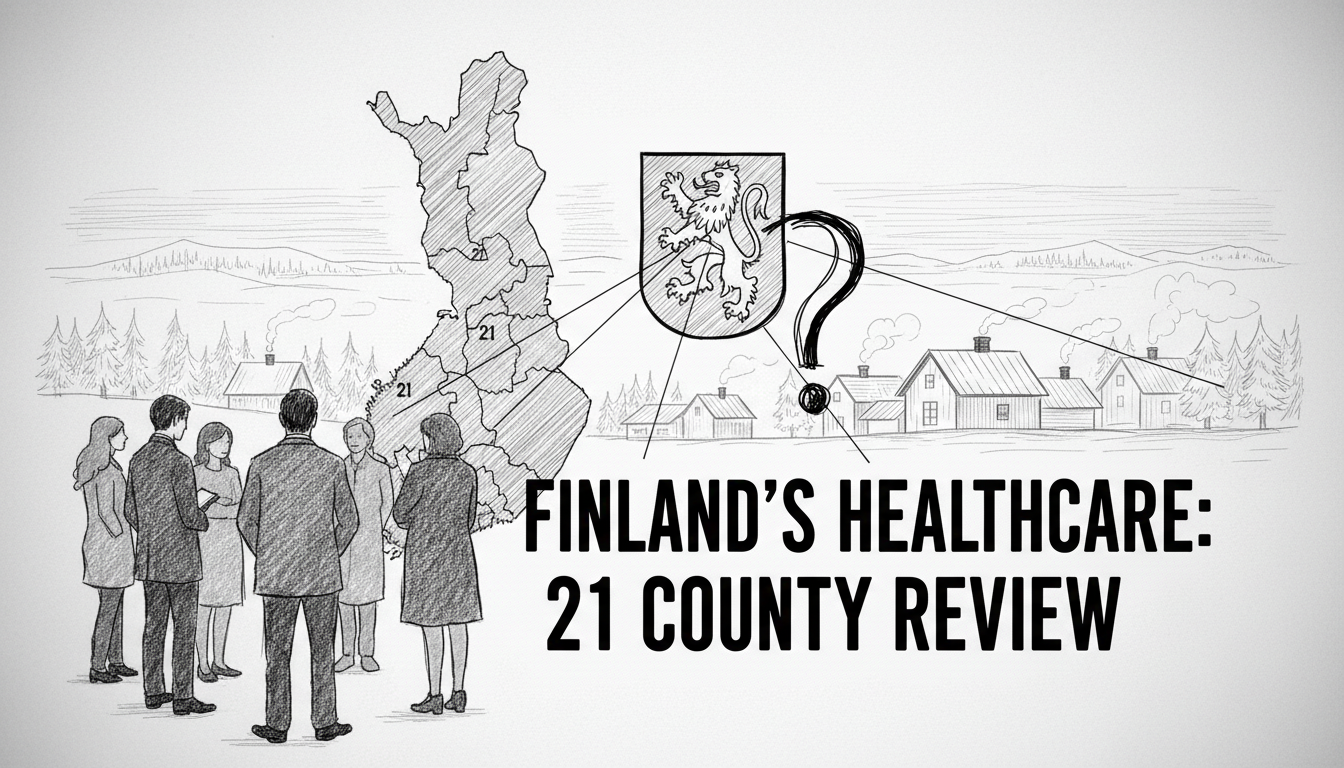
Finland's landmark social and healthcare reform, which created 21 new regional governments, is now under official review with experts recommending a fundamental reassessment of the entire structure. An expert group's interim report, delivered to the government in Helsinki, calls for a fresh evaluation of the number of wellbeing services counties (hyvinvointialueet) and proposes urgent fixes to their controversial funding model. This development marks the first major governmental acknowledgment that the sweeping 2023 overhaul, known as the sote-uudistus, may require significant structural corrections less than two years after its launch.
The report, while noting some improvements in service equality, directly challenges the foundational architecture of the reform. It suggests the current configuration of 21 distinct counties might not be optimal for long-term sustainability and efficiency. The expert group also urges a review of plans to consolidate Finland's hospital and emergency care network, a politically sensitive issue that affects access in rural regions. These recommendations land on the desk of a coalition government already grappling with economic pressures and complex negotiations over next year's state budget.
A System Built for Equality Faces Scrutiny
The social and healthcare reform was the largest administrative restructuring in modern Finnish history. Its primary goal was to end a postcode lottery in services by transferring responsibility from roughly 300 individual municipalities to 21 larger, dedicated wellbeing services counties. Proponents argued that larger entities would ensure equal, high-quality care for all citizens regardless of location and help control the relentless rise in healthcare costs. The system began operating on January 1, 2023, after years of political debate and several failed legislative attempts.
"The reform's ambition was unquestionably right—to guarantee every Finn has access to the same standard of care," said political scientist Laura Saarenmaa from the University of Helsinki. "But the political compromise that birthed 21 counties was always a potential weakness. Some regions, especially in more densely populated areas, may be too small to achieve the economies of scale needed for financial resilience." The expert group's interim report cautiously states that service quality and equality have improved, and availability has largely remained at pre-reform levels nationwide. However, this stability comes at a high and potentially unsustainable cost.
The Persistent Problem of Funding and Geography
At the heart of the recommended review is the counties' financing model. The system is designed to combine state funding with county-level taxes, but critics say it fails to adequately account for vast regional differences. Counties with older populations or higher rates of chronic illness face inherently greater costs, yet their revenue base is often weaker. This creates a structural deficit that threatens service levels unless filled by increased state subsidies, defeating a key goal of cost containment.
The geography of Finland amplifies these challenges. Sparsely populated counties in Lapland or Eastern Finland must maintain service access across enormous distances with a limited taxpayer base. Meanwhile, larger urban counties like Helsinki-Uusimaa benefit from a denser population and a stronger economy. "The funding model must be corrected to ensure genuine equality," the expert group's report states, highlighting this as a priority for the government's final evaluation. The need to review the consolidation of hospital and emergency services further underscores the tension between efficiency and accessibility in a country of Finland's size and shape.
Political Reactions and the Path to Revision
The expert report has triggered immediate reactions across the political spectrum in the Eduskunta. The opposition Social Democratic Party has seized on the findings as evidence that the governing coalition rushed the reform's implementation. "We have warned for years that 21 counties were too many and the funding model was flawed," said SDP health policy spokesperson Katri Kulmuni. "This report validates our concerns. A serious revision is now necessary to protect our welfare state."
Government ministers, particularly from the center-right National Coalition Party and the Finns Party, have been more measured. They emphasize the report's positive notes on service equality while acknowledging the need for "technical adjustments." Minister of Social Affairs and Health Sanni Grahn-Laasonen stated the government will "carefully analyze all recommendations" but did not commit to reducing the number of counties. Any such move would require reopening complex political negotiations with regional leaders and could face strong resistance from counties earmarked for mergers.
The European Context and Future of Finnish Welfare
Finland's reform is being watched closely within the European Union, where many member states face similar pressures from aging populations and rising healthcare costs. The Nordic model of universal, publicly funded care is often cited as a benchmark, making Finland's current experiment particularly significant. A successful recalibration could offer a blueprint; persistent problems would serve as a cautionary tale.
The expert group's interim report is just the first step. A final report with concrete legislative proposals is expected next year. The ultimate decisions will test the Finnish government's ability to adapt a major policy after its launch, balancing evidence-based analysis with regional political realities. The core question remains: can the system be adjusted to ensure financial sustainability without compromising the foundational principle of equal access for all citizens?
The coming months will involve intense debate in Helsinki's government district. The goal is no longer just implementing the reform, but fundamentally optimizing it for the decades ahead. The outcome will define the practical reality of Finland's famous welfare state for a generation.