
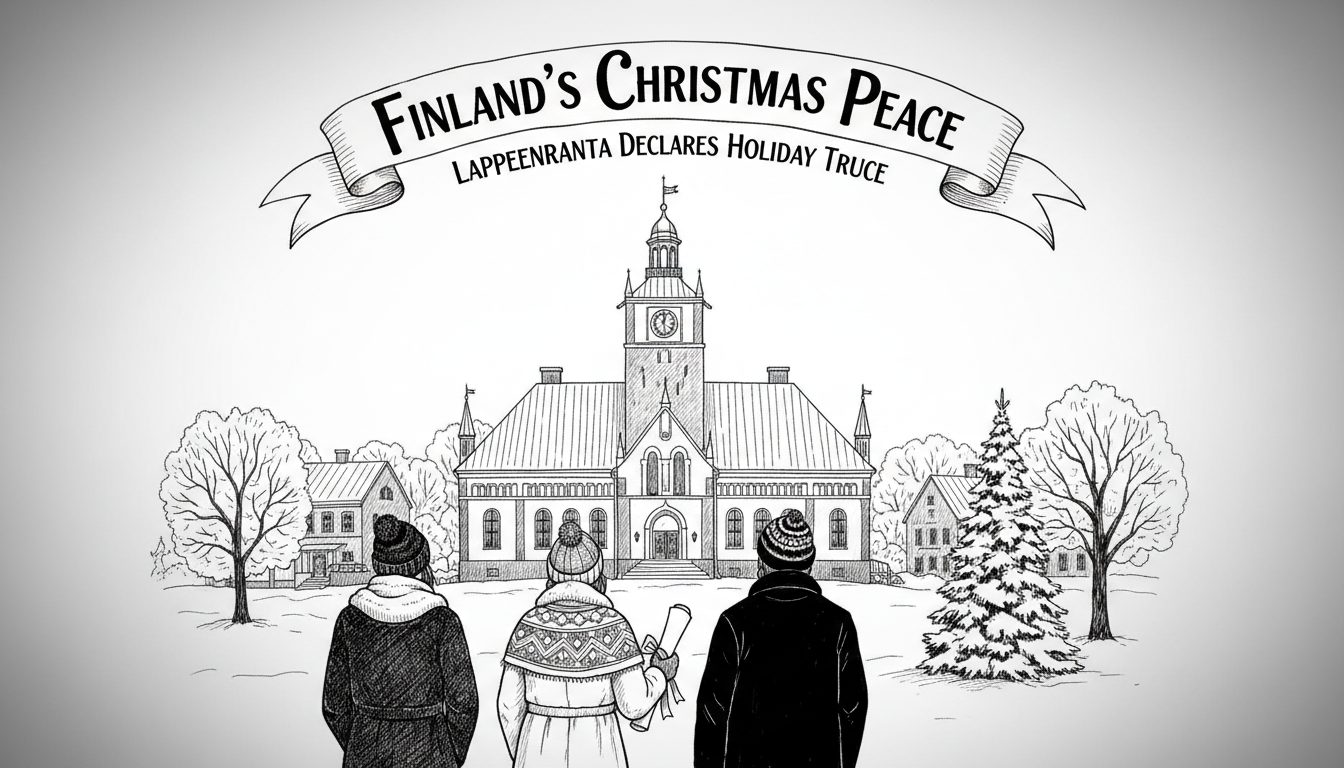
Finland's centuries-old tradition of declaring Christmas Peace will resonate once more from Lappeenranta's Citizen's Square this Christmas Eve. At precisely noon on December 24th, Deputy Mayor Jari Iskanius will read the solemn declaration from the steps of the city hall, formally announcing a period of peace and goodwill for the holiday season. The event, blending civic ceremony with community music, underscores a national ritual that connects modern Finland to its medieval past.
A Ceremony Rooted in Medieval Law
The declaration of Joulurauha is not merely a festive custom but a living fragment of Finnish legal and social history. The tradition dates back to the 13th century, originating from a Swedish royal decree that established a period of enforced peace during major religious holidays. Violators of this peace faced severe penalties. Over the centuries, the practice evolved from a strict legal ordinance into a broader cultural symbol of harmony and communal responsibility. Today, the text read by officials like Iskanius is a direct descendant of those medieval proclamations, adapted for contemporary times but retaining its core message. It calls for respectful behavior, warns against disturbances, and formally inaugurates the Christmas festivities.
This historical continuity is a point of national pride. "The Christmas Peace declaration is a unique thread that runs from our past to our present," explains Dr. Elina Lappalainen, a cultural historian at the University of Helsinki. "It transforms a historical legal act into a modern civic ritual. It reminds us that peace and orderly society are conscious choices, even if just for a few days. In a world of constant noise, this moment of collective, quiet proclamation holds significant power."
Lappeenranta's Noon Gathering on Citizen's Square
The setting for Lappeenranta's observance is deeply symbolic. Kansalaistori, or Citizen's Square, in front of the city hall, is a quintessential public forum. Choosing this location emphasizes that the Christmas Peace is a communal contract, declared by a civic leader to and for the citizens. The timing at noon on Christmas Eve is also nationally synchronized; while the most famous declaration is in Turku, Finland's former capital, hundreds of towns and cities hold their own simultaneous ceremonies, creating a wave of peace declarations across the country.
Deputy Mayor Jari Iskanius, as the reader, embodies the local government's role in upholding this tradition. His participation bridges the administrative function of the city with its cultural heartbeat. The accompanying musical program, provided by the Rakuunasoittokunta (Dragoon Band) under Captain Marko Saikko and the choir from Kimpisen school led by teacher Hanna Hyvärinen, adds layers of community participation. The involvement of school children is particularly poignant, representing the passing of the tradition to the next generation. The planned pieces, from general Christmas music to the specific hymn "Jouluvirsi nro 21," frame the proclamation within a shared cultural and musical heritage.
The Social Function of a Seasonal Truce
Beyond its historical pageantry, experts argue the Christmas Peace declaration serves a vital social function in modern Finland. In a season that can be stressful and isolating for some, the public, collective act of calling for peace and goodwill reinforces community bonds. It is a shared moment that transcends individual family celebrations, connecting people to their neighbors and their local institutions.
"It acts as a societal deep breath," says sociologist Mika Kortelainen. "For a brief period, the normal competitive pressures and conflicts of daily life are explicitly asked to cease. The declaration doesn't magically solve problems, but it creates a shared normative framework—a collective agreement to strive for harmony. This is incredibly valuable for social cohesion." The tradition also carries an implicit message of safety and order, a reassurance that the community is committed to a peaceful holiday for all its members.
A Tradition Adapting to Contemporary Finland
While steadfast in its core, the Joulurauha tradition subtly adapts. The text itself has been modernized over the decades. Contemporary declarations often include warnings against domestic disturbances and emphasize care for the vulnerable, reflecting current social concerns alongside the historical prohibitions against public disorder. The inclusion of diverse community groups in the ceremonies, like school choirs and local bands, ensures the tradition remains a living, participatory event rather than a museum piece.
Its endurance is a testament to its resonance. In an increasingly secular Finland, the Christmas Peace has maintained its significance, perhaps because its message is more civic and humanistic than purely religious. It speaks to a universal desire for peace and a well-ordered society. The ceremony in Lappeenranta, like those across the nation, is a performance of Finnish values: quiet dignity, respect for law and tradition, and a deep-seated belief in communal responsibility.
A Moment of Collective Pause in a Connected World
In the digital age, the simple power of a live, unamplified voice declaring peace to a gathered crowd holds new significance. It is an antidote to virtual fragmentation, a tangible, local experience shared in real time. The act of gathering at noon, in the heart of the city, represents a conscious pause from the hectic pre-Christmas rush. It marks the official transition into the holiday itself.
As the notes from the Dragoon Band fade over Citizen's Square and the school choir's last hymn ends, the declared peace settles over Lappeenranta. The tradition, upheld by Deputy Mayor Iskanius, Captain Saikko's musicians, and Teacher Hyvärinen's students, completes its annual cycle. It offers a question to every citizen within earshot: in a world that rarely stops, can we collectively honor this ancient call for tranquility, if only for a few cherished days? The continuity of this Finnish ritual suggests that, each Christmas, the answer remains a hopeful yes.