
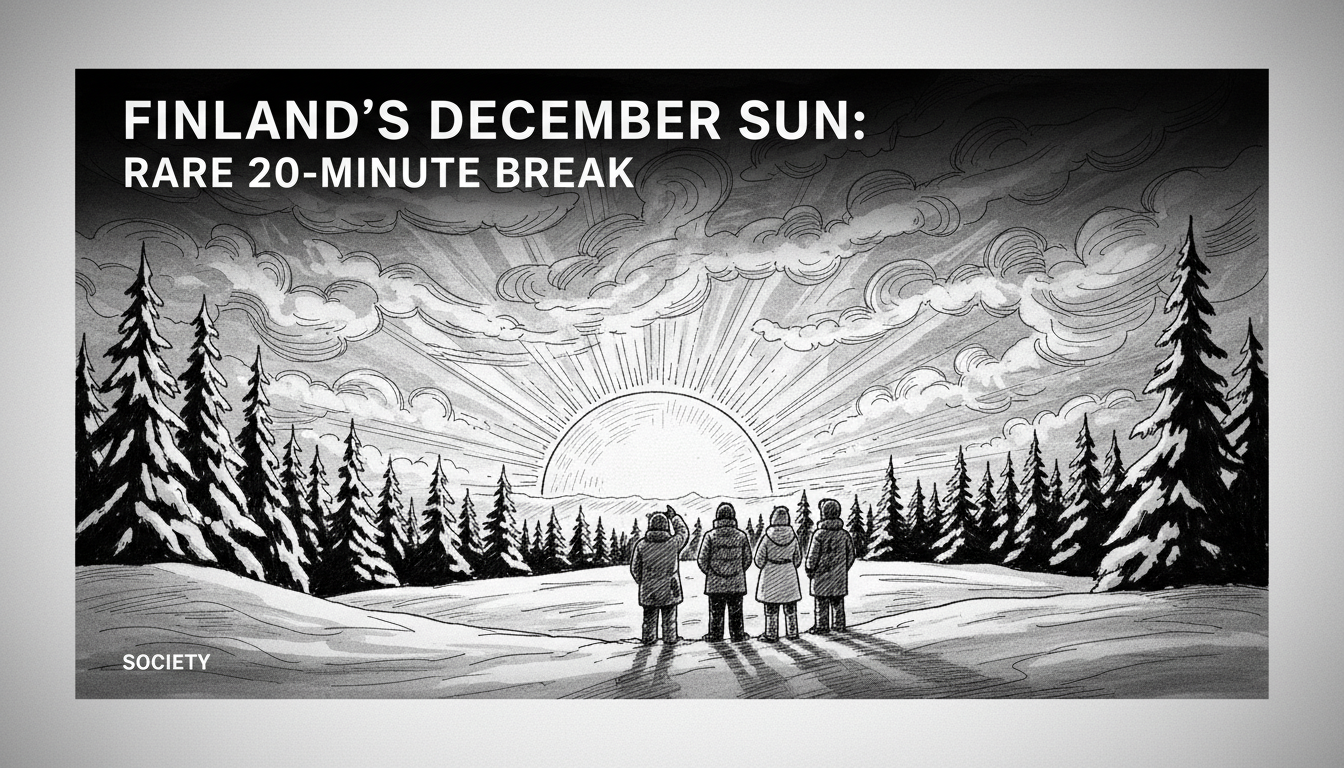
Finland's capital Helsinki recorded just 20 minutes of sunlight in December before a rare sunny day broke through the persistent gloom last Friday. Time-lapse footage from a rooftop camera in the city center starkly contrasted the bright, clear skies of that day with the dense gray cloud cover of the preceding Thursday. This visual evidence highlights the extreme variability of Nordic winter weather, where a single sunny hours can feel like a minor miracle during one of the darkest months of the year. For residents accustomed to the deep twilight of December, such a day provides a crucial psychological lift and a fleeting connection to the sun.
A Glimpse of Gold in the Gray
The rooftop camera, positioned atop a central Helsinki building, captured two full days of weather last week. The accelerated video clearly shows a dramatic shift from a uniformly overcast Thursday to a Friday where sunlight illuminated the cityscape. Meteorological data from the Finnish Meteorological Institute (Ilmatieteen laitos) contextualizes this event. Before that Friday, official observations indicated that cumulative sunshine duration for Helsinki in December had indeed been minimal, roughly aligning with the 20-minute figure suggested by the visual footage. While precise minute-by-minute verification for the entire month requires comprehensive institute data, the video serves as a powerful anecdotal record of the season's character. December in southern Finland is notoriously cloud-bound, often ranking as the gloomiest month for solar exposure.
December's Dim Reality
The contrast seen in the video is not unusual statistically, but it feels acute to those living through it. Helsinki's average sunshine duration for December sits between 20 and 30 hours, according to long-term climate records from the Finnish Meteorological Institute. These hours are spread across the entire month, meaning many days can pass without direct sunlight. The limited daylight compounds the issue; around the winter solstice, the sun is above the horizon for only about six hours in Helsinki, and its low angle means light is weak and diffuse even when clouds part. This year has trended cloudier than average, making last Friday's clear skies a notable deviation. The institute's climatologists note that annual variability is high, driven by prevailing weather systems from the Atlantic and Eurasian continents. A persistent low-pressure system can blanket the region in cloud for weeks, while a high-pressure ridge can bring crisp, clear, and cold days.
Meteorological Mechanisms and Patterns
Explaining the scarcity of sunshine requires understanding Finland's geographical position. Located between 60 and 70 degrees north latitude, the country experiences profound seasonal shifts in daylight. In winter, the sun's path is low and short, providing little solar energy. Furthermore, Finland's climate is a battleground between mild, moist maritime air from the Atlantic and cold, dry continental air from the east. During December, the maritime influence often dominates, leading to frequent cloud formation and precipitation that obscures the sun. Meteorologists emphasize that the perceived darkness is a product of both astronomical reality and meteorological luck. The high albedo from snow cover, when present, can amplify available light, but this December has seen intermittent snow in Helsinki, reducing this reflective effect. The institute's models show no significant long-term trend in December sunshine hours, but researchers actively monitor changes in cloud cover patterns as part of broader climate change studies.
Sunshine, Society, and Subtle Policy Links
The absence of sunlight has tangible effects on daily life and public health. Seasonal Affective Disorder (SAD) and general winter fatigue are common concerns, prompting public health advisories from the Finnish Institute for Health and Welfare. While this is a general weather story, the conditions it describes intersect with policy areas. Municipalities, including Helsinki, design urban lighting and public spaces to combat the psychological effects of darkness. At the national level, discussions about flexible working hours and access to light therapy are part of a broader conversation on well-being. The European Union's climate adaptation strategies also touch on societal resilience to extreme seasonal weather, though Finland's winter darkness is a perennial, predictable challenge rather than a sudden crisis. The rarity of a sunny December day underscores why these considerations remain relevant in Nordic governance.
Looking Beyond the Immediate Gloom
Last Friday's sunshine, while brief, offered a reminder of the natural cycles that govern life at high latitudes. It provided a moment of visual clarity and perhaps a boost to public mood, a subject often discussed in Finnish media during this season. As the year turns, daylight will gradually increase, but January and February can remain deeply cold and dark. The Finnish Meteorological Institute continues to provide detailed forecasts and climate analyses, helping citizens and authorities prepare for the winter's remainder. The rooftop camera's simple comparison—gray versus gold—captures a fundamental experience of Finnish winter. It poses an implicit question: in a season defined by absence, how do we value and harness the fleeting moments of light? The answer lies in both personal resilience and the societal structures built to withstand the long night.