
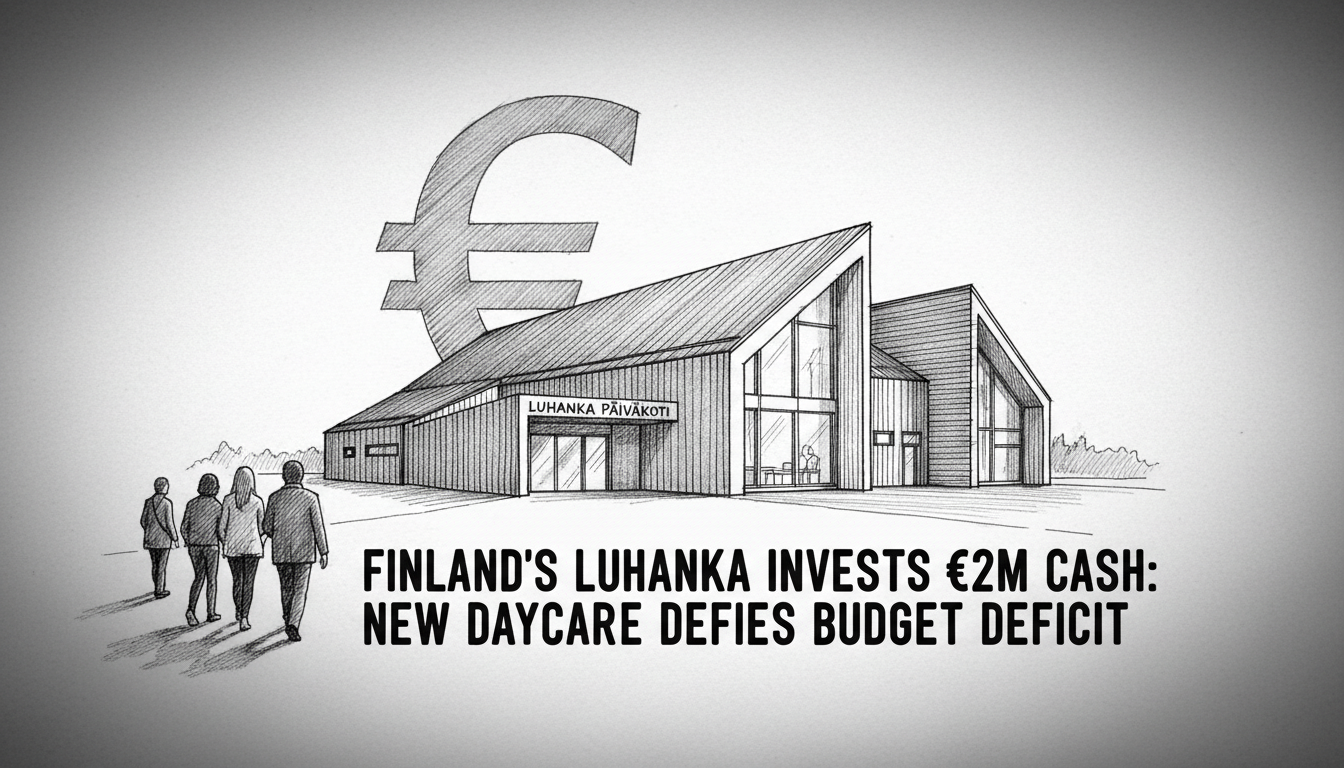
Finland's smallest municipalities are making strategic investments to secure their future, even when official budgets show a deficit. The municipality of Luhanka, with a population of just 700, has proposed a 2026 budget with a 560,000-euro shortfall. Yet, its leadership is moving forward with a significant investment in a new daycare center, funded from substantial municipal cash reserves. This decision highlights a critical debate in Finnish local governance: the balance between fiscal prudence and strategic investment for survival.
"Luhanka's municipality has cash reserves of over two million euros," said municipal manager Tuomo Kärnä. "In relation to the municipality's operations, it is unnecessarily large." Kärnä's statement cuts to the heart of the issue. For a tiny municipality, a 560,000-euro deficit appears daunting. However, the existence of a 2-million-euro cash buffer provides a rare opportunity. The planned daycare investment represents a conscious choice to use these reserves not just as a safety net, but as a tool for proactive community development.
A Strategic Gamble for Demographic Survival
This is more than a simple construction project; it is a demographic intervention. Like many rural Finnish municipalities, Luhanka in Central Finland faces the relentless pressures of an aging population and youth outmigration. Basic services, from schools to healthcare, are funded through a combination of local income tax and state subsidies based on population and need. A shrinking, aging population creates a vicious cycle: lower tax revenue, reduced state support, and declining services, which in turn makes the area less attractive for young families.
Investing in a modern, high-quality daycare center is a direct attempt to break that cycle. The goal is twofold: to improve the quality of life for existing young families and to make Luhanka a more appealing place for new ones to settle. "For a municipality of this size, every family counts," explains Dr. Laura Pekkala, a researcher in municipal economics at the University of Eastern Finland. "An investment like this isn't just a line item in a budget. It's a signal to current and potential residents that the community is committed to its future and to the well-being of children. In the long-term calculus of municipal survival, that signal can be as valuable as the service itself."
The Finnish Municipal Finance Model Under Strain
Luhanka's situation exposes the tightrope all Finnish municipalities walk. They are legally responsible for providing extensive welfare services—education, social care, healthcare, infrastructure—with significant autonomy but within a rigid financial framework. The system is designed for equity, but for very small municipalities, the margins are exceptionally thin. A single large infrastructure project or a shift in the demographic balance can create substantial budgetary shocks.
Kärnä's characterization of the cash reserves as "unnecessarily large" is a pragmatic assessment within this context. Hoarding large cash reserves earns minimal interest and does nothing to address the core challenges of service provision and population decline. Conversely, spending them down on operational costs is unsustainable. Directing them into a capital investment that addresses a key strategic need—supporting young families—represents a middle path. It converts static financial capital into social infrastructure with the potential for a demographic return on investment.
However, experts urge caution. "Using reserves for one-off investments is sound, provided the ongoing operational costs of the new facility are sustainably covered in future budgets," warns Dr. Pekkala. "The new daycare will have annual staffing, maintenance, and utility costs. The municipality must have a credible plan for how these will be funded after the construction money from reserves is spent. Otherwise, they risk trading a healthy balance sheet for an ongoing structural deficit."
The Bigger Picture: Rural Finland's Fight for Relevance
Luhanka's decision mirrors a broader trend across rural Finland. From Lapland to South Ostrobothnia, municipalities are deploying creative strategies to remain viable. Some are merging services with neighbors; others are investing heavily in digital infrastructure and remote work hubs to attract a new kind of resident. Family-friendly services like daycare, modern schools, and recreational facilities are consistently at the top of the strategic investment list.
The debate in Luhanka's council, which must approve the budget and the investment, will likely center on risk tolerance. Is it riskier to spend a portion of the "unnecessarily large" reserve on a concrete project aimed at growth, or to preserve the cash while the community's demographic foundations slowly erode? The political decision reflects a fundamental choice about what municipal reserves are for: Are they merely a financial cushion, or are they a strategic fund for ensuring the municipality's future existence?
A Test Case for Proactive Local Governance
As the Luhanka municipal council deliberates the 2026 budget proposal, its members are effectively voting on a vision for the next decade. The numbers tell a simple story: a deficit of 560,000 euros against reserves of over 2 million. The human and strategic story is more complex. It involves the laughter of children in a new building, the relief of parents with access to reliable care, and the faint hope of a population curve that stabilizes or even bends upward.
Finland's system grants its smallest municipalities the agency to make these consequential choices. Luhanka is choosing to interpret fiscal strength not as an end in itself, but as a means to an end—the end being a living, thriving community. The success of this daycare investment won't be measured solely on a balance sheet in 2027, but in school enrollment figures in 2030 and population statistics in 2035. In the quiet forests of Central Finland, a small municipality is betting its cash on its children, demonstrating that sometimes, the most prudent financial decision is to invest boldly in people.