
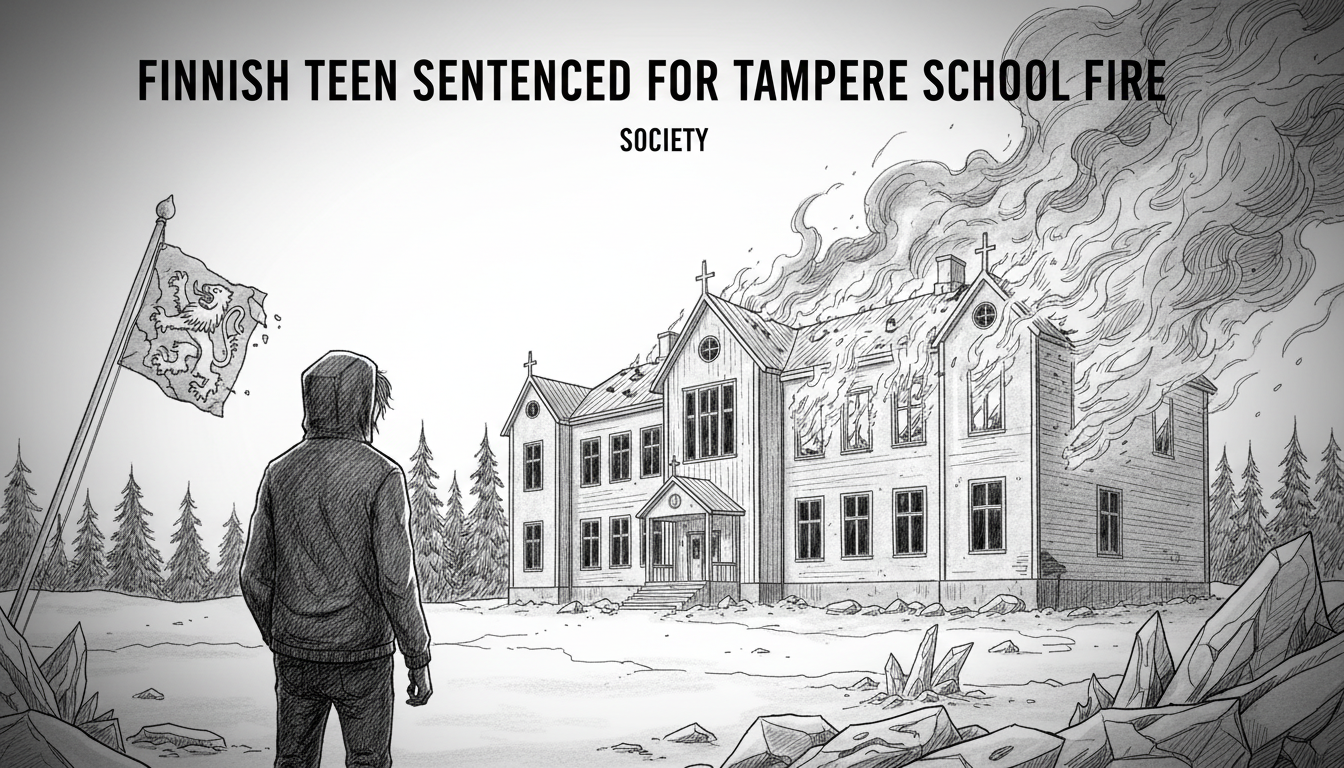
Finland's Pirkanmaa District Court has sentenced a 19-year-old man to a conditional prison term for setting fire to a disused school in Tampere. The conviction brings a partial close to a case that severed a friendship, left a young adult with crushing debt, and exposed the complex interplay between youth, mental state, and justice in Finland. The 19-year-old, deemed to have acted with diminished capacity, must now pay over 80,000 euros in damages for a blaze that caused an estimated 300,000 euros in destruction.
The January Inferno at Saukonpuisto
Flames erupted at the vacant Saukonpuisto school in Tampere on the afternoon of January 6th. Firefighters received the alarm around 3 p.m., finding flames shooting from the roof and windows shattering from the heat. The fire, which began with a mat set alight under a canopy in the school's south wing courtyard, spread rapidly into the building's interior. Dense smoke billowed across the neighborhood, prompting authorities to issue a danger warning to local residents. The disused school, owned by the City of Tampere, sustained extensive structural and interior damage, with initial municipal estimates pegging losses at approximately 300,000 euros.
A Friendship Consumed by Flames
The police investigation revealed a narrative centered on two teenagers. The convicted 19-year-old admitted to the act of arson, classified as 'tuhotyö' under Finnish law. During interrogations, he struggled to articulate a motive, stating, 'Ei ole ollut ajatuksia nyt eikä silloinkaan. Tai nyt tulee ajatuksia, että sellaista ei saisi tehdä' ('I had no thoughts then, and I don't now. Or now I have thoughts that such a thing should not be done'). A 16-year-old boy, who was with him at the time, was also charged but ultimately not convicted. This younger teen told a contrasting story, claiming he tried to intervene by throwing snow on items the older boy was playing with using a lighter, and even extinguishing a smaller trash fire earlier. He insisted he did not start the school blaze. In the aftermath, the 16-year-old severed ties with his older friend, sending him news links about the fire and searching online for information on arson and statutory limitations for crimes.
Legal Reckoning in the District Court
The Pirkanmaa District Court delivered its verdict after considering the evidence and the defendants' mental states. The 19-year-old was found guilty of damage to property, with the court acknowledging he understood the consequences of his actions but did so with reduced culpability due to his health condition—a state referred to legally as 'alentuneesti syyntakeisena.' This finding of diminished responsibility significantly influenced the sentencing. He received a three-month conditional prison sentence and was ordered to pay the City of Tampere 80,000 euros in damages, plus interest, a fraction of the total cost. The court found no incontrovertible evidence linking the 16-year-old to the arson, leading to his acquittal. The judgment is not yet legally binding and can be appealed to the Turku Court of Appeal.
Expert Analysis: Diminished Capacity and Finnish Justice
Legal experts note this case highlights key facets of Finland's criminal justice approach. 'The sentence reflects the Finnish system's consideration of individual circumstances, particularly the defendant's mental state at the time of the crime,' says Helsinki-based legal scholar Dr. Elina Saarelma. 'The concept of 'alentuneesti syyntakeinen' allows courts to mitigate punishment when a person's ability to understand or control their actions is impaired, often due to health issues. However, the substantial civil damages order underscores the principle of responsibility for one's actions.' The discrepancy between the 80,000-euro compensation order and the 300,000-euro total damage estimate is common; courts often award amounts based on proven direct losses and the defendant's realistic capacity to pay. From a criminological perspective, the lack of a clear motive and the age dynamic are notable. 'These are not uncommon elements in youth-involved property crimes,' comments criminologist Professor Jari Kääriäinen. 'The incident and its aftermath—the broken friendship, the online searches about crime—show a belated grasp of gravity, a ripple effect of thoughtless action.'
Policy Context and Broader Implications
While not a direct government policy story, this arson case touches on ongoing discussions in the Eduskunta, Finland's parliament, regarding youth crime, mental health services, and municipal property security. The City of Tampere, as the property owner, bears the bulk of the financial loss, raising questions about the protection of vacant public buildings. In recent years, Finnish legislators have debated tightening penalties for serious property damage, but proposals often balance deterrence with rehabilitation, especially for young offenders. The case also indirectly connects to Finland's social welfare model, which emphasizes reintegration over purely punitive measures, as seen in the conditional nature of the prison sentence. The court's decision to prioritize the young man's diminished capacity over the sheer scale of damage offers a concrete example of this principle in action. It demonstrates how Finnish courts navigate the criminal code's provisions on sanity and culpability, a process distinct from the more punitive frameworks seen in some other jurisdictions.
Community Aftermath and Looking Ahead
The Saukonpuisto school fire left a scar on the local community in Tampere, a city renowned for its educational institutions. For the convicted teenager, the path forward is laden with a decades-long financial burden, a tangible reminder of a single January afternoon. The failed friendship between the two boys underscores the personal collapses that often accompany criminal acts. As Finland continues to refine its justice and social support systems, cases like this one serve as critical reference points. They force a societal conversation about how to effectively hold individuals accountable while addressing the underlying factors—like mental health—that can lead to destruction. The appeal period now waits, but the flames at Saukonpuisto have already cooled, leaving behind ashes, a bill, and a broken bond that no court can repair.