
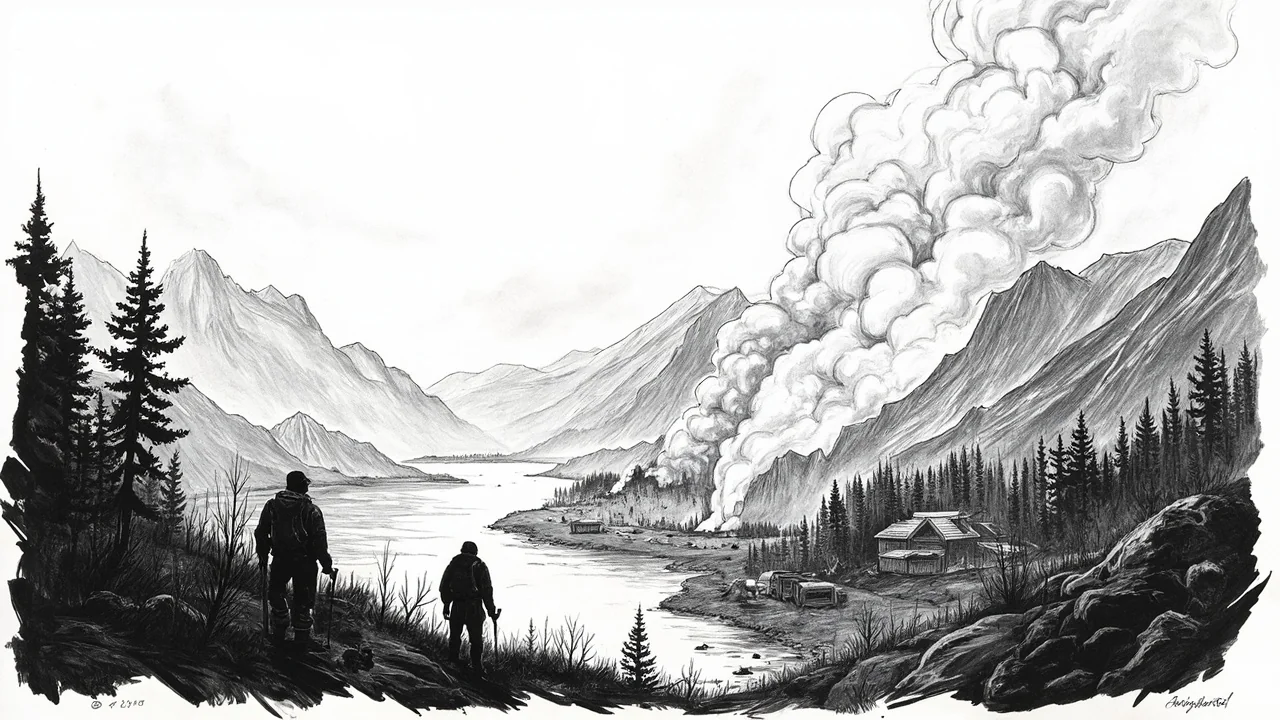
Norway's terrain fires have increased 940% this year, prompting a stark warning from fire chiefs who fear a repeat of the nation's worst wildfire in decades. Fire and rescue services have responded to 52 terrain fires so far in 2024, compared to just five in the same period last year, according to official statistics. This is the highest number of early-year callouts since 2016.
Fire Chief Dag Botnen of Haugaland Fire and Rescue issued a clear recommendation to halt all controlled heather burning in the region. 'Now there are completely special conditions,' Botnen said. 'When the heather burners have lost control, and they are so skilled and experienced, then there is reason to take a step back.' He has not seen similar conditions since 2014, the year a major wildfire destroyed 64 buildings in Flatanger, Trøndelag.
A Regional Disconnect on Prevention
The warning from Haugaland is not being uniformly adopted across western Norway. While Botnen calls for a complete stop, neighboring Rogaland Fire and Rescue is taking a different approach. Tom Meyer, the duty fire chief in Rogaland, said they have no plans for a similar ban. Instead, they urge those considering controlled burns to think carefully. 'They are totally responsible if they are going to set a fire. Your fire, your responsibility, is our appeal,' Meyer stated. However, he acknowledged the severity of the situation, noting, 'We assess the situation day by day and what measures we should take. It goes very badly once it catches fire.'
Conditions Ripe for Disaster
The root cause is an extended period of unusually dry weather. For weeks, a yellow warning for grass and heather fire danger has been in effect for Rogaland, Vestland, and parts of Møre og Romsdal. Botnen describes vegetation as 'bone dry' and warns the dryness extends beyond natural fuels. 'You don't need to scrape your car in the morning because the air humidity is so low... When this has lasted so long, it is not just the heather and grass that are dry, but also the cladding on houses,' he cautioned. This significantly increases the risk of a small terrain fire spreading rapidly to structures.
Echoes of the 2014 Catastrophe
The reference to 2014 is not made lightly. The Flatanger fire, which began on January 27 of that year, remains the largest in Norway since World War II. It serves as a dire benchmark for fire services. 'It went quite wrong in 2014,' Botnen said, emphasizing, 'We do not want that to happen again.' Recent incidents underscore the current volatility. In February, crews from two fire stations and a forest fire helicopter were deployed to Karmøy to stop a controlled burn from spreading toward forest and buildings, where several hundred acres burned. Another fire broke out in terrain near Oksvoll on Ørland, spreading toward a mountainside and buildings.
Localized Miracles and Daily Assessments
The human impact is already being felt. In one recent incident, a resident noted the fire could have reached his farm, calling its survival 'a miracle.' This near-miss exemplifies the fine margin for error. The divergent strategies between regions highlight the challenging balance between traditional land management practices and unprecedented risk. Rogaland's Meyer maintains his service's position of daily assessment rather than a blanket ban, but the underlying concern is shared. The core message from all professionals is one of extreme caution.
The Path Forward in a Drier Climate
As climate models predict warmer and drier periods in Norway, especially in coastal regions, the events of this winter may transition from an anomaly to a recurring pattern. The 2014 Flatanger fire is no longer a singular historical reference point but a precedent. Fire services must now consider whether their seasonal preparedness calendars need permanent adjustment. For the public, the old norms of spring burning are being invalidated by new meteorological realities. The immediate appeal from chiefs like Botnen and Meyer is for supreme vigilance. The longer-term implication is a national conversation about fire mitigation, land management, and adaptation in the face of a changing climate, where the smell of smoke in February becomes a more familiar, and feared, scent.