
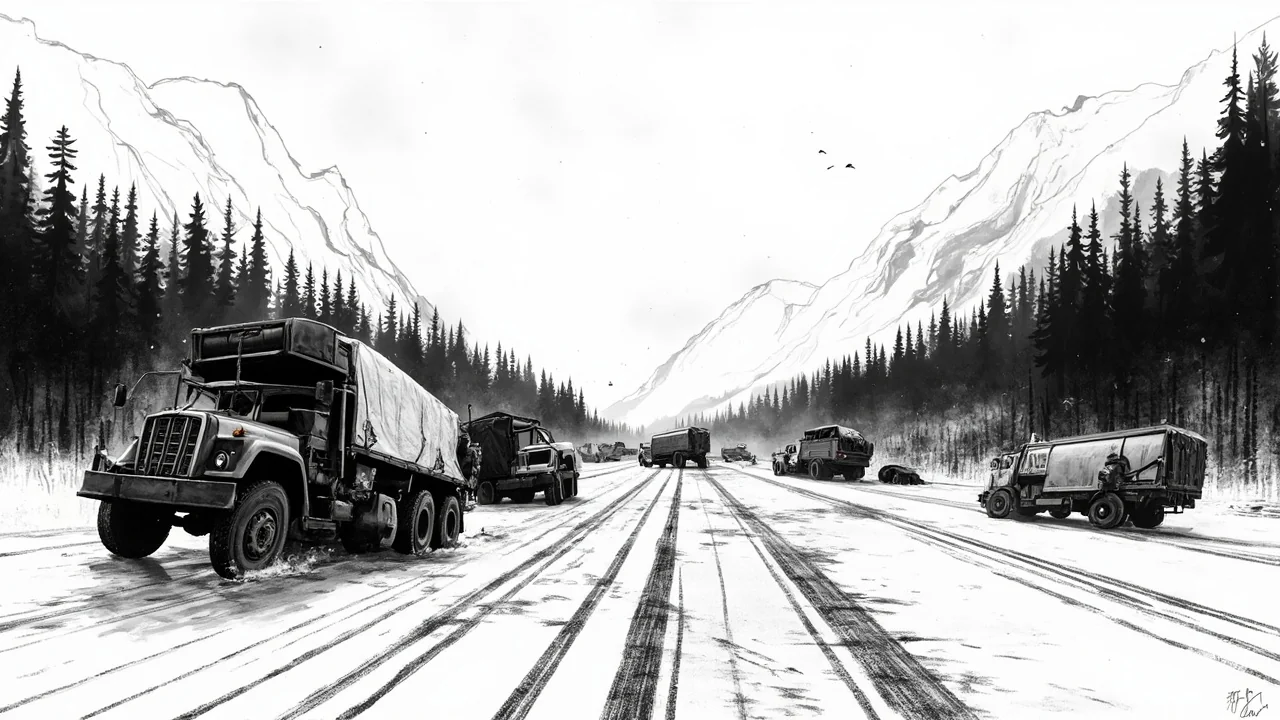
Norway's first major snowfall of the season triggered a cascade of traffic chaos Monday afternoon, with a multi-vehicle pileup on the E18 near Oslo and three military trucks skidding off a highway in the east. The incidents, occurring during the evening rush hour, caused significant delays and highlighted the perennial challenge of transitioning to winter driving conditions.
A collision involving nine vehicles shut down a lane on the E18 motorway near Asker, west of Oslo. Four cars required towing from the scene. Emergency services, including the fire brigade, responded. Police confirmed one person reported pain, though the full extent of injuries remained unclear. "We haven't received any feedback on whether the accident is related to the snow and slippery roads, but I would assume it is a contributing factor. Because it is snowing now," said operations manager Kristian Engh of the Oslo Police District.
Simultaneously, nearly 150 kilometers to the north, three military transport trucks slid off the E6 highway between Rena and Elverum in Innlandet county. One vehicle crashed through a guardrail and nearly ended up in the oncoming lane. Police closed the road in both directions temporarily. "It has not led to major traffic problems," said operations manager Andreas Ulshagen Jorde, noting no injuries were reported. A motorist stuck in the resulting queue described conditions as "treacherously slippery" and reported waiting for thirty minutes.
A Sudden Blanket of Snow
The disruptions followed weather warnings for up to 40 centimeters of snow in Southern Norway, with heavy showers also predicted for the broader Eastern region. The snow arrived rapidly during the Monday commute, catching many drivers off guard. While the Eastern Traffic Centre reported few major alerts about snow-caused trouble by late afternoon, they acknowledged the impact. "There is snow plowing, and traffic flow can thus be somewhat reduced. Also because motorists adjust their speed to the conditions. But it is wise to take it nice and easy," said duty officer Tilia Mathre.
The contrasting severity of the two incidents—a multi-car crash with injuries on a major artery versus a military accident with no injuries on a less trafficked route—underscores the unpredictable nature of early-season winter weather. Both, however, stemmed from the same meteorological event, revealing a systemic vulnerability during the first significant snowfall.
The Annual Winter Reckoning
Every autumn, Norwegian authorities and motoring organizations launch campaigns urging drivers to fit winter tires and exercise caution. Yet, the first substantial snow consistently leads to a spike in accidents. This year proved no exception. The E18, a critical corridor connecting Oslo to major western cities like Drammen and Kristiansand, is particularly sensitive to disruptions. Any closure or lane reduction creates immediate and lengthy tailbacks, as witnessed Monday when queues stretched "quite far" from the Asker crash site.
Expert analysis suggests these incidents are less about a lack of preparedness and more about adjustment. Driver psychology plays a key role. After months of dry or wet asphalt, motorists must recalibrate their perception of braking distances and safe cornering speeds. This cognitive shift often lags behind the changing conditions, resulting in accidents like the chain-reaction collision on the E18. The involvement of military vehicles, typically operated by trained drivers, further illustrates how quickly even experienced operators can be overcome by black ice or sudden loss of traction.
Infrastructure and Response Under Scrutiny
The response to Monday's events tests Norway's winter readiness protocols. The quick deployment of plows and salt trucks is standard, but their effectiveness depends on timing. The snow fell during the peak traffic period, limiting the ability of road crews to clear lanes before congestion set in. This turned highways into packed, snow-covered surfaces where stopping distances become dangerously extended.
Police and traffic management centers faced the dual challenge of managing accident scenes while disseminating real-time information to prevent further collisions. The decision to close the E6 entirely after the military truck incident, while prudent for safety, is a major intervention that disrupts freight and long-distance travel. The fact it did not cause "major traffic problems," as police stated, may indicate alternative routes were available or traffic volumes were lighter on that stretch.
For commuters on the E18, however, the impact was severe. With one exit lane closed, traffic in the main carriageway crawling past the accident site, and continuing snowfall, travel times ballooned. This creates a secondary economic impact, from lost working hours to delayed logistics, which multiplies the cost of a single weather event.
A Look at the Road Ahead
This week's snow is merely a precursor. The Norwegian Meteorological Institute forecasts a winter with variable precipitation and temperature patterns, influenced by broader North Atlantic systems. For transport authorities, the immediate task is clearing Monday's aftermath and reinforcing warnings. For drivers, it is a stark reminder that winter tires—a legal requirement from November to Easter in most regions—are only part of the solution. Defensive driving, increased following distance, and reduced speed are essential behavioral changes.
The incidents near Asker and Elverum will likely feature in upcoming traffic safety bulletins. They serve as case studies in how quickly conditions can deteriorate and how multiple vehicles can become involved in a single moment of lost control. As the season progresses, the focus will shift from initial adjustment to enduring resilience against prolonged cold spells and heavy snowfall, particularly in mountain passes and coastal areas prone to slush and ice.
Norway's relationship with winter is one of respect forged through necessity. Monday's chaos is an annual ritual, a harsh reacquaintance with the forces that shape Scandinavian life for nearly half the year. The true test is not whether such accidents happen, but how swiftly the country learns from them and adapts its collective behavior on the roads. With darkness descending early and temperatures set to drop further, that learning curve must be a short one.