
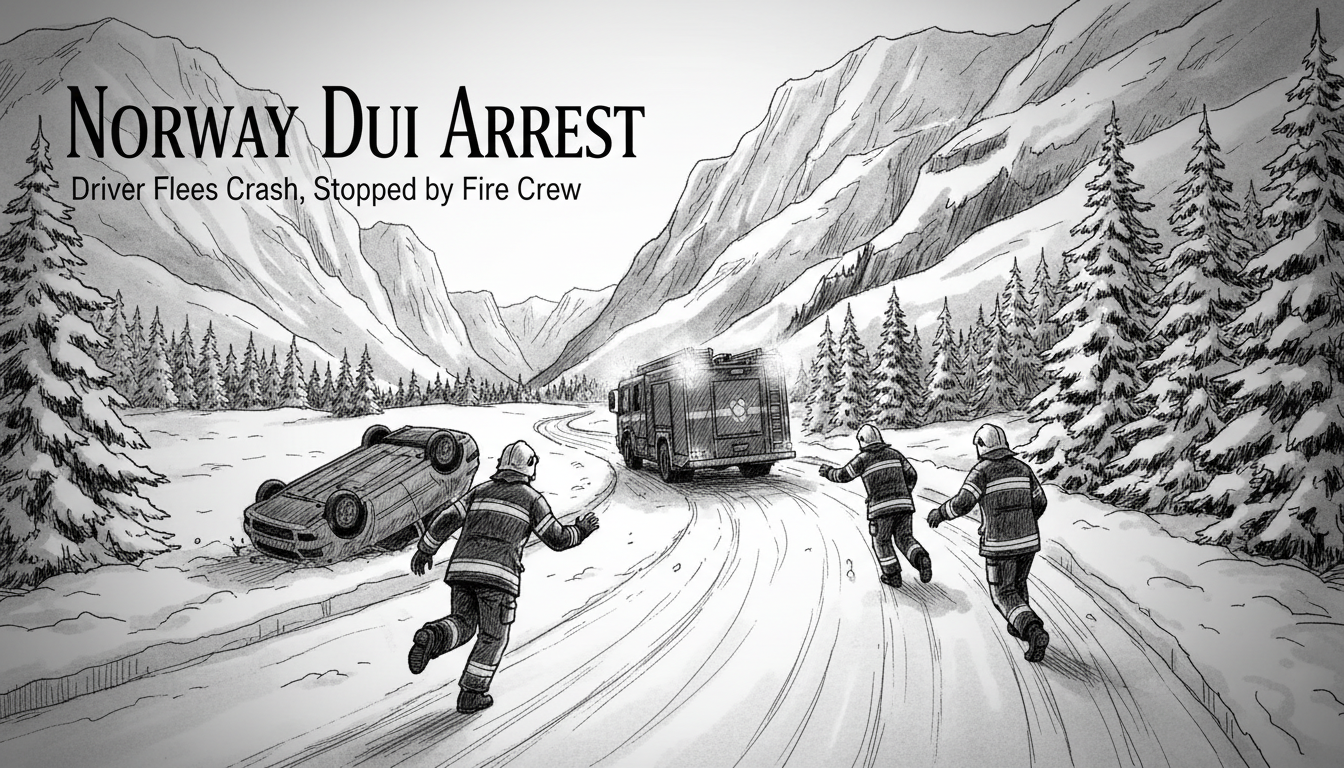
Norway's strict drunk driving laws face a stark test after a young driver allegedly attempted to flee the scene of a single-vehicle crash on Askøy island, only to be intercepted by responding firefighters. The incident, occurring in the early hours on Ravnangervegen, saw a car collide with a guardrail and land in a ditch. Police operations leader Morten Rebnord confirmed the driver, a man in his 20s, is suspected of driving under the influence.
A Chaotic Scene on a Quiet Road
Emergency services received the call at 1:10 AM. Upon arrival, they found a damaged car in the ditch. Initial reports from other motorists who stopped indicated the driver had tried to run away immediately after the crash. "The driver is a man in his 20s who tried to run away but was held back by other motorists who came to the scene," Rebnord said in a statement. This initial restraint by citizens highlights a public expectation to uphold road safety laws, even before authorities arrive.
However, the situation escalated. The man managed to break free and ran from the scene. His escape was short-lived. "The driver managed to break loose and ran off, but he was stopped a few hundred meters away by the fire service, which was on its way to the accident," Rebnord reported. The responding fire crew, en route to secure the vehicle and check for hazards, instead found themselves making an impromptu citizen's arrest. The driver was then taken to Haukeland University Hospital for assessment; the extent of his injuries remains unclear to police.
The Legal Duty to Stop
This flight attempt places the driver in direct violation of Section 12 of the Norwegian Road Traffic Act. This law is unequivocal: anyone involved in a traffic accident, regardless of fault, must stop and participate in the necessary measures the accident triggers. This includes providing assistance, exchanging information, and securing the scene. Fleeing an accident, or hit-and-run, is considered a serious aggravating circumstance in Norwegian law, often leading to harsher penalties than the initial traffic violation.
"The vehicle sustained major material damage," Rebnord noted, indicating a significant impact. But the material damage is a secondary concern to the alleged behavior behind the wheel. Police have initiated a case, confiscated the man's driver's license, and stated clearly: "Suspicion of driving under the influence." Norway maintains one of the world's strictest legal blood alcohol content (BAC) limits at 0.02%, effectively a zero-tolerance policy for most drivers.
The High Stakes of Impaired Driving in Norway
This incident on Askøy, a municipality connected to Bergen by bridge, is a microcosm of a national safety challenge. The Norwegian Institute of Public Health consistently cites impaired driving as a contributing factor in a significant percentage of the nation's traffic fatalities. Norway's mountainous terrain, frequent adverse weather, and dark winters make driving conditions demanding even for sober, alert drivers. Adding alcohol or drugs to the mix dramatically elevates the risk.
Experts point to the country's stringent laws and rigorous enforcement as key reasons for Norway's generally strong road safety record. The penalty for DUI can include substantial fines, mandatory prison sentences for higher BAC levels, and a long-term loss of driving privileges. The social stigma is also considerable. "The legal and social consequences in Norway for driving under the influence are severe by international design," says Lars Tingelstad, a legal scholar specializing in transport law. "The law serves as both a punishment and a powerful deterrent. Cases involving flight from the scene are treated with particular seriousness, as they demonstrate a conscious disregard for legal and ethical responsibility."
Analysis: Deterrence and Public Responsibility
The Askøy case presents a layered narrative. First, it underscores the effectiveness of Norway's integrated emergency response, where even a fire crew becomes an essential link in upholding public safety. Second, it highlights the role of the public, as other motorists initially intervened. This collective responsibility is a cornerstone of Nordic societal safety models.
However, the driver's repeated attempts to flee suggest a potential awareness of grave personal consequences, likely linked to the suspicion of impairment. This raises a persistent question for policymakers: does the fear of harsh punishment sometimes provoke irrational actions like flight, potentially endangering others further? Traffic safety campaigns increasingly balance messages about strict penalties with reminders of the legal duty to stop and the escalated penalties for failing to do so.
The physical geography of the incident is also relevant. Askøy's road network, with stretches like Ravnangervegen, can be narrow and winding. A single-vehicle crash into a guardrail and ditch is a common outcome for impaired or distracted driving on such routes, where margin for error is slim. The outcome could have been far worse without the safety barrier.
A Pending Reckoning
The man, now released from medical care, awaits formal questioning and charges. The police investigation will determine his exact level of impairment and reconstruct the events leading to the crash. The charges will likely encompass DUI, violation of Section 12 for leaving the scene, and possibly reckless driving. The court will consider the flight as an aggravating factor.
This episode serves as a stark, real-world reminder of Norway's uncompromising stance on road safety. It demonstrates the system in action: from citizen intervention to multi-agency response, all anchored by a clear, strict legal framework. As the case moves through the legal system, it reaffirms a fundamental principle in Norwegian traffic law: if you cause an accident, you must stay. The consequences of driving impaired are severe, but the consequences of trying to evade them are even more so.
The damaged guardrail on Ravnangervegen will be repaired. The legal and personal ramifications for the driver, however, are just beginning. This incident begs the question for all drivers: in a moment of crisis, compounded by poor judgment, will you take responsibility or compound your mistakes? In Norway, the system is designed to ensure you face that choice, one way or another.