
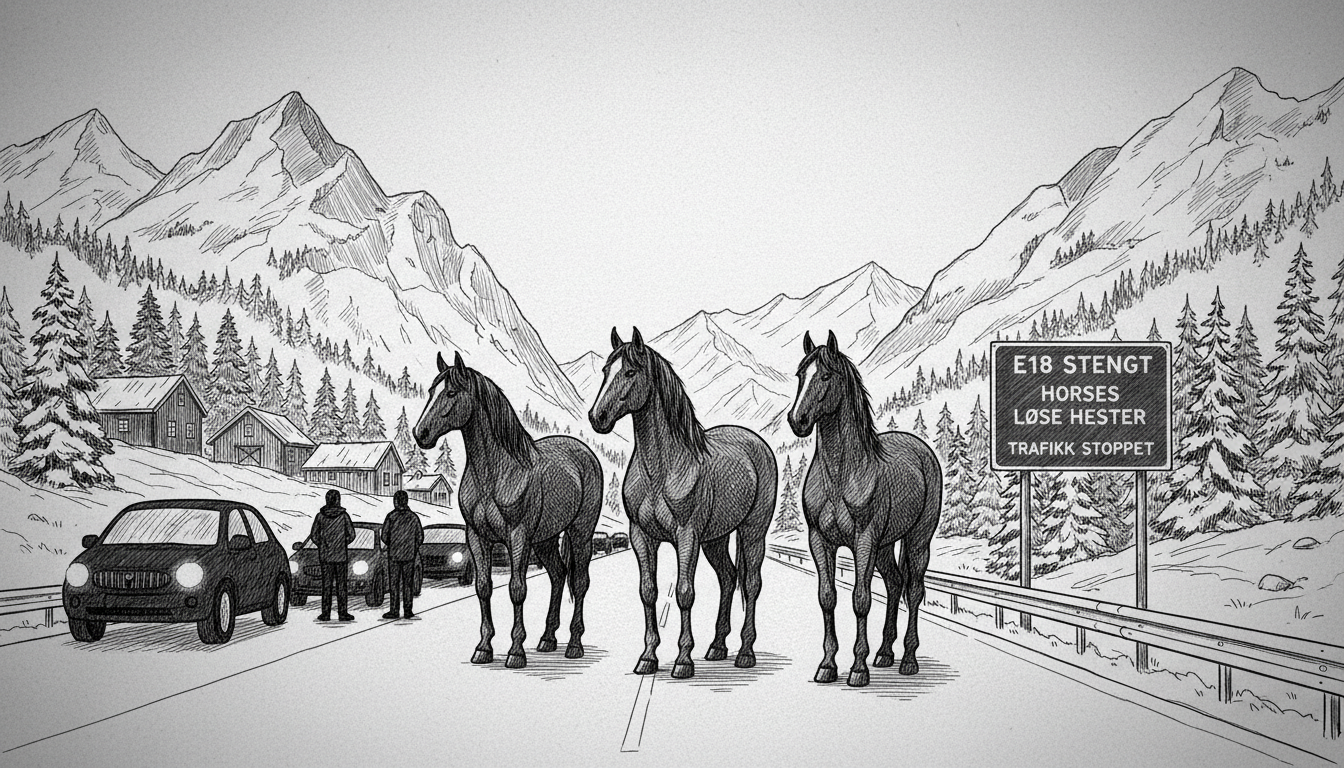
Norway's E18 highway was shut down in both directions near Drammen on Thursday after three loose horses were reported running in the southbound lanes. Police halted all traffic at Skoger, a critical junction west of Oslo, citing an uncontrolled danger to motorists. The incident caused immediate and significant disruptions on one of the country's most vital transport arteries.
Operational commander Inge Omli Landsrød confirmed the closure in a statement. "We have patrols on site and see ourselves forced to stop traffic in both directions," Landsrød said. "There is no control over the horses." Authorities successfully contacted the animals' owner, who was traveling to the scene to assist. The National Road Traffic Centre was also notified to manage the wider traffic implications.
A Major Artery Grinds to a Halt
The E18 is not just any road. It is part of the European route network, running from Craigavon in Northern Ireland through Norway, Sweden, and Finland to Saint Petersburg, Russia. In southeastern Norway, it functions as the primary corridor connecting Oslo to cities like Drammen, Tønsberg, and Kristiansand. A full closure, especially during daytime hours, creates a cascade of congestion on alternative routes like the E134 and county roads.
Drammen, where the incident occurred, is a major commuter hub for the capital region. The sudden stoppage at Skoger likely stranded thousands of drivers and disrupted freight transport. "Any incident that closes the E18 completely has immediate and severe consequences for regional mobility," said traffic analyst Henrik Larsen. "The network lacks redundant capacity to absorb that volume of traffic without major delays."
The Unpredictable Danger of Loose Animals
While loose livestock on roads is more commonly associated with rural areas, this event highlights a persistent, high-risk hazard. A collision between a vehicle traveling at highway speeds and a large animal like a horse can be catastrophic. Norwegian road safety data consistently lists animal collisions as a cause of serious accidents, particularly involving moose and deer.
"The risk profile with horses on a controlled-access highway like the E18 is extreme," explained safety expert Dr. Kari Nilsen. "Drivers have a high expectation of a clear roadway. Horses are powerful, unpredictable animals that can panic due to traffic, lights, and noise. A driver swerving to avoid one could easily cause a multi-vehicle pile-up." Police protocols for such situations prioritize absolute safety, often mandating a full closure until the hazard is secured.
Ownership, Welfare, and Liability
The swift police action to locate the horse owner is a standard procedure. Norwegian law holds animal owners strictly liable for damages caused by their animals if they escape due to inadequate fencing or supervision. The owner's immediate cooperation is crucial not only for resolving the traffic situation but also for the welfare of the animals themselves.
Running on asphalt and near heavy traffic poses significant injury risks to the horses, from stress and exhaustion to potential impact. Animal welfare organizations stress the dual concern in such incidents. "Our first thought is for the safety of both people and the animals," said a representative from the Norwegian Animal Protection Alliance. "These horses are likely terrified. The priority is a calm, professional recovery to prevent injury."
The Ripple Effect on Infrastructure and Response
This incident serves as a case study in inter-agency response. The police, the Road Traffic Centre, and potentially local municipal animal control units must coordinate in real-time. The Road Traffic Centre's role is to update digital signage, reroute satellite navigation systems, and inform the public via radio and traffic apps.
The economic cost of a major highway closure is substantial. It includes lost productivity from delayed commuters, increased fuel consumption from idling and detours, and potential delays for just-in-time logistics. For a brief period, a few loose animals can bring a piece of Norway's modern infrastructure to a standstill, revealing its vulnerability to simple, unforeseen events.
A Resolution and a Return to Normal
As the owner arrived on scene with police, the careful process of securing the horses would begin. This typically involves herding them into a trailer or a secured area away from the road. Police would only reopen lanes once they were certain the animals were contained and the roadway was completely clear.
The reopening of the E18 would provide immediate relief but would be followed by a prolonged period of congestion clearance as the backlog of vehicles slowly dissipated. For the horses, the ordeal would end with a return to their pasture, pending an investigation into how they escaped. For the authorities, the event would be logged as another example of the unpredictable nature of traffic management.
Norway's highways, engineered for efficiency and speed, remain subject to the timeless challenge of sharing the landscape with nature. This event on the E18 is a stark reminder that progress and pastoral life sometimes collide, with traffic safety hanging in the balance. How should infrastructure planning better account for these rare but high-impact events in the future?