
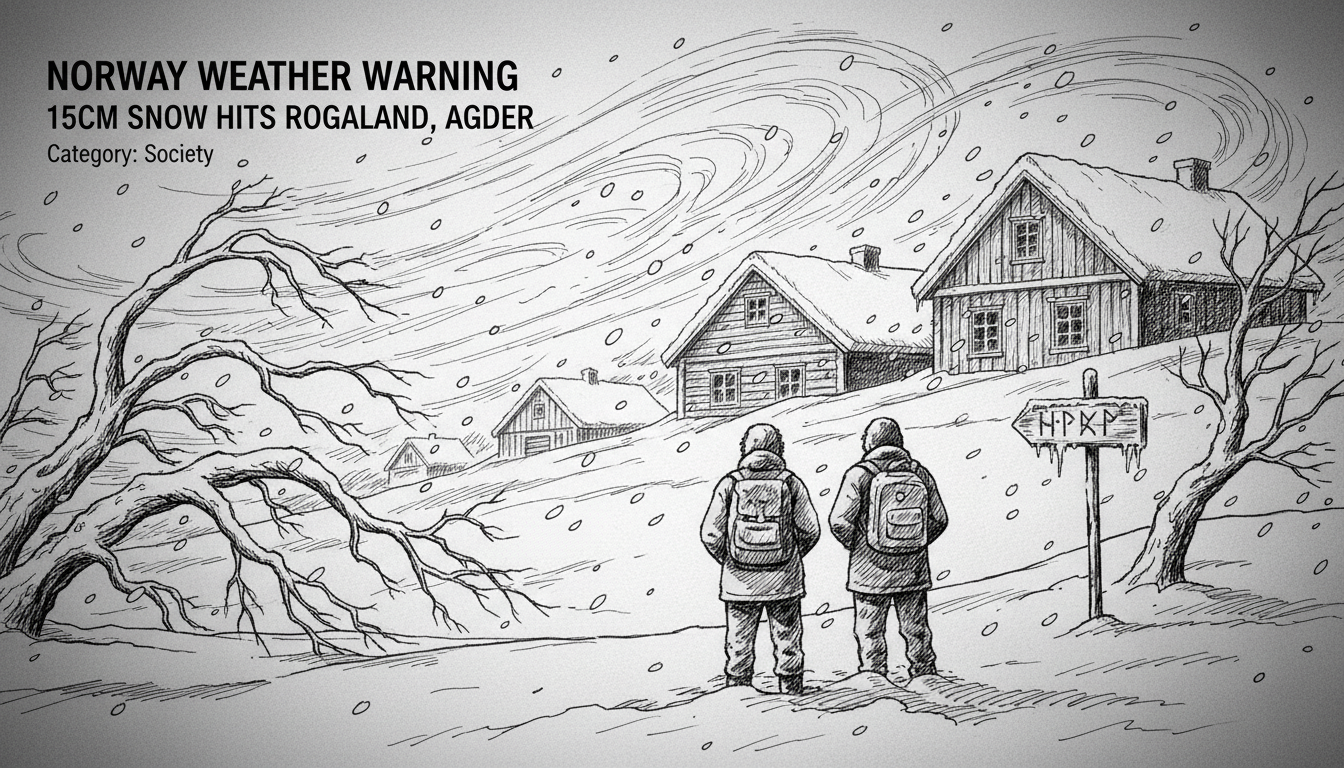
Norway weather warnings have been issued for three southern counties as a significant spring snowfall event moves inland from the North Sea. The Norwegian Meteorological Institute has activated a yellow-level danger warning for Rogaland, Agder, and Sunnhordland, forecasting between 5 to 15 centimeters of fresh snow on Monday. Coastal areas are expected to bear the brunt of the system, with meteorologists advising the public to prepare for major travel disruptions and hazardous road conditions.
This late-season snow highlights the persistent volatility of Norway's coastal climate, even as the country transitions toward spring. The warning system, a critical tool for public safety, triggers coordinated responses from the Norwegian Public Roads Administration and local emergency services. For residents, the immediate impact will be felt during the Monday morning commute, with authorities urging drivers to adjust their plans.
A Yellow Warning's Practical Meaning
A 'gult farevarsel' represents a moderate risk level in Norway's three-tiered system. It signals conditions that are potentially hazardous to the general public and require heightened awareness. "A yellow warning is not an advisory to cancel plans, but a clear signal to prepare," explained a meteorologist from the institute. "It means the weather will cause local disruptions and require extra caution, particularly for road users."
The institute's forecast calls for the heaviest accumulation in 'ytre strøk,' or outer coastal districts. These areas, exposed to moist airflows from the sea, often experience more intense precipitation. Snowfall amounts will taper off further inland. The timing of the event, beginning overnight Sunday into Monday, is designed to give citizens and municipal road crews sufficient notice to prepare.
Transport Networks Brace for Impact
The primary consequence of the yellow warning will be felt across southern Norway's transportation infrastructure. The Norwegian Public Roads Administration (Statens vegvesen) typically issues its own guidance coinciding with meteorological warnings. Drivers are advised to equip vehicles with winter tires, which are legally required in Norway until Easter in most regions, and to reduce speed significantly on snow-covered roads.
"Allowing extra travel time is not just a suggestion; it's a necessity for safety," a road administration spokesperson said. "Sudden snow showers can reduce visibility to near-zero in minutes, and roads can become slippery very quickly." Public transport operators in Stavanger, Kristiansand, and surrounding municipalities are preparing for potential delays and cancellations on bus and regional train lines.
Aviation is also likely to see disruptions. Sola Airport in Stavanger and Kjevik Airport in Kristiansand may experience delays or cancellations due to reduced visibility and the need for intensified runway de-icing procedures. Travelers are advised to check with their airline for the latest flight information before departing for the airport.
The Science Behind a Spring Snowfall
While April often brings milder temperatures to southern Norway, snowfall at this time of year is not uncommon. The phenomenon is driven by the clash between lingering cold air masses over the Scandinavian interior and relatively warmer, moisture-laden air from the Atlantic. When these systems meet along the coast, they can produce significant precipitation that falls as snow, even at lower elevations.
"This event is a classic example of coastal dynamic cooling," the meteorologist noted. "As the moist maritime air is forced to rise over the coastline and colder land air, it condenses and precipitates. With temperatures at the surface near or below freezing, that precipitation falls as snow." The complex topography of the Norwegian coast, with its deep fjords and valleys, can further intensify these localized weather events.
Climate data shows that while average winter temperatures are rising, the frequency of intense, wet snowfall events in transitional seasons may be increasing in some parts of coastal Norway. This presents a distinct challenge for infrastructure and emergency planning, requiring adaptability to both warmer trends and sudden, severe cold snaps.
Municipal Response and Public Preparedness
Local authorities in the warned regions have activated their winter weather contingency plans. This includes pre-positioning snowplows and salting trucks on key arterial routes and near critical infrastructure like hospitals and emergency service stations. Municipalities also monitor vulnerable groups, such as the elderly living alone, to ensure they have necessary supplies and support.
For the public, preparedness involves practical steps. Beyond travel adjustments, Norwegians are accustomed to ensuring they have adequate supplies at home to weather a short-term disruption. This cultural readiness is a key component of national resilience. The Directorate for Civil Protection (DSB) routinely advises households to have a basic emergency kit, a recommendation that takes on immediate relevance during a formal weather warning.
Schools and workplaces typically remain open during a yellow warning, but individual institutions may make localized decisions based on actual conditions Monday morning. Parents are advised to check for any notifications from their children's schools.
Economic Ripple Effects
Even a moderate weather event like this carries an economic cost. The immediate impact falls on logistics and transportation companies facing delays. Local commerce can also suffer if consumers choose to stay home rather than venture out in poor conditions. For the crucial offshore energy sector centered in Stavanger, the weather is closely monitored, though operations in the North Sea are generally less affected by coastal snow than by offshore winds and waves.
The event serves as a reminder of the ongoing operational challenges posed by Norway's climate, even for a society expertly adapted to winter. It tests the real-time coordination between the Meteorological Institute, the Road Administration, and local emergency managers—a system refined over decades.
A Test of Seasonal Transition
This late snowfall is a fitting test for a region in seasonal flux. As daylight rapidly increases and temperatures slowly climb, such events are a potent reminder that winter retains a firm grip on the Norwegian coast well into spring. It challenges the public's switch to a spring mindset, requiring a temporary but swift return to winter habits and vigilance.
The true measure of the system's effectiveness will be seen Monday morning in traffic accident reports, public transport punctuality, and the smoothness of the societal response. For now, the warning stands: a yellow alert on the map, a call for caution, and a testament to the ever-present dialogue between Norwegians and their formidable, beautiful, and unpredictable weather. Will this be a routine spring disruption, or will this coastal snow demonstrate the enduring power of a Norwegian winter to command the nation's attention?