
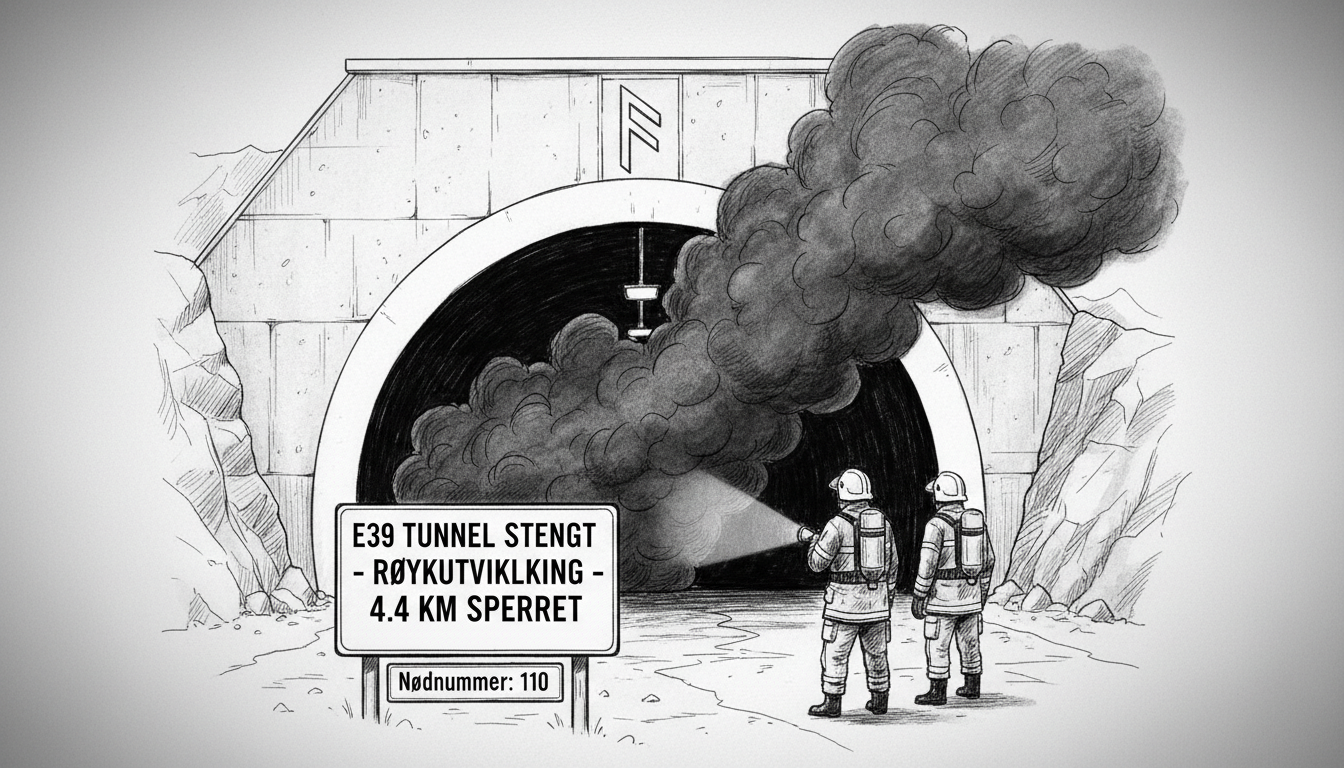
Norway's critical E39 coastal highway faced major disruption today after a bus broke down inside the 4.4-kilometer Mastrafjord Tunnel near Stavanger. The incident, initially reported as a vehicle fire, led to a full closure of the tunnel in both directions as emergency services responded to significant smoke development. Police confirmed the bus had suffered a mechanical failure causing it to emit smoke, not an open fire. The tunnel has since reopened to traffic.
A Critical Artery Temporarily Severed
The closure of the Mastrafjord Tunnel, even for a few hours, underscores the vulnerability of Norway's transport network to single-point failures. The E39 highway is the main road connecting the southwestern city of Stavanger, Norway's energy capital, to the rest of the country. This route is vital for commuters, freight, and the offshore oil and gas industry. Tunnels like Mastrafjord are engineering necessities in a nation defined by fjords and mountains, but they also create unique safety and logistical challenges. Any incident inside them triggers an immediate and comprehensive response protocol.
“It was a bus that broke down inside the tunnel. It was not a fire. It is a bus that smoked, and a new bus is on the way,” said Police Operations Manager John Ask, clarifying the situation for the public. This distinction between smoke and fire is crucial for emergency response but matters little to stranded motorists. The immediate action was a full closure to prevent any risk of smoke inhalation or a potential escalation.
Tunnel Safety: A Norwegian Priority
Norwegian authorities treat tunnel incidents with extreme seriousness. The country has one of the world's most advanced sets of tunnel safety regulations, developed over decades of experience with long, deep, and complex subsea and mountain passages. When sensors detect smoke or fire, or when an emergency call is placed, standard procedure mandates closure, ventilation control, and guided evacuation if necessary. The primary goals are to save lives, protect the tunnel structure, and prevent secondary accidents.
“Incidents involving smoke in a confined space like a tunnel are treated as high-risk until proven otherwise,” explains a former director of the Norwegian Public Roads Administration, speaking on condition of anonymity due to their current role. “The potential for rapid visibility loss and toxic fume buildup means the default is always to clear the tube. The economic cost of a closure, while significant, is never the primary factor.”
This incident, though resolved without injury, serves as a live drill for the Rogaland police, fire department, and road authorities. It tests communication, coordination, and the effectiveness of public alert systems. For travelers, it is a stark reminder of the inherent risks of long tunnel transits, risks that Norwegian engineering and regulation work constantly to mitigate.
The Economic Ripple Effect
Beyond the immediate inconvenience for drivers, a closure on the E39 has tangible economic consequences. Stavanger is the operational hub for Norway's continental shelf activities. While major supply bases have alternative logistics routes, time-sensitive personnel transfers and equipment movements can be delayed. The region's tourism and general commerce also feel the impact when a main road is severed.
Traffic is typically diverted onto lengthy alternative routes around the fjord, adding hours to journey times. This increases fuel consumption, delivery delays, and frustration. For the haulage industry, such delays translate directly into increased costs. The Norwegian Public Roads Administration continuously models the economic impact of road closures to prioritize maintenance and improvements, with tunnels on the E39 consistently ranking high on the list of critical infrastructure.
A History of Engineering and Incident
The Mastrafjord Tunnel is part of a fixed link that replaced a ferry connection, a common story in Norway's ongoing quest to replace slow ferries with bridges and tunnels. Opened in 1992, it was a significant improvement in travel time and reliability. However, its 4.4-kilometer length means that any vehicle stopping inside it becomes a major problem. Today's event involved a bus, but past incidents in Norwegian tunnels have involved everything from truck fires to dangerous goods spills, each one leading to a review and potential tightening of safety rules.
Norway's most severe tunnel fire, the 2013 Gudvanga Tunnel incident, involved a truck fire that led to a massive explosion and a thirteen-day closure. That tragedy directly influenced national safety standards, including stricter rules on heavy goods vehicle inspections and the installation of more robust emergency systems. Every minor incident today is managed with the lessons of such past events in mind.
Looking Ahead: Resilience and Redundancy
Today's swift resolution highlights effective emergency response, but it also points to a systemic weakness: a lack of redundancy. Many of Norway's key road links, especially in the fjord-rich west, rely on single tunnels without parallel escape routes. The government's ambitious "Ferry-Free E39" project aims to replace all remaining ferry crossings on the route with bridges or tunnels by 2050. This project inherently considers building twin-tube tunnels for major crossings, which would allow one tube to remain open if the other is closed.
Until such mega-projects are complete, the nation remains dependent on the integrity and safety of single passages like the Mastrafjord Tunnel. Investment in next-generation tunnel safety—better fire suppression systems, enhanced real-time monitoring with AI for early anomaly detection, and improved evacuation signage—continues to be a budget priority in transport committees within the Storting, Norway's parliament.
The smoke in the Mastrafjord Tunnel has cleared and traffic flows again. For the passengers on the stricken bus, it was a frightening halt in a dark tube. For Norway's transport planners, it is another data point in the endless calculation of risk, safety, and connectivity in a nation where geography demands extraordinary engineering. The question remains: as traffic volumes increase, is building more single-point critical infrastructure the right path, or does the future require a more resilient, redundant network? The answer will shape Norway's western landscape for the next century.