
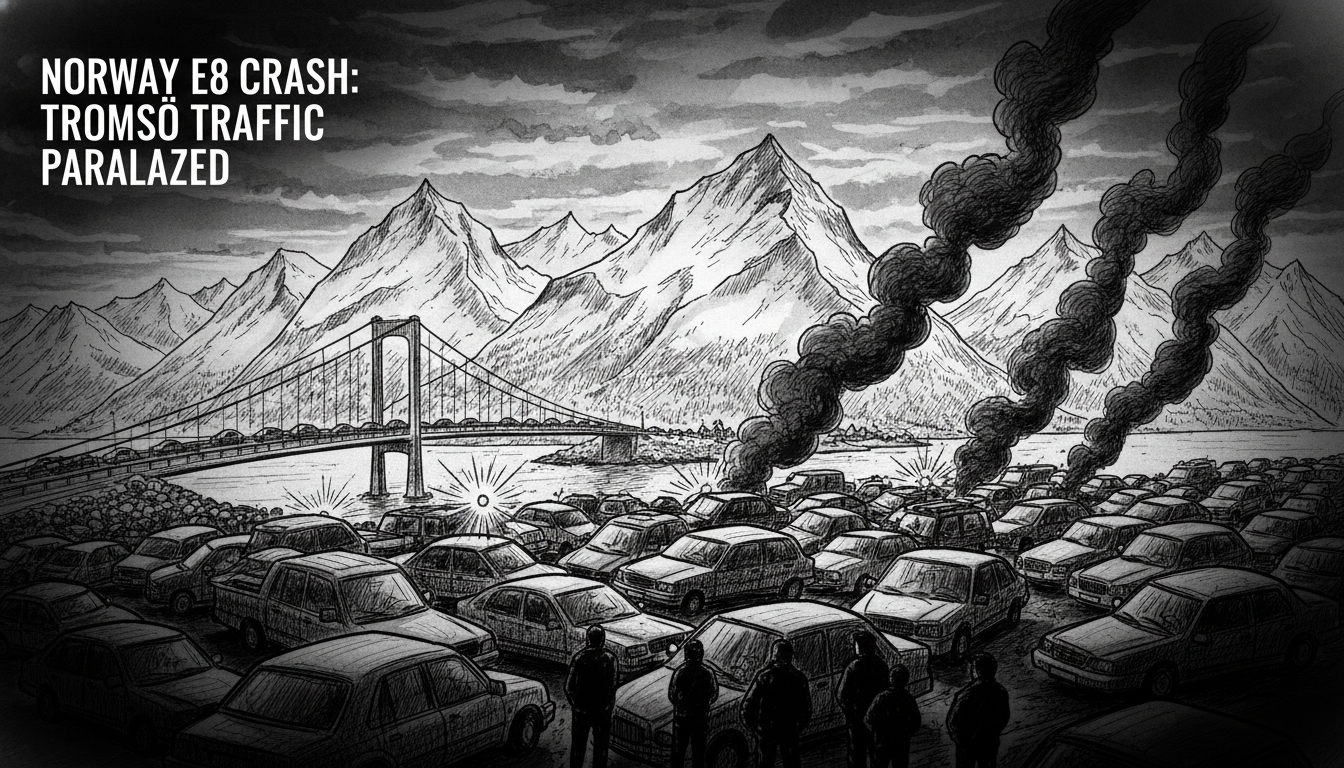
Norway's E8 highway crash near Tromsø on Friday afternoon caused major traffic paralysis on the region's vital northern artery. Two cars carrying six people collided in Ramfjord, approximately 20 kilometers south of the city. Police confirmed no one was seriously injured, with all involved receiving care from ambulance personnel on site. The incident forced the complete closure of the main access road to Tromsø, creating extensive queues and disrupting travel for hours during a busy afternoon period.
This single accident underscored the fragility of transport infrastructure in Norway's Arctic north. The E8 is not merely a local road; it is part of the European route E8 system, a critical transnational corridor connecting Norway with Finland and Russia. For Tromsø, the largest urban area in Northern Norway with a population exceeding 77,000, the highway is an indispensable lifeline for commuters, commercial goods, and tourism.
A Vital Artery Severed
The closure had immediate and widespread effects. The E8 serves as the primary southern gateway to Tromsø, a city situated on an island. With the bridge across the Tromsøysundet being the only other major access point, the Ramfjord blockage effectively cut off a major approach. Traffic backed up for kilometers, stranding motorists and delaying freight. Local bus routes were rerouted or canceled, impacting public transport across the municipality.
“When the E8 closes, the entire region feels it,” said a spokesperson for the Norwegian Public Roads Administration in a statement to Nordics Today. “Our priority is always safety first—ensuring the crash scene is cleared properly and investigating the cause. But we are acutely aware of the knock-on effects for a city like Tromsø.” The geography of the region, with its fjords and limited road networks, means there are few practical alternative routes for heavy traffic.
The Persistent Challenge of Arctic Roads
While this crash resulted in no serious injuries, it highlights the ongoing safety challenges on Norway’s northern highways. The E8 in this region traverses demanding terrain alongside the Ramfjorden. Weather conditions can change rapidly, with ice, snow, and poor visibility common for much of the year. These factors, combined with high speeds on certain stretches, contribute to accident risk.
Norway is a global leader in road safety through its Vision Zero policy, which aims to eliminate all traffic fatalities and serious injuries. The country has one of the world's lowest rates of road deaths. Yet, the ambition faces a stern test on roads like the E8. In 2023, the broader Troms og Finnmark county, where Tromsø is located, recorded three fatal traffic accidents. While low by international standards, each is a tragedy and every non-fatal crash a warning.
“Vision Zero is about system design,” explains Lars Tennebo, a traffic safety researcher at the University of Tromsø. “On these key Arctic routes, it means continuous investment: better road grading, consistent and aggressive winter maintenance, dynamic speed limits that adjust for conditions, and physical barriers. The margin for error is smaller when you’re driving next to a fjord.”
Economic and Logistical Ripple Effects
The economic impact of such closures, though temporary, is significant. Tromsø is a hub for fisheries, Arctic research, and tourism. Delays in logistics chains can affect fresh seafood exports and the supply of goods to stores. The tourism industry, particularly in seasons for the Northern Lights or the Midnight Sun, relies on predictable access. Tour buses and rental car traffic were caught in Friday’s gridlock.
Furthermore, Tromsø serves as a regional hospital center for Northern Norway. The University Hospital of North Norway (UNN) is the largest such facility in the region. While emergency services have protocols for road closures, a prolonged shutdown of a main artery could complicate patient transfers and staff commutes in a critical situation.
Local politicians have long advocated for increased investment in northern infrastructure. This incident provides fresh ammunition for those arguments. “It shows our vulnerability,” said a member of the Storting’s transport committee from the region. “We talk about developing the North, about green industry and Arctic opportunity. That requires resilient infrastructure. A single crash cannot be allowed to bring traffic to a standstill for hours. We must look at capacity and redundancy.”
The Path Forward: Safety vs. Connectivity
The response to Friday’s crash involved a coordinated effort from police, road authorities, and medical services. Their swift work prevented injuries from being more serious and eventually reopened the road. However, the event will likely reignite debates on long-term solutions.
Proposals often include more frequent safety upgrades to existing stretches of the E8, enhanced avalanche and rockfall protection in mountainous sections, and improved real-time traffic information systems. Some planners even discuss the long-term possibility of additional fixed links or tunnels to create alternative routes, though such projects carry enormous cost.
The core tension is balancing the imperative of absolute safety with the practical need for reliable, efficient connectivity in a sparsely populated but economically vital region. Norway’s commitment to Vision Zero is unwavering, but achieving it on every kilometer of challenging Arctic highway is a continuous, resource-intensive endeavor.
Friday’ crash in Ramfjord was a routine incident with a fortunate outcome regarding injuries. Yet its disruptive power was far from routine. It served as a stark reminder that in the Norwegian North, the road is more than pavement; it is a fragile thread tethering communities to each other and to the wider world. As traffic finally began to flow again into Tromsø, the question lingered: How does a nation committed to zero road deaths fortify its essential northern lifelines against the unpredictable realities of weather, geography, and human error? The answer will require continued political will and significant investment, ensuring the path to the Arctic capital is both safe and secure.