
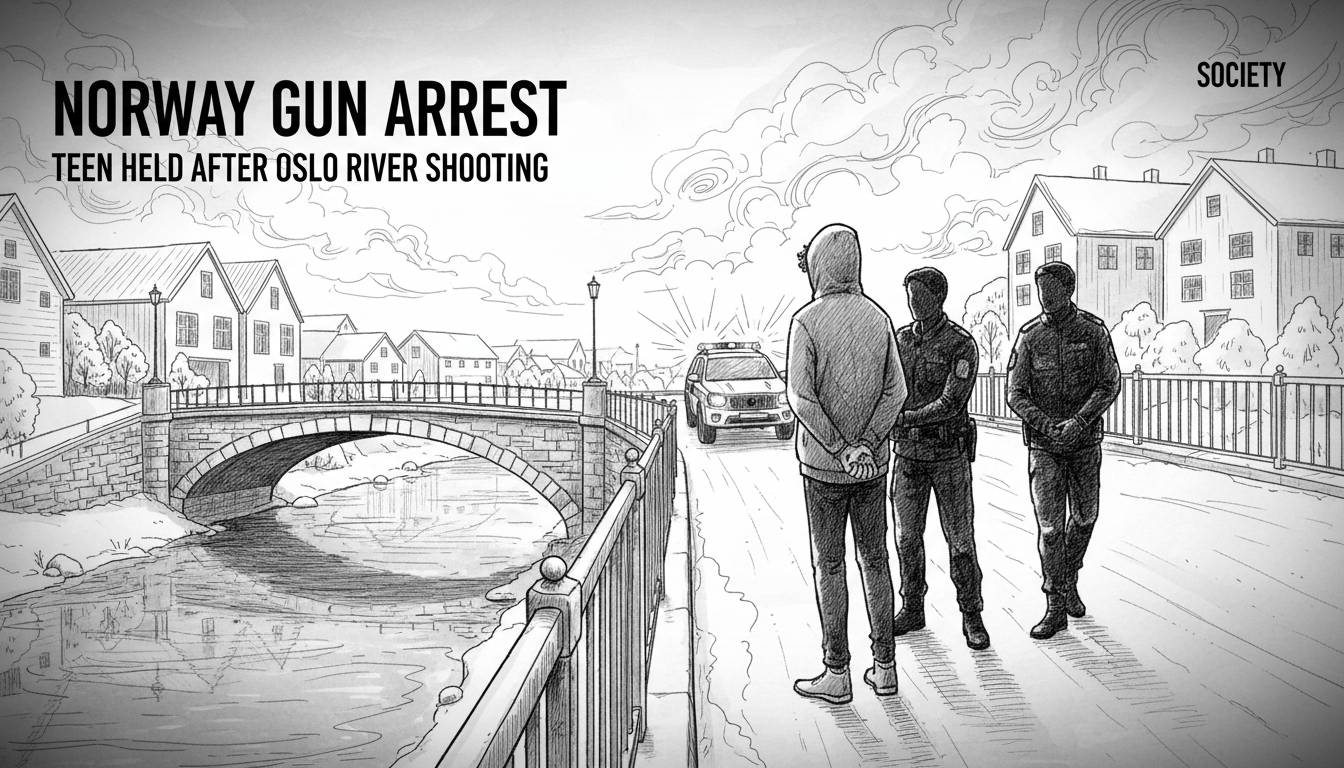
Norway's strict gun control laws faced a stark test early Sunday when police arrested a teenager for firing a live handgun into the Akerselva river in central Oslo. The incident, which occurred in the popular Grünerløkka district, resulted in no injuries but prompted a significant police response and has reignited discussions about firearm safety in one of Europe's most peaceful nations.
Oslo police district reported hearing loud bangs near the upper part of the river shortly after midnight. Officers quickly located three individuals further downstream. "One of these had a live handgun," police stated in a log update at 3:13 AM. The arrested individual, a man in his late teens, is directly linked to discharging the weapon into the waterway. He was taken into custody and the firearm was seized. Authorities confirmed no one was threatened or shot at during the incident.
A Peaceful Capital Confronts Gunfire
The sound of gunshots along the Akerselva, a river lined with parks, cafes, and cycling paths, is profoundly unusual for Oslo. The city consistently ranks among the world's safest capitals, with violent crime rates far below those of major European and North American cities. This shooting, though isolated and non-injurious, disrupts the normative sense of public security. It occurred in a vibrant, gentrified area known more for its nightlife and cultural venues than for criminal activity.
Police have not released a motive for the shooting. The investigation will focus on how the teenager obtained the weapon and his intentions. The immediate arrest and seizure highlight Norway's proactive policing protocols when firearms are involved. "The individual is connected to the use of the weapon by having fired shots into the Akerselva," police wrote, establishing the direct link for the arrest.
Norway's Framework of Firearm Control
This incident unfolds against the backdrop of Norway's rigorous gun legislation. Ownership is not a right but a privilege granted for specific purposes. To legally possess a firearm, a Norwegian citizen must demonstrate a "valid reason," such as hunting, sport shooting, or professional necessity like farming. Self-defense is not considered a valid reason for gun ownership.
Applicants undergo comprehensive background checks performed by police, who assess mental fitness, criminal history, and overall suitability. They must also complete mandatory safety training courses. Licenses are granted for specific firearms, and all guns must be registered with the authorities. Police maintain broad discretionary power to deny or revoke licenses if an individual is deemed unfit, a system that emphasizes prevention over reaction.
These controls contribute to Norway's low rate of firearm-related homicide. In 2022, the country of 5.4 million people recorded 32 homicides total; only a fraction involved guns. This contrasts sharply with the United States, where firearm homicides occur at a rate nearly 50 times higher per capita.
The Statistical Reality of Guns in Norway
Despite strict laws, Norway has a significant number of legally owned firearms, a fact often surprising to outsiders. The 2017 Small Arms Survey estimated 28.8 firearms per 100 residents, placing Norway in the top 15 countries globally for civilian gun ownership. This high density is primarily driven by the country's deep-rooted hunting and sport shooting traditions, particularly in rural areas.
This creates a complex picture: widespread legal ownership within a tightly regulated system that yields very low rates of gun violence. The vast majority of these firearms are long guns used for hunting. Handguns, like the one used in the Oslo incident, are more tightly controlled, typically restricted to certified sport shooters who must be active members of approved clubs.
The presence of an illegal handgun in Oslo, therefore, represents a breach of multiple control layers. It immediately raises questions about black market sources, possible theft from legal owners, or smuggling across borders.
Expert Analysis: System Stress Test
Criminologists view such incidents as stress tests for Norway's societal and legal frameworks. "The system is designed to be robust, but no system is perfect," says a researcher at the University of Oslo's Department of Criminology, who spoke on background. "The effectiveness is shown in the immediate police response and the rarity of such events. The concern always lies in the illegal market and the potential for weapons to fall into the wrong hands."
Experts emphasize that Norway's approach integrates gun control with strong social welfare and mental health support systems, aiming to address potential root causes of violence. The focus on early intervention and a generally high level of social trust are seen as complementary pillars to legislative measures.
"This appears to be an isolated, reckless act rather than a targeted attack," the criminologist added, analyzing the known facts. "The real investigation now is into the provenance of the weapon. That will tell us more about potential vulnerabilities than the act itself."
Oslo's Crime Landscape in Context
Oslo's overall crime rate remains low. The city has experienced challenges with gang-related activity, particularly in certain eastern suburbs, but these rarely involve random shootings in central recreational areas. Violent crime is more often linked to personal disputes or organized crime conflicts, not random discharges in public spaces.
The Grünerløkka shooting is anomalous. It does not fit typical patterns for the city, which makes the police investigation crucial for understanding whether it was a one-off event or indicative of a new, worrying trend. Police statistics show that the clearance rate for serious crimes in Norway is high, often above 70%, suggesting a strong likelihood of a comprehensive investigation outcome.
Legal Consequences and Next Steps
The late-teen suspect faces serious charges. Under Norwegian law, the illegal possession of a firearm, especially its discharge in a public place, carries a potential prison sentence. The specific charges will depend on the prosecutor's assessment of intent and circumstances. Given his age, the judicial process will consider rehabilitation alongside punishment.
The police investigation will have two parallel tracks: establishing the full details of the night's events and conducting a forensic trace on the seized weapon. The latter involves checking ballistics against national and international databases to see if the gun has been used in other crimes and tracing its manufacturing and sales history to determine how it entered illegal circulation.
A Nation's Reflexive Response
Initial public and political reaction has been measured, reflecting confidence in institutions. There is no widespread panic or immediate calls for sweeping legal changes, as might occur in other nations. Instead, there is an expectation that the existing system will function as intended: police investigate, the judiciary prosecutes, and policymakers will examine if any procedural gaps were exposed.
This calm response is itself a product of Norway's high institutional trust and the historical effectiveness of its public safety policies. The shadow of the 2011 attacks by Anders Behring Breivik, who used legally owned weapons in a politically motivated massacre, remains long. That tragedy led to a further tightening of gun laws, particularly around semi-automatic rifles, and reinforced a national consensus on strict control.
Sunday's event is of a completely different scale and nature, but it touches the same nerve regarding weapons in public spaces. It serves as a reminder that absolute safety is unattainable, but also that Norway's multifaceted approach—combining restrictive laws, proactive policing, and social investment—has created one of the world's most effective barriers against gun violence. The coming days will reveal not just what happened by the Akerselva, but how a society built on trust responds when that peace is briefly fractured.