
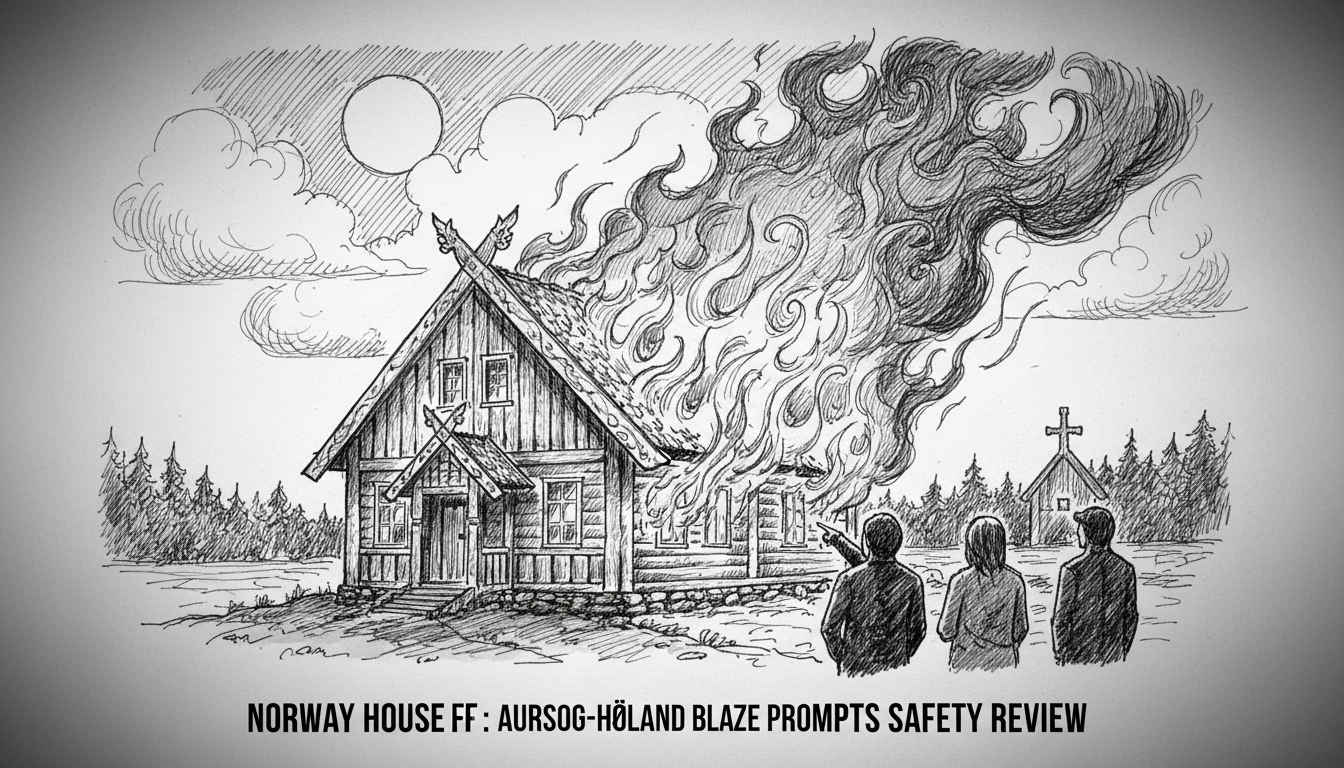
Norway's emergency services rushed to a residential fire in Aurskog-Høland on Tuesday after dispatchers received reports of open flames in a kitchen. The incident has ignited a broader discussion about fire safety in Norway's expanding commuter belt.
"We have observed open flames in the kitchen," said Petter Thon, a shift leader at the Eastern Norway 110 emergency dispatch center. Initial reports indicated it was unclear if anyone was inside the single-family home at the time of the alarm. Fire crews from the local municipality, supported by neighboring districts, responded to the scene in the rural area northeast of Oslo.
The quick containment of the fire prevented a total loss, but the kitchen sustained significant damage. No injuries were reported, a fact authorities attributed to the early alarm and rapid response. The cause of the blaze remains under investigation by local fire inspectors.
A Community on Edge
Aurskog-Høland, with a population of roughly 17,500, represents a growing trend in Norwegian housing. More families are moving to such municipalities for more affordable property and green space, while maintaining jobs in Oslo. This shift places different demands on emergency infrastructure originally designed for lower-density rural living.
"Every fire is a stark reminder," said Lars Holen, a fire safety consultant with over twenty years of experience. "In these areas, homes are often older wooden structures, spread out, and response times, while good, are longer than in a city. Prevention is not just a recommendation; it is an absolute necessity."
Holen emphasized that the most common causes of residential fires across Norway are electrical faults and issues with heating appliances like wood stoves. Older homes, which are prevalent in municipalities like Aurskog-Høland, can have outdated wiring that struggles with modern electrical loads from numerous devices.
The Statistics Behind the Smoke
While Norway has a strong reputation for safety, fire remains a persistent domestic threat. The country records approximately 4,000 structural fires annually. A significant portion of these are in residential buildings. The Directorate for Civil Protection (DSB) consistently reports that working smoke detectors are the single most effective factor in preventing fatalities.
"The number one thing we see in fatal fires is missing or non-functional smoke alarms," a DSB spokesperson said in a recent briefing. "It sounds simple, but checking them monthly and replacing batteries is a habit that saves lives."
The response architecture is robust. The Øst 110-sentralen, which handled this call, coordinates fire, ambulance, and rescue services for all of Eastern Norway. Their decentralized model aims to get the nearest appropriate unit to any incident as fast as possible, a system that proved effective in this case.
The Rural Firefighting Challenge
Fighting a fire in Aurskog-Høland presents different challenges than in urban Oslo. Properties can be set back from roads, have long driveways, and may rely on private wells rather than public hydrants. This requires fire trucks to carry more water and can complicate initial attack efforts.
"Our crews train for these scenarios," said Kari Moe, a regional fire chief in Akershus. "We have tanker trucks and establish water shuttle operations from lakes or streams if needed. The cooperation between volunteer and professional brigades in these districts is excellent, but distance is always a factor we battle against."
This incident will likely lead to a local review of access roads and water supply points near residential clusters. Municipal planners are increasingly considering fire service access when approving new housing developments in previously undeveloped areas.
A National Conversation on Prevention
Beyond the immediate response, the fire prompts a wider policy discussion. The Norwegian government has recently proposed stricter building codes for new homes, mandating more fire-resistant materials and compartmentalization to slow a fire's spread. For existing homes, a national campaign promoting fire extinguishers and fire blankets, alongside smoke detectors, is gaining traction.
Insurance companies also play a role. Companies like Gjensidige and Tryg offer premium discounts for homes with installed sprinkler systems or verified, updated electrical systems. For many homeowners, this financial incentive is a powerful motivator to invest in safety upgrades.
"After something like this happens in your community, you look at your own house differently," said Anna Berger, a resident of a neighboring village. "You check the date on your smoke alarm, you look at the cord behind the television. It’s a wake-up call that safety is something you actively maintain."
Looking Ahead: Safety in a Changing Landscape
The Aurskog-Høland fire, though successfully managed, underscores a national reality. As Norway's population distribution changes and homes age, a proactive approach to fire safety must evolve. Experts argue for regular, mandatory electrical inspections for older homes, similar to vehicle checks, and greater public funding for updating the housing stock's safety features.
The investigation into this specific fire will determine the precise cause. Whether it was an electrical fault, a cooking accident, or a heating appliance issue, the result will be added to the national data set that shapes future safety regulations and public awareness campaigns.
For now, the community is relieved there were no injuries. The incident serves as a potent, real-world reminder of a simple truth repeated by fire services across the Nordic region: a fire prevention plan is as essential as a fire response plan. In the quiet, wooded municipalities circling Oslo, where urban comforts meet rural life, that vigilance must be constant.