
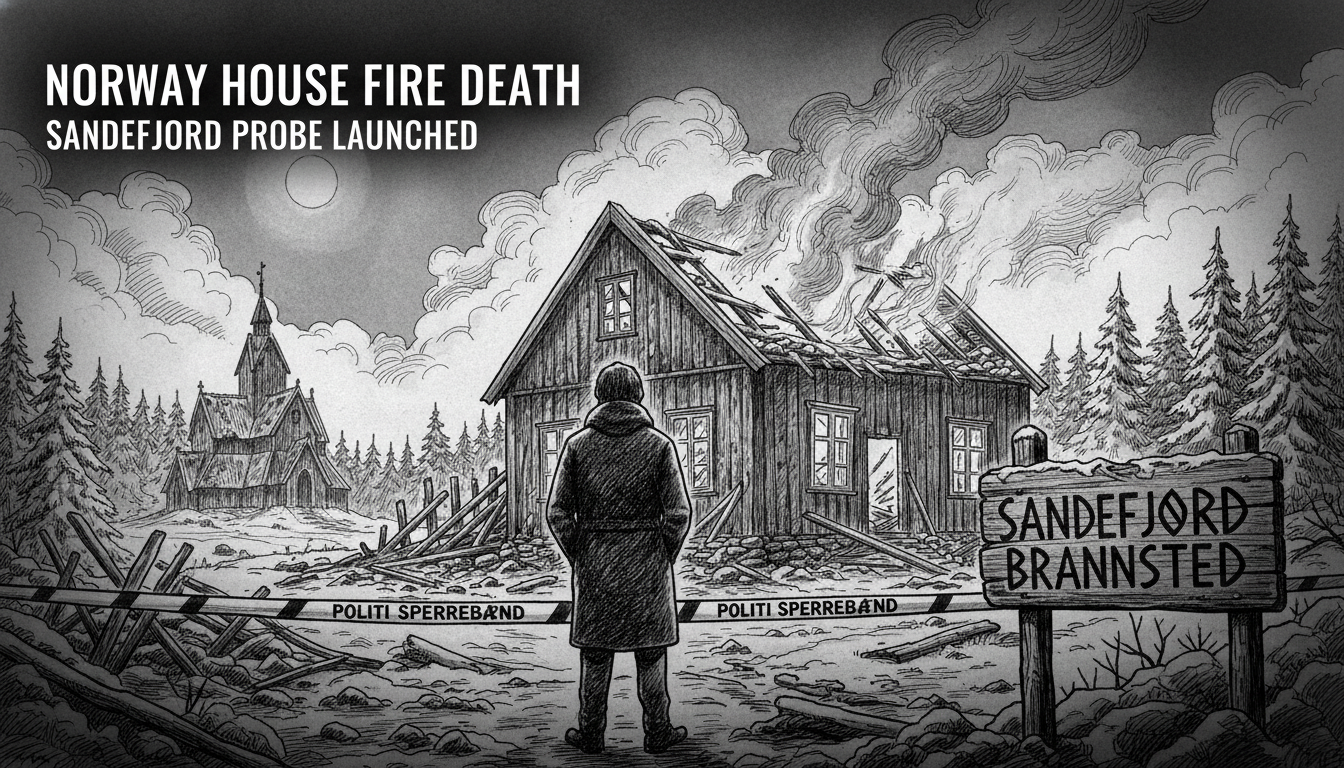
Norway's emergency services responded to a fatal house fire in Sandefjord early Saturday morning, discovering one person dead after the blaze completely destroyed a detached wooden home. Police were alerted to the fire at 03:31 and have launched a full investigation, with forensic technicians examining the scene throughout the afternoon. The victim's next of kin have been notified, but authorities have not released the cause of the fire or the identity of the deceased.
A Tragic Discovery in Vestfold
The fire occurred in a residential area of Sandefjord, a coastal city in Vestfold county famed for its maritime heritage and summer tourism. The specific neighborhood has not been disclosed by police, who are treating the site as an active investigation. Initial reports confirm the structure was a single-family wooden house, known locally as an 'enebolig.' Such buildings are common across Norway but present unique fire safety challenges due to construction materials. The speed and intensity of the fire left the home a total loss, complicating the initial stages of the investigation.
Fire crews from Sandefjord Fire and Rescue Service arrived quickly but faced a fully involved structure upon arrival. Their primary efforts shifted from rescue to containment, preventing the fire from spreading to nearby properties. The early morning timing, when most residents are asleep, is a critical factor being examined by investigators. This tragedy immediately raises questions about detection and early warning systems in the home.
The Investigation and Unanswered Questions
Police have stated the cause is unknown and are pursuing all lines of inquiry. 'The investigation is ongoing, and we are working to clarify the course of events,' a police representative said in a statement. This process involves meticulously sifting through the debris to locate the fire's origin point. Forensic technicians, often referred to as kriminalteknikere, are searching for electrical faults, signs of accelerants, or other evidence that could explain how the fire started.
A key part of the investigation will be determining whether the fire was accidental or criminal. While most residential fires in Norway are accidental, stemming from electrical issues, cooking, or heating appliances, police must rule out foul play. The complete destruction of the property makes this forensic work particularly difficult. Investigators will also look into the building's age, recent renovation work, and the functionality of any installed smoke alarms.
'The first minutes are decisive in a house fire, especially in older wooden buildings,' said a fire safety expert consulted for this analysis. 'Modern smoke detectors provide that crucial early warning. In a total loss scenario like this, establishing whether detectors were present and operational is a priority for investigators.' Norwegian building codes have required interconnected smoke alarms in all homes since 2010, but compliance in older homes can be inconsistent.
Wooden Homes and Norway's Fire Safety Challenge
This incident highlights an enduring safety tension in Norwegian housing. The country has a deep cultural and practical affinity for wood as a primary building material. It is sustainable, readily available, and provides excellent insulation against the cold climate. However, timber-frame houses are inherently more vulnerable to rapid fire spread compared to concrete or brick structures. Once a fire takes hold in a wooden home, it can reach a fully developed stage in a matter of minutes, severely limiting escape time.
National statistics show that while fire fatalities in Norway are relatively low, a significant proportion occur in residential settings, often in older wooden dwellings. This has led to continuous updates to building regulations and public safety campaigns. The focus has been on prevention through electrical system standards, heater safety, and mandatory smoke alarms. For existing homes, especially those built before stricter codes, retrofitting and homeowner awareness are constant challenges for municipal safety officials.
Sandefjord itself, like many Norwegian towns, features picturesque neighborhoods of traditional and modern wooden homes. The city's architecture is a point of local pride but also a collective responsibility for fire safety. Community fire departments regularly conduct outreach, but tragedies such as this weekend's fire underscore the persistent risk.
Community Impact and the Path Forward
The death has undoubtedly sent shockwaves through the local community in Sandefjord. The police practice of notifying next of kin before releasing any victim details is a standard but deeply respectful protocol in Norway. It ensures families are informed privately during a traumatic time. This silence from authorities, while procedurally correct, often leaves a community in a state of anxious waiting, wondering about the fate of a neighbor or friend.
Local officials and crisis response teams will likely offer support to affected residents and the victim's family. The sight of a completely burned-out home in a residential street is a stark and unsettling reminder of vulnerability. It prompts neighbors to check their own smoke alarms and discuss family escape plans—a small but meaningful response to a shared loss.
From a policy perspective, every fatal fire is analyzed for lessons that could strengthen national safety standards. Investigators' findings from Sandefjord will be added to a national database used by the Directorate for Civil Protection (DSB) and the Norwegian Fire Protection Association. Their work informs future revisions to building codes, particularly for the existing housing stock that comprises most Norwegian homes.
The road ahead for the investigation is methodical. Police and fire experts will compile a detailed technical report. The coroner will work to formally identify the victim and determine the exact cause of death. This process can take weeks or even months before a final, public conclusion is reached. For now, a quiet street in Sandefjord bears the scars of a sudden, devastating loss, and a family begins the difficult process of mourning. The unanswered question of 'why' hangs heavily in the air, awaiting the careful, painstaking work of investigators sifting through the ashes.