
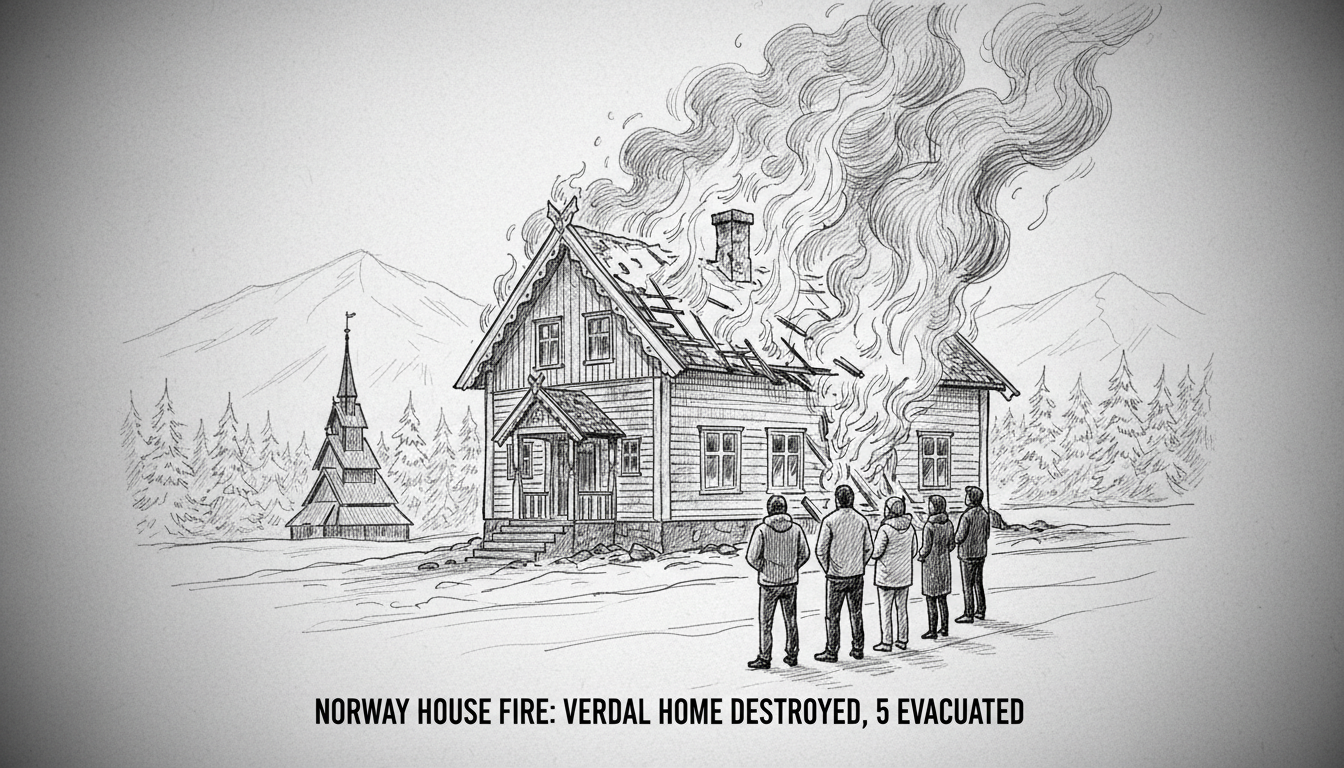
Norway house fire in the municipality of Verdal has completely destroyed a detached home and forced the evacuation of neighboring residents. The blaze, which erupted overnight into Wednesday, saw one man escape the burning structure before it was engulfed. Four people from an adjacent house were evacuated by emergency services and provided with alternative housing by the Verdal municipality, highlighting the rapid community response to such crises in rural Norway.
Flames lit up the early morning darkness in a residential area of Verdal, a community in Trøndelag county known for its rich agricultural lands and historical significance. Police operations leader Marie Fossen confirmed that firefighters were engaged in extensive mop-up operations by 5:30 AM. The cause of the fire remains unknown, and local police have opened an investigation. This incident underscores the persistent threat residential fires pose across Norway, where wooden construction is common.
A Community's Swift Response
The immediate evacuation of four neighbors demonstrates the precautionary measures Norwegian emergency services prioritize when faced with a significant structural fire. The Verdal municipality's quick action to secure alternative housing for those displaced is a standard but critical function of local government in such emergencies. It prevents secondary crises of homelessness and provides immediate stability for affected families. This system is a key part of Norway's civil preparedness framework, tested regularly in a country where isolated communities can be vulnerable.
Residents in surrounding homes likely experienced a terrifying night, with the intense heat and light of the blaze disrupting the quiet, rural area. The psychological impact on both the man who lost his home and his evacuated neighbors can be substantial, often requiring follow-up support from municipal health services. While the physical danger is contained once the fire is extinguished, the shock and disruption linger for weeks.
The Persistent Challenge of Residential Fires
This fire in Verdal is not an isolated incident. Norway experiences hundreds of serious residential fires each year, with detached homes (eneboliger) being particularly vulnerable. The prevalence of wood in construction, while sustainable and traditional, contributes to rapid fire spread if ignition occurs. Modern building codes mandate fire-resistant materials and compartmentalization, but older homes, which constitute a large portion of the housing stock, may not meet these updated standards.
Fire safety experts consistently emphasize the non-negotiable importance of working smoke detectors. Norwegian law requires them in all homes, and they are credited with saving countless lives by providing early warning. The fact that the sole occupant of the Verdal house escaped unharmed suggests alarms likely functioned as intended. However, total destruction of the property indicates the fire gained an overwhelming foothold quickly, possibly originating in an area like a workshop, garage, or attic where detection can be delayed.
“The speed at which a fire in a detached home can become uncontrollable is often underestimated,” a fire safety engineer with the Directorate for Civil Protection (DSB) explained, speaking on general principles. “Factors like wind, the volume of combustible materials in a modern home, and response time for rural fire brigades all play a role. Prevention through public awareness and adherence to safety codes is the first and most important line of defense.”
Investigation and Insurance Implications
The police investigation into the Verdal fire will seek to determine the origin and cause. Common sources include electrical faults, malfunctioning heating appliances, chimney fires, or cooking accidents. The process involves forensic examination of the scene, interviews with the occupant and witnesses, and review of any available technical data from the home. Determining a cause is crucial not only for closure but also for compiling national statistics that inform future safety regulations and public information campaigns.
For the homeowner, the path forward involves navigating the insurance process. Most Norwegian homeowners hold comprehensive coverage (innboforsikring and husforsikring) that typically includes fire damage. The classification of the home as “totally damaged” (totalskadd) means the insurance company will assess whether the cost of rebuilding exceeds the value of the salvagable structure, leading to a total payout. The process of settlement and potential rebuilding can take many months, adding to the displacement experienced by the affected individual.
Rural Preparedness and Climate Considerations
Verdal’s emergency response, while effective, operates within the constraints of a rural municipality. Fire stations are often staffed by a combination of professional and dedicated volunteer firefighters. Response times, while fast, are inherently longer than in dense urban centers like Oslo or Trondheim. This reality places a greater emphasis on individual preparedness and robust early-warning systems in homes. Municipalities like Verdal regularly conduct community drills and safety outreach to mitigate these geographical challenges.
Furthermore, experts are increasingly examining the potential link between climate change and fire risk, even in Norway’s temperate climate. Drier, warmer summers can increase the flammability of natural surroundings and create more favorable conditions for fires to start and spread. While this winter fire in Verdal is less likely to be directly climate-related, the broader trend is prompting a review of long-term risk assessments for residential areas near forests or fields.
The Verdal fire is a stark reminder that safety is a shared responsibility. It rests on individual vigilance, robust building standards, efficient emergency services, and a supportive social safety net. The community’s capacity to rally around those displaced—from the municipal housing officer to the local Red Cross—defines the recovery. As the investigation continues and the homeowner faces the daunting task of rebuilding, the silent, charred footprint of the house will stand as a testament to both sudden loss and the structured resilience of Norwegian society. How can other communities learn from this event to strengthen their own layers of protection?