
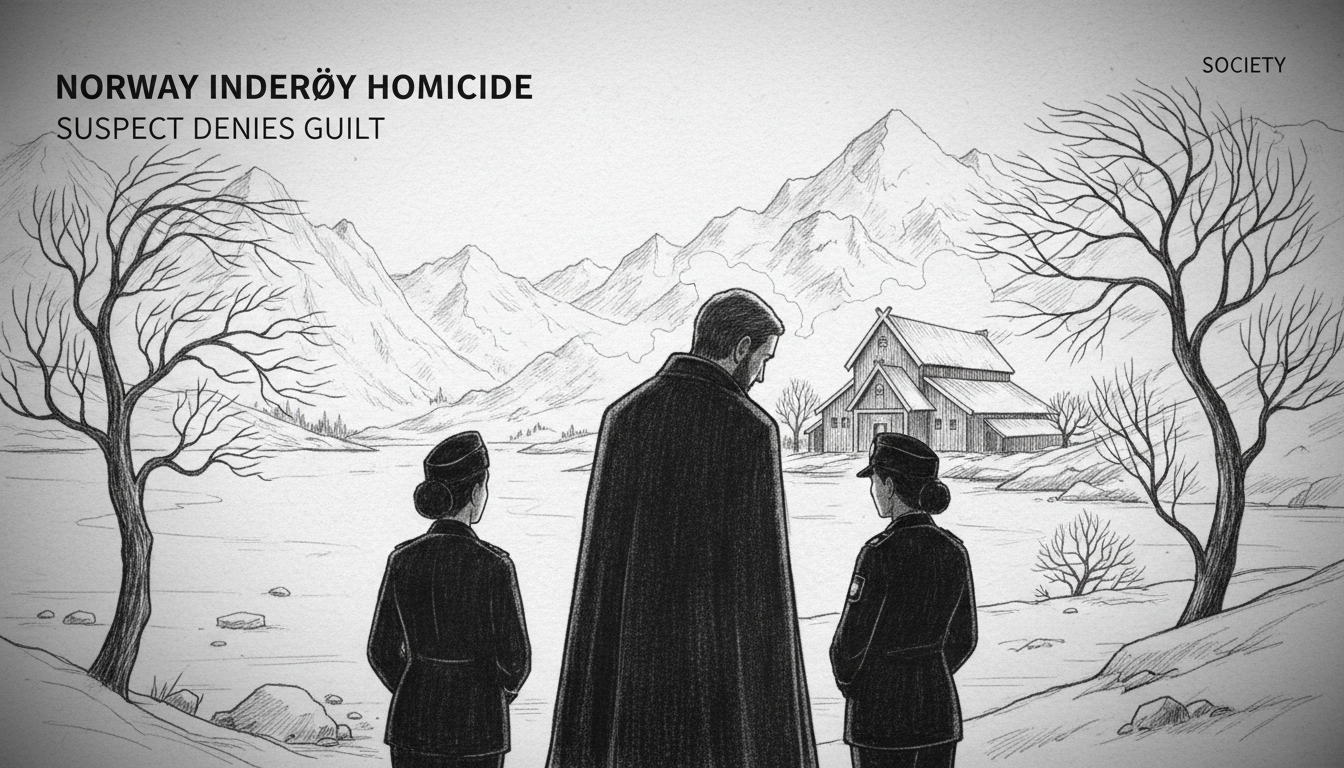
Norway police are investigating a suspected homicide in Inderøy after a woman in her sixties was found dead. Her male cohabitant, a man in his fifties, was arrested Sunday evening and denies any criminal guilt for the incident. The tragic event in the rural municipality of Trøndelag has shifted focus to Norway's generally low but persistent rates of domestic violence.
A Quiet Community Confronts Tragedy
Police responded to a report in Inderøy late Sunday, leading to the discovery of the deceased woman. Investigators moved quickly, arresting a man known to the victim at the scene. "The suspect does not admit criminal guilt. The suspect and the deceased were cohabitants," the prosecuting authority confirmed in a statement Monday. The specific location within the municipality, known for its agricultural landscapes and proximity to the Trondheimsfjord, has not been disclosed by officials seeking to protect the integrity of their work and the privacy of those involved.
The nature of the relationship, defined legally as samboere or cohabitants, is a central element of the investigation. This status, common in Norway, denotes a couple living together in a marriage-like relationship without being formally married. It carries significant legal weight, particularly in matters of inheritance and separation, and now forms a crucial context for detectives examining the circumstances leading to the woman's death.
The Norwegian Context of Domestic Homicide
This case emerges against the backdrop of Norway's enviable but complex crime statistics. The nation maintains one of the world's lowest homicide rates, typically around 0.5 incidents per 100,000 inhabitants. This figure represents a fraction of the rates seen in many other developed countries. However, a consistent pattern within these low numbers reveals a sobering truth: a significant proportion of homicides in Norway occur within close relationships, often in domestic settings.
"The low overall rate can create a perception that these events are exceedingly rare," notes a criminologist at the University of Oslo, who studies violent crime. "But when they do occur, the dynamics often follow familiar, tragic patterns. The home, statistically, remains a potential site of lethal violence, even in a society as peaceful as Norway's." Police treat all suspicious deaths with extreme thoroughness, frequently deploying forensic teams from the National Criminal Investigation Service (Kripos) to assist local authorities, as is likely in this Inderøy case.
Legal Process and Investigative Rigor
The suspect's denial of guilt sets the stage for a meticulous judicial process. He will be arraigned for custody within a strict timeframe, where a judge will decide if police can hold him in pre-trial detention while the investigation continues. The burden of proof lies entirely with the prosecution. In Norway, pre-trial detention requires that police demonstrate there is probable cause for suspicion and that detention is necessary to prevent flight, interference with evidence, or further criminal acts.
The suspect's legal defense will have early access to the basis of the case against him. Norway's legal system emphasizes proportionality and rehabilitation, even for serious crimes. However, sentences for murder or culpable homicide can be severe, with a maximum penalty of 21 years imprisonment. Aggravating circumstances, such as violence in a close relationship, can influence sentencing.
Domestic Violence: A National Priority
While the Inderøy investigation determines whether this is a case of domestic violence, the event has sparked discussion on the issue nationwide. Norwegian authorities have intensified efforts against intimate partner violence in recent decades. A national action plan, updated regularly, coordinates police response, victim support, and perpetrator programs. The police operate a national database for high-risk cases of domestic violence, aiming to identify and intervene in situations with a potential for escalation.
Support services for victims, such as the nationwide crisis hotline and a network of shelters, are well-established. Yet, experts point to the hidden nature of much domestic abuse. "Reporting rates have improved, but these crimes still occur behind closed doors," says a legal scholar specializing in family law. "The samboer relationship, while legally recognized, can sometimes involve complex emotional and financial dependencies that make it difficult for individuals to leave dangerous situations."
A Community in Mourning
Beyond the police tape and legal procedures, the incident leaves a profound impact on the small community of Inderøy. With a population of just over 6,000, the municipality is a place where many residents know each other. Local clergy and municipal care services typically mobilize to provide support for neighbors and friends affected by the shock. The peaceful image of rural Norwegian life, with its scenic fjords and farmland, is momentarily shadowed by an event that feels both alien and deeply personal to residents.
The police investigation will now follow a careful path. Forensic experts will work to establish an exact cause of death. Detectives will interview witnesses, examine digital evidence, and build a timeline of the events preceding Sunday evening. Every finding will be documented in a comprehensive case file that will eventually be presented to the prosecuting authority. They must then decide whether to press formal charges.
For now, a woman is dead, a man is in custody denying responsibility, and a community is left waiting for answers. This single event in Trøndelag underscores a universal, painful paradox: that the greatest danger can sometimes lie not in public spaces, but within the private walls of a home. The thoroughness of the Norwegian judicial system will be tested in its pursuit of justice, while the nation quietly reckons with a form of violence that persists even in its safest corners.