
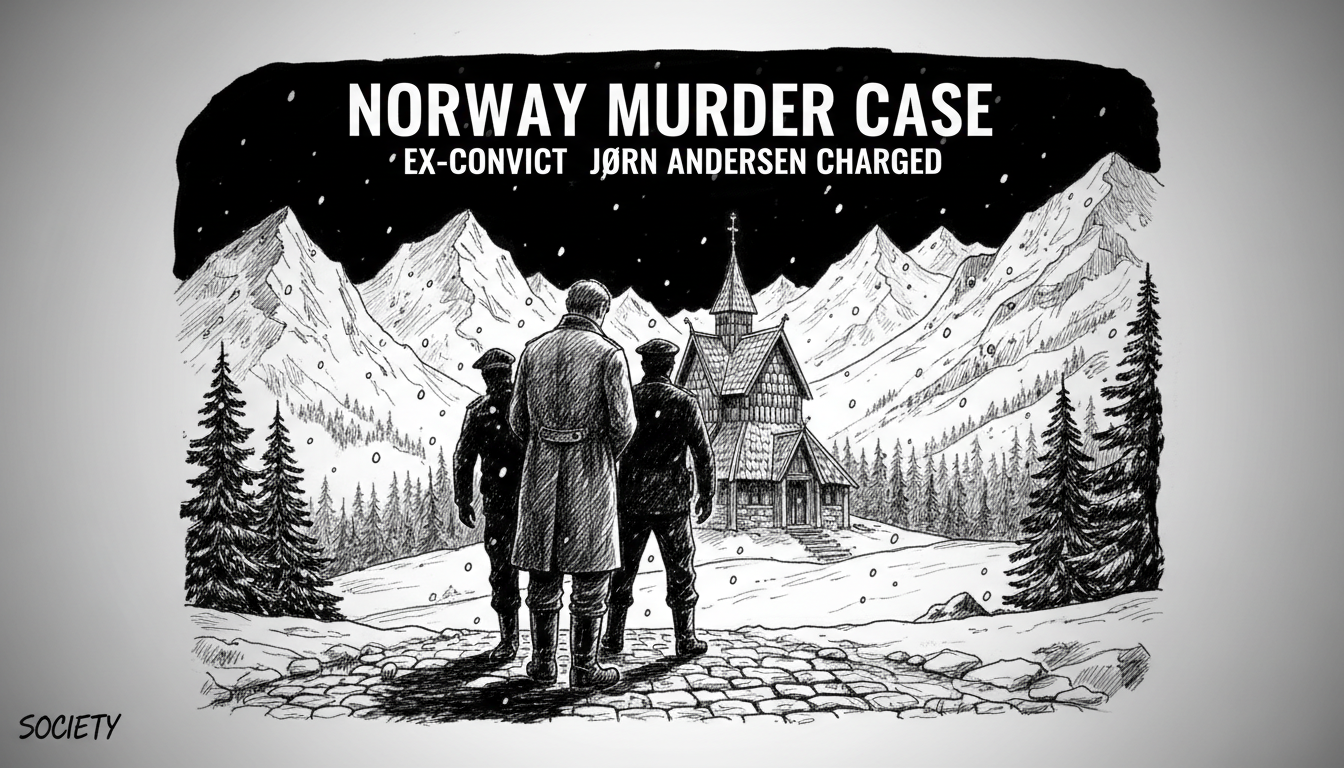
Norway's low crime rate faces a stark test with the arrest of Jørn Andersen. The 54-year-old, previously convicted of murder, is now charged with killing a woman in her 30s in Orkland, Trøndelag. The case has ignited a national debate about domestic violence, recidivism, and the justice system's ability to protect victims.
A hiker discovered the woman's body outdoors late Saturday night. Police immediately declared a homicide alert. Officers arrested Andersen, a local man in his 50s, shortly after. Authorities confirmed a relationship between the suspect and the deceased but have not specified its nature.
Andersen's defense lawyer, Fredrik Schøne Brodwall, declined to comment on the charges. The suspect's criminal history casts a long shadow over the new investigation. In 2000, Andersen received a 14-year prison sentence for murdering his ex-girlfriend, Linn Charlott Nesblom, in 1999. He stabbed her in the chest with a knife that pierced her heart and lung.
A History of Violence and Warnings
Weeks before her death, Nesblom reported Andersen to police for violence and death threats. Reports at the time indicated the complaint was not pursued due to a lack of resources. This failure to act remains a painful part of the case's history. Andersen confessed to the killing during police interrogation but denied it was premeditated.
His violent behavior continued after his initial conviction. In 2009, while on parole, Andersen attacked another ex-girlfriend. He showed up unannounced at her apartment, choked her, and threatened to kill her. Court documents reveal he told her, "Were you scared now? I didn't think you were afraid to die. I will kill you, then I will kill myself."
This parole violation led to his release being revoked. A court sentenced him to preventive detention. An appeals court later set the term at four years and six months. Andersen was released in 2016. A court assessment from that period, cited in local media, stated there was "no objective" evidence he would reoffend, though it acknowledged the gravity of his past crimes.
A System Built on Rehabilitation Faces Scrutiny
Norway's justice system is internationally noted for its focus on rehabilitation over pure punishment. The country's homicide rate is approximately 0.5 per 100,000 people, one of the lowest in the world. Prison sentences are often shorter than in other nations, with a strong emphasis on preparing inmates for reintegration.
This philosophy is now under intense public scrutiny. "Cases like this force us to ask difficult questions," said Kari Larsen, a criminologist at the University of Oslo. "How do we balance the principle of rehabilitation with the absolute need to protect potential victims, especially in patterns of domestic violence? The system is designed for second chances, but it must also recognize when an individual poses a persistent, high risk."
Legal experts note that prior convictions, particularly for violent crimes, are central to sentencing and parole decisions in Norway. Andersen's extensive history will be a major factor in the current investigation and any future trial. Prosecutors will likely argue it demonstrates a pattern of behavior.
The Persistent Shadow of Domestic Violence
The case highlights the deadly serious nature of domestic violence threats. Nesblom's unanswered police report in 1999 echoes a global challenge: victims are often most at risk when they attempt to leave a relationship or report abuse. "Threats of violence, especially from a partner with a known history, must be treated with the utmost seriousness," said Anna Berger, head of a national crisis center network. "This isn't just a private matter. It's a public safety issue that requires immediate and coordinated response from police, support services, and the courts."
Recidivism rates for violent offenders in Norway are a topic of ongoing study and debate. While overall re-conviction rates are lower than in many punitive systems, high-profile failures have a profound impact. Each one damages public trust and raises the stakes for the correctional system's risk assessments.
Police in Trøndelag are continuing their investigation into the Orkland killing. They are examining the crime scene and gathering forensic evidence. The focus is on establishing the precise circumstances of the woman's death and the nature of her relationship with Andersen in the period leading up to it.
A Community in Mourning, A Nation Questioning
The small community of Orkland is reeling from the violent death. Local officials have offered counseling and support services to residents. The tragedy has spread a sense of shock far beyond the municipality, becoming a national news story that touches on deep-seated fears about safety and justice.
Norway prides itself on a safe, egalitarian society. Incidents that seem to betray that self-image provoke intense reaction. Commentators in major newspapers are already analyzing the systemic lessons. Questions center on parole board decision-making, the monitoring of high-risk offenders after release, and resource allocation for investigating domestic violence complaints.
The coming legal proceedings will be closely watched. Andersen will undergo formal questioning by police. A judge will decide whether to remand him in custody while the investigation continues, a likely outcome given the severity of the charge and his criminal record. The prosecution will have the burden of proving his guilt in the new case beyond a reasonable doubt.
For the families of the victims, both past and present, the news has reopened old wounds. It is a brutal reminder that the consequences of violence ripple across decades. The case stands as a somber test for a justice system committed to humanity, challenging it to prove it can also deliver unwavering protection for the vulnerable.