
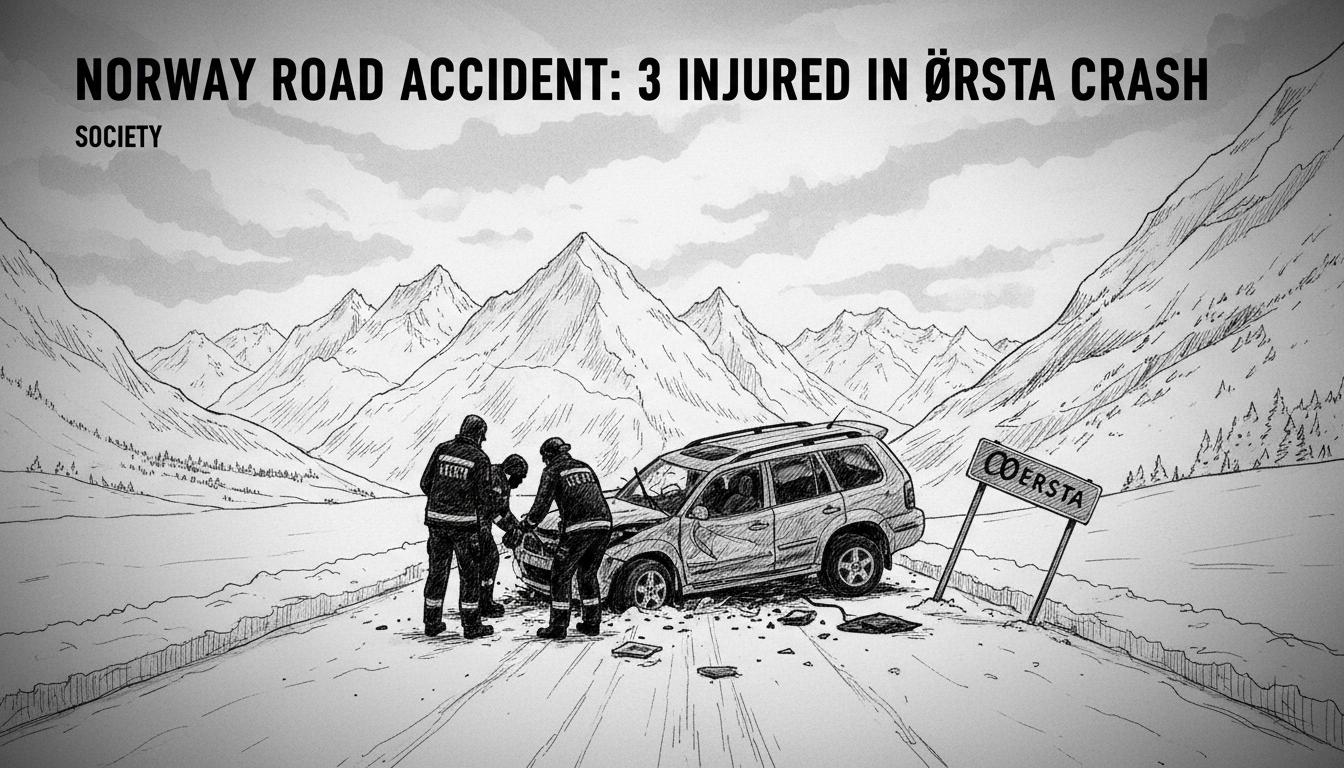
Norway's emergency services responded to a serious traffic accident involving two cars in Ørsta, Møre og Romsdal county on Wednesday. Police confirmed three people were involved in the collision, with one vehicle ending up in a ditch and the other remaining on the roadway.
The immediate police dispatch included multiple patrol units and ambulance crews. Initial reports from the scene described significant vehicle damage, though the exact severity of injuries remained unclear hours after the crash. Rescue operations focused on extracting occupants and securing the crash site on the local road network.
This incident adds to a persistent national concern over road safety in Norway's varied and often challenging terrain. Ørsta, situated within the dramatic fjord landscape of western Norway, features roads that can test even experienced drivers with sharp curves, changing weather, and steep gradients.
Emergency Response and Scene Assessment
Police operations in Møre og Romsdal followed standard procedure for a reported collision with potential injuries. The priority was securing the area to prevent further danger and providing immediate medical assistance. Officers documented the positions of the vehicles—one in the ditch, one on the road—as critical first evidence for the mandatory investigation.
Traffic in the immediate vicinity experienced disruptions as emergency vehicles accessed the site. Norwegian law requires a thorough technical investigation for all accidents causing injury, a process that began as soon as the scene was safe. This involves measuring skid marks, assessing vehicle damage points, and interviewing those involved if possible.
"Our first duty is to the people involved, to ensure they receive care," a police operations coordinator said in a statement. "Once the scene is secure, we begin the meticulous work of understanding exactly what happened. Every detail matters."
The Persistent Challenge of Norwegian Road Safety
While Norway boasts one of the world's lowest road fatality rates per capita, accidents like the one in Ørsta highlight ongoing risks. The country's geography presents unique hazards. Long, dark winters, sudden weather changes, and roads carved into mountainsides demand constant driver vigilance.
National road safety strategy, overseen by the Norwegian Public Roads Administration (Statens vegvesen), focuses on the "Vision Zero" goal of eliminating fatal and serious injuries. This involves engineering safer roads, strict enforcement of traffic laws, and continuous public education campaigns. Yet, human factors remain the most volatile element in the system.
"We have excellent roads and strict laws, but the final component is always the driver," said Lars Tingelstad, a senior advisor with the Norwegian Council for Road Safety (Trygg Trafikk). "Distraction, misjudgment of speed or distance, or simply a moment of inattention on a demanding road can have serious consequences. This is true everywhere, but our landscape offers less margin for error."
Common contributing factors in Norwegian accidents include speeding for conditions, failure to yield right of way, and driver inattention. Alcohol impairment, while less common than in past decades due to severe penalties, remains a concern, particularly in rural areas.
Analyzing Risk in Møre og Romsdal's Terrain
Møre og Romsdal county, where Ørsta is located, encapsulates Norway's road safety challenges. The county contains famous tourist routes like the Atlantic Ocean Road and the Geiranger-Trollstigen mountain pass, which mix breathtaking views with driving complexity. Local residents and visitors alike must navigate these roads daily.
Accident statistics for the county typically reflect a higher incidence of single-vehicle accidents—where a car leaves the roadway—compared to more urbanized regions. This often points to factors like driver fatigue, excessive speed on curves, or encounters with unexpected obstacles like wildlife. Collisions between two vehicles frequently occur at intersections or during overtaking maneuvers on two-lane roads.
Road conditions can change rapidly, especially in spring when melting snow creates wet patches and winter damage to asphalt becomes apparent. The Ørsta area, while not the most extreme in the county, still requires drivers to adapt constantly.
The Human and Systemic Aftermath
For the individuals involved, an accident like this begins a difficult journey of physical recovery and administrative processes. Norway's universal healthcare system provides medical treatment, but the personal impact is profound. Insurance assessments, potential vehicle loss, and the psychological effect of a crash create significant stress.
From an official perspective, every injury accident triggers a review process. Police investigators will reconstruct the event, examining all possible causes. Was there a mechanical failure? Did road surface conditions contribute? Were all drivers adhering to traffic rules? The findings contribute to national accident databases, which inform future safety measures.
Local municipalities also review accident sites to determine if engineering improvements are needed. These can include better signage, improved road markings, adjusted speed limits, or physical changes like adding guardrails or widening lanes. Such measures are part of Norway's proactive, data-driven approach to saving lives.
A Broader Look at Norway's Safety Record
Norway's commitment to road safety has yielded impressive results. Fatalities have fallen dramatically over the past fifty years, despite a large increase in the number of cars and kilometers driven. This success is attributed to a combination of factors: stringent laws against drunk driving, a graduated licensing system for young drivers, widespread use of winter tires, and continuous vehicle safety improvements.
However, each accident serves as a sobering reminder that the goal of zero fatalities has not been reached. Safety campaigns consistently target key risk areas: reminding drivers to put away mobile phones, to take breaks on long journeys, and to always match their speed to the visibility and road conditions.
"Complacency is the enemy," Tingelstad noted. "We cannot think that because our cars are safer or our laws are strict, that accidents won't happen. They can, and they do. Safety is a conscious choice every time you turn the key."
The Path Forward from the Ørsta Crash
As the investigation into the Ørsta collision proceeds, the focus will shift from emergency response to understanding and prevention. The detailed police report will answer the critical questions of cause and responsibility. For the community, it is another data point in the long-term effort to make every journey safe.
The incident underscores a universal truth for Norwegian drivers: the nation's stunning natural beauty comes with a responsibility for extreme care. From the winding roads of the western fjords to the long, straight stretches of the eastern valleys, attention must never waver. The alternative, as seen in Ørsta, is a sudden call to the police, flashing lights in the rearview mirror, and lives altered in an instant.
Can Norway's relentless drive for perfect road safety ever fully account for the human element behind the wheel? The country's world-leading statistics suggest it is getting closer, but as long as people and machines share these dramatic landscapes, the work is never finished.