
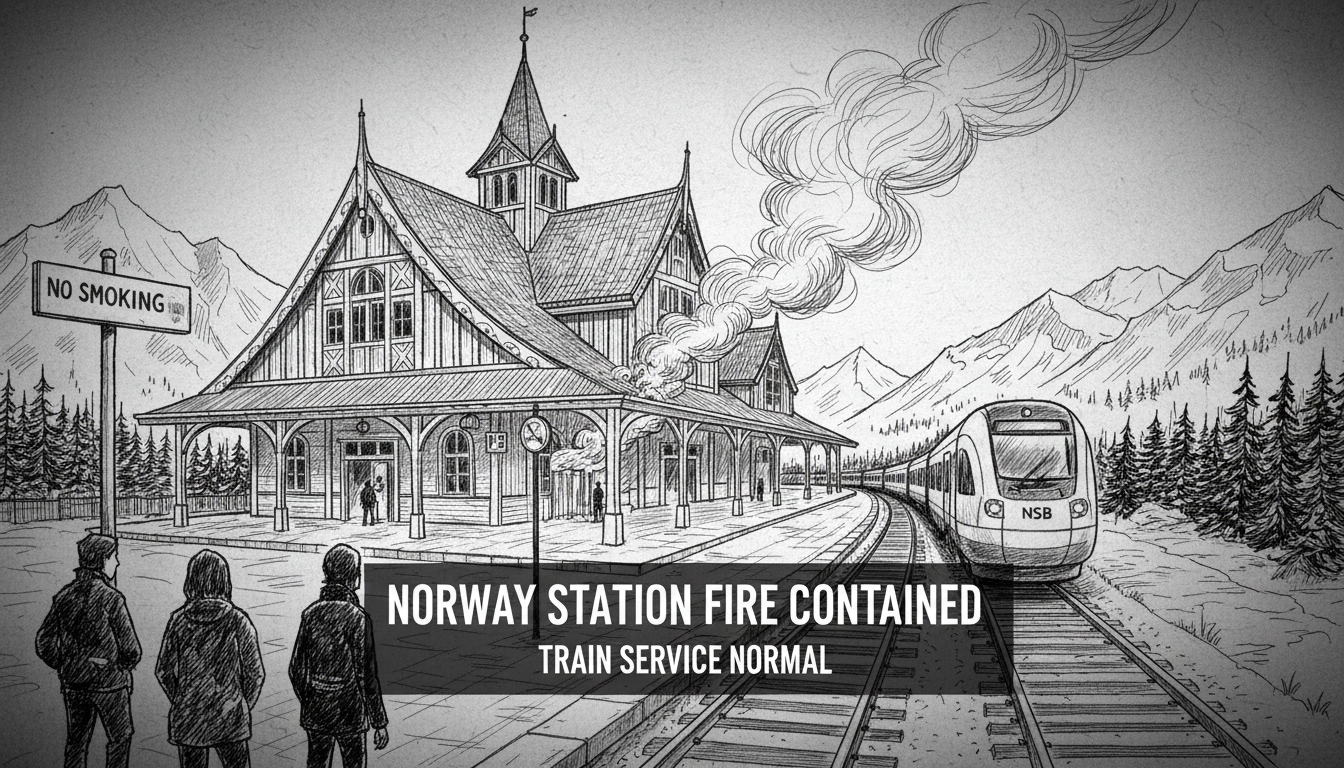
Norway's Kongsvinger Line faced a potential disruption when a car fire ignited at Rånåsfoss Station early Wednesday, but swift action prevented any train delays. The incident, reported at 4:39 AM, saw flames spread from a vehicle to the cladding of a station building before being fully controlled by fire crews within hours. This minor event underscores the robust emergency protocols that protect Norway's critical railway infrastructure from cascading failures.
Early Morning Blaze at Rånåsfoss
Flames lit up the dark near the railway tracks at Rånåsfoss Station in the predawn hours of Wednesday. The Øst Police District logged the first alert just after 4:30 AM, marking the start of a coordinated response. Initial reports indicated the fire had spread from a burning vehicle to the station building itself, raising immediate concerns for both safety and rail operations.
Operational leader Henrik Larsen confirmed the situation in an early statement. 'The fire has spread to the station building. The fire service is working to gain control,' Larsen said. The scene at Rånåsfoss, a village in Viken county approximately 47 kilometers northeast of Oslo Central Station, became a focus for local emergency services. Their priority was to isolate the blaze and prevent any impact on the Kongsvinger Line, a key route for commuters and freight.
Rapid Response Limits Damage
Within a short time, the outlook improved significantly. Firefighters from the region quickly contained the flames, preventing structural damage to the station. Operations leader Martin Sæther Ottesen provided an update, signaling the situation was under control. 'The car fire is now extinguished. The fire had spread to the cladding on a building on the site. The fire service has control, and we are conducting investigations on site,' Ottesen stated.
This efficient response meant that the first passenger train of the day, the 5:20 AM departure to Asker, experienced only a minor delay of a few minutes. The fact that train traffic proceeded almost normally is a testament to the effectiveness of Norway's incident management systems. Quick assessments and clear communication between police, fire services, and railway operator Vy minimized operational interference.
Kongsvinger Line: A Vital Artery
The Kongsvinger Line is not just a local commuter route. It stretches from Lillestrøm to Kongsvinger, forming part of an international corridor connecting Oslo to Swedish networks via the Värmland Line. Rånåsfoss Station serves a small community but sits on this strategically important piece of infrastructure. Any prolonged closure could have disrupted cross-border travel and freight logistics.
Vy, the state-owned company that operates passenger trains on this line, maintains a frequent schedule for Oslo-bound commuters. The line is a lifeline for residents of Viken county, which was formed in 2020 through the merger of Akershus, Buskerud, and Østfold. This administrative consolidation has aimed to streamline services, and the coordinated response to this fire can be seen as a practical benefit of such integration.
Railway Safety Protocols in Focus
While this incident ended without serious consequence, it highlights the ever-present risks to transport networks. Railway experts consistently emphasize that even minor fires near tracks or stations require rapid intervention. The proximity of vehicles to station buildings, as seen at Rånåsfoss, presents a specific hazard that infrastructure managers must mitigate.
Norwegian railway safety protocols are designed to prevent small events from escalating into major crises. These include regular inspections of station areas, clear guidelines for fuel storage and vehicle parking near infrastructure, and integrated communication channels between emergency services and rail control centers. The investigation at Rånåsfoss will likely review these factors to identify any lessons learned.
Norway has a strong track record in railway safety, with investment in modern signaling and preventative maintenance. However, aging infrastructure in some areas and increased traffic volumes pose ongoing challenges. Incidents like this serve as real-world tests of the system's resilience. The successful containment at Rånåsfoss demonstrates that protocols are functioning as intended, but authorities remain vigilant.
The Investigation and Future Precautions
Police and fire investigators remained on site at Rånåsfoss Station through Wednesday morning. Their work will determine the exact cause of the car fire, which is not yet known. Potential causes range from electrical faults to accidental ignition. The spread to the building's cladding will also be examined, with attention to the materials used and their fire resistance.
Findings from such investigations often inform national safety guidelines. The Norwegian Railway Directorate and the Norwegian National Fire Safety Association may review the outcomes to see if broader recommendations are needed for station design or vehicle access rules. In a country where wooden buildings are common, fire safety in public transport hubs is a persistent priority.
This incident occurs against a backdrop of Norway's broader infrastructure ambitions, including the expansion of rail to reduce road traffic and cut emissions. Maintaining public confidence in the safety and reliability of trains is crucial for these policies to succeed. A single fire, even a minor one, can affect perceptions if not handled transparently and efficiently.
Commuter Confidence Unshaken
For the daily users of the Kongsvinger Line, the morning of the fire passed with little notice. Social media and local news carried brief reports, but the lack of major disruption meant most commuters experienced a normal journey. This invisibility of crisis management is often the mark of its success. Passengers on the 5:20 AM train to Asker might have seen emergency vehicles but arrived at their destinations on time.
The reliability of public transport in Eastern Norway is a key economic factor. The region around Oslo depends on a network of trains and buses to function smoothly. Events that could snarl this network are treated with utmost seriousness by municipal and national authorities. The response at Rånåsfoss shows that the system's safeguards, from first responders to railway controllers, are aligned to protect this mobility.
Looking ahead, the investigation's conclusions may lead to localized safety enhancements at Rånåsfoss or similar small stations. These could include improved firebreaks between parking areas and buildings, or additional monitoring equipment. However, the broader lesson is one of preparedness. Norway's approach to railway incident management, built on decades of experience in harsh climates and complex terrain, proved effective in this early morning test.
As the clean-up at Rånåsfoss concludes and train services continue unabated, the incident fades into the routine of maintaining a nation's infrastructure. Yet it stands as a reminder that vigilance and coordinated action are the cornerstones of keeping Norway's railways moving, no matter the hour or the challenge. For a country investing heavily in its rail future, such small victories in risk management are foundational to larger ambitions.