
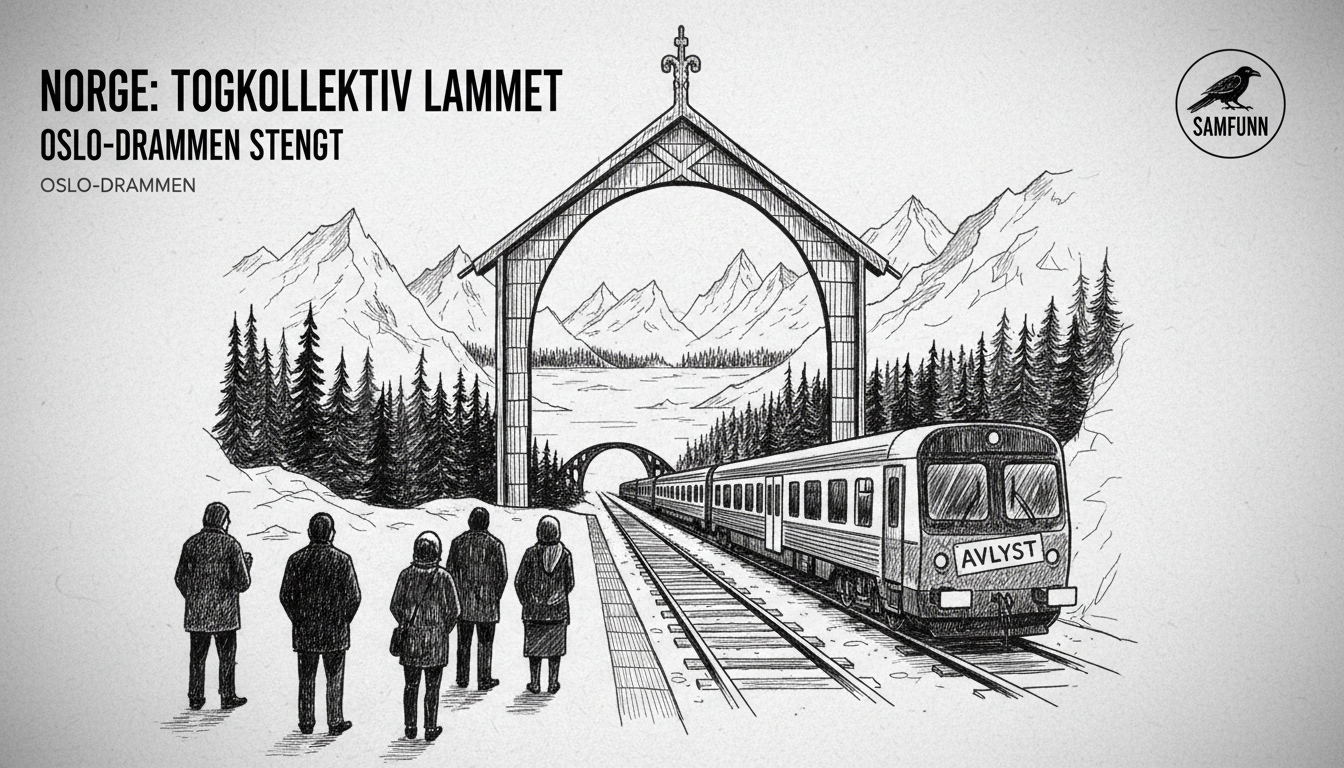
Norway's critical Drammen railway line faces a major and prolonged shutdown after a serious incident on the tracks between Drammen and Asker stations. Emergency services are on the scene, and infrastructure manager Bane NOR warns it could be hours before the vital commuter and freight artery reopens, stranding thousands of evening passengers and triggering cascading cancellations across the network. This disruption to one of the nation's busiest rail corridors exposes the fragility of a transport system upon which the capital region's economy depends.
The immediate human impact is severe. Evening commuters from Oslo found themselves abruptly stranded at stations or aboard stationary trains. Replacement bus services, a standard but often inadequate contingency, struggle to absorb the sudden surge of displaced travelers. For the city of Drammen, a major commuter hub southwest of Oslo, the closure effectively severs its primary public transport link to the capital, forcing road congestion as people seek alternatives. The timing—during the evening rush—maximizes disruption for workers, students, and families.
A Strategic Chokepoint Goes Silent
The Drammen Line is not just another railway. This 53-kilometer stretch between Oslo Central Station and Drammen Station is a foundational piece of Norwegian infrastructure. It functions as the main southwestern gateway from the capital, carrying local, regional, and some long-distance services. A closure here does not isolate a single town; it cripples a significant segment of the national network's western operations. Punctuality statistics for the entire rail system are sensitive to delays on this line due to the high frequency of services. The incident's exact nature remains unclear, but any 'event on the track' requiring emergency response suggests significant damage or danger, from a landslide or obstruction to a technical failure.
"When the Drammen Line sneezes, the entire network catches a cold," says Lars Fjelldal, a transport economist at the Oslo School of Management. "The concentration of traffic on this corridor means there is very little redundancy. Our contingency planning often relies on buses, which cannot match the capacity or speed of a train. This isn't just an inconvenience; it's a direct economic drain through lost productivity and highlights a systemic vulnerability."
Infrastructure Strain in the Spotlight
This incident will inevitably renew fierce debates about investment in Norway's railway infrastructure. While billions have been spent on projects like the Follo Line to increase capacity southeast of Oslo, key sections like parts of the Drammen Line remain congested and vulnerable. The line is a mix of double and single-track segments, creating potential bottlenecks where delays can propagate quickly. Experts have long warned that increased frequency and older infrastructure can elevate the risk of disruptive incidents.
Bane NOR, the state-owned entity responsible for the network, faces immense pressure to maintain reliability while executing upgrades. Their communication during this crisis is being closely watched. A statement that reopening "could take time" offers little comfort to stranded passengers and underscores the uncertainty inherent in such situations. The agency must balance transparency with the risk of speculation before their teams fully assess the damage.
The Economic and Political Ripple Effect
The ramifications extend beyond frustrated commuters. Freight traffic on the line is also halted, disrupting supply chains for goods moving to and from the port of Drammen and industrial areas along the fjord. Each hour of closure represents a tangible economic cost. Politically, the opposition is quick to seize on such events. Members of the Storting's transport committee are already calling for explanations.
"This is precisely the scenario we have warned about," said Ingrid Liland, a parliamentarian from the opposition Conservative Party. "Our rail infrastructure is being pushed to its limits without sufficient parallel investment in resilience. We need clear answers from the government and Bane NOR on what happened here tonight and what will be done to prevent a repeat. The people relying on this line for their daily lives deserve more than just apologies."
The government, led by Transport Minister Jon-Ivar Nygård, must now navigate the aftermath. Expect pointed questions in parliament about maintenance budgets, the pace of double-tracking projects, and the adequacy of contingency plans. The Social Democratic government has championed a shift from road to rail to meet climate goals, but incidents like this undermine public confidence in that transition.
A Look at the Road Ahead
As recovery crews work under floodlights, the path to normalcy involves complex steps: securing the site, conducting investigations, repairing any damage, and rigorously testing the line before the first train can pass. For Norway's transport authorities, the work after the trains restart is just as critical. A thorough forensic analysis of the cause is essential to inform future maintenance and investment priorities.
This shutdown serves as a stark reminder. Norway's geography, with its mountains and fjords, makes its railway network a series of critical chokepoints rather than a interconnected web. The Drammen Line is one of the most crucial of these. Its reliability is not a local issue but a matter of national economic security. As the country continues to invest in its rail future, the question remains: is it investing enough in making its existing backbone resilient to the shocks that will inevitably come? The thousands waiting on cold platforms tonight certainly hope so.