
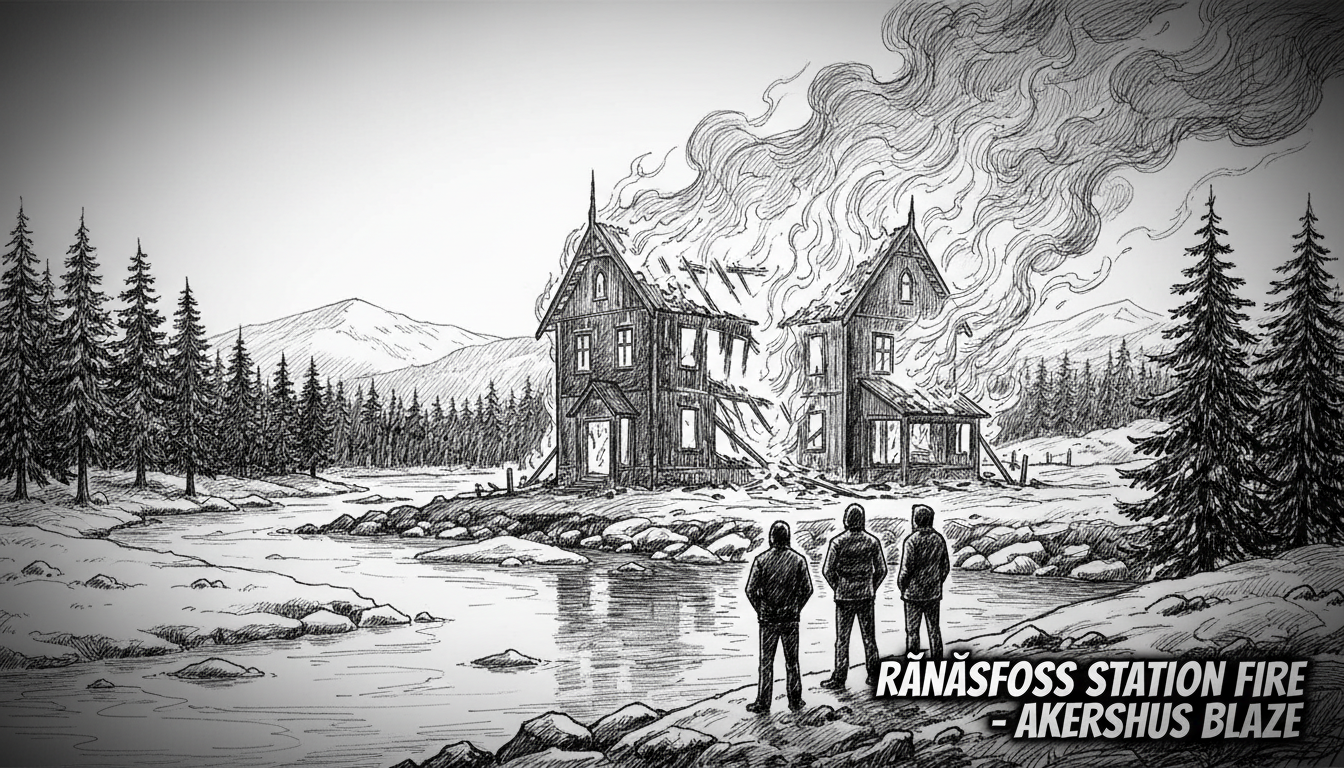
Norway's Rånåsfoss railway station suffered a significant fire early Wednesday morning, with flames from a fully engulfed car spreading to the station building. The 4 a.m. blaze at the station on the Kongsvinger Line caused notable damage to the building's cladding and destroyed the vehicle. No persons were involved in the incident, according to police operations manager Martin Ottesen.
A Midnight Emergency in Rural Akershus
The call came in at four o'clock in the morning. In the darkness of rural Akershus, a passenger car parked near the Rånåsfoss station was alight with intense flames. Strong winds, a common feature in the valley surrounding the Glomma river, carried embers and heat towards the adjacent wooden station building. Local volunteer firefighters from Nes and Årnes, alongside police from the Øst police district, responded to the scene. Their swift action prevented a total loss. 'The building has minor damage to the cladding,' said Police Operations Manager Martin Ottesen. 'The car the fire started in is more or less completely burned out.' The successful containment meant train traffic on the crucial Kongsvinger Line experienced no disruptions, a testament to the response.
Anatomy of a Contained Disaster
Fire experts point to several factors that prevented a catastrophic outcome. The immediate emergency response, despite the remote location, was decisive. The station's construction, while vulnerable, did not contain large fuel loads that could have created an unstoppable inferno. The separation between the ignition source—the vehicle—and the main structure, though breached, provided critical minutes for firefighters to deploy. 'This incident highlights two things,' said a fire safety consultant familiar with Norwegian infrastructure, who spoke on background. 'First, the value of rapid intervention, especially for older wooden structures. Second, it shows the inherent risk of vehicles parked in close proximity to such buildings, a common feature at many of our smaller, unmanned stations.' The consultant noted that while the direct cause remains under investigation, electrical faults in vehicles or improperly discarded smoking materials are common precursors in such scenarios.
The Vital Role of Rånåsfoss
To understand the potential impact of this fire, one must understand what Rånåsfoss represents. The station is a quiet stop on the 115-kilometer Kongsvinger Line, which connects Oslo Central Station to the border town of Kongsvinger and onward to the Swedish rail network. It serves a small village that is overshadowed by its industrial giant: the Rånåsfoss Hydroelectric Power Station. Built in the 1960s, Rånåsfoss kraftverk is one of Norway's largest river power plants, harnessing the Glomma river to produce significant electricity for the grid. The railway station and the power plant are linked threads in Norway's infrastructure tapestry, one moving people, the other power. A major, prolonged fire at the station could have disrupted both transportation for local workers and access for technical personnel to the vital energy facility. The fact that operations continued normally at the power plant underscores the localized nature of the firefight's success.
A Pattern of Vulnerability for Historic Stations
This incident at Rånåsfoss is not an isolated event in the Nordic region. Norway and Sweden possess hundreds of historic wooden station buildings, many built in the late 19th and early 20th centuries. Their architectural charm is matched by their fire vulnerability. Just last year, a historic station in Sweden was severely damaged by fire, sparking debates about preservation and safety upgrades. In Norway, Bane NOR, the state-owned entity responsible for the railway infrastructure, has a continuous program for maintaining and securing these assets. This fire will likely prompt a renewed internal review of fire mitigation measures at similar unmanned stations. Key considerations include the installation of more robust external lighting, monitored heat or smoke detection systems that alert central dispatchers directly, and clearer zoning to increase the distance between public parking areas and historic wooden structures.
The Investigation and Path Forward
Police have launched a standard investigation into the cause of the Rånåsfoss fire. Forensic technicians will examine the remains of the vehicle to determine the point of origin and the likely source of ignition. They will also interview any potential witnesses, though activity at 4 a.m. in a small village is typically minimal. For Bane NOR, the path forward involves repair and assessment. Contractors will be brought in to evaluate the damage to the station's cladding and structural members. The repairs must balance historical authenticity with modern building standards. Meanwhile, commuters from Rånåsfoss and the surrounding areas experienced no interruption to their daily travel, a quiet victory for the region's emergency planners. The incident serves as a stark reminder of the silent guardianship required over Norway's dispersed infrastructure network, from the majestic hydroelectric plants to the humble wooden stations that dot its landscapes.
A Narrow Escape for Local Heritage
While not a national landmark, the Rånåsfoss station building is a part of the local community's daily life and heritage. Its potential loss would have been felt deeply. The successful firefighting operation preserved this piece of local identity. It also prevented a logistical headache for the region's connectivity. The Kongsvinger Line is a critical transport artery for commuters, students, and freight moving between Oslo and the eastern valleys. A prolonged closure would have forced bus replacements, adding hours to travel times. The fact that service continued uninterrupted is a direct result of precise, effective emergency work in the middle of the night. As the investigation continues, the community can reflect on a crisis that was, ultimately, averted. The charred cladding will be repaired, the car removed, but the lesson in preparedness for remote infrastructure across Norway's vast geography will remain.