
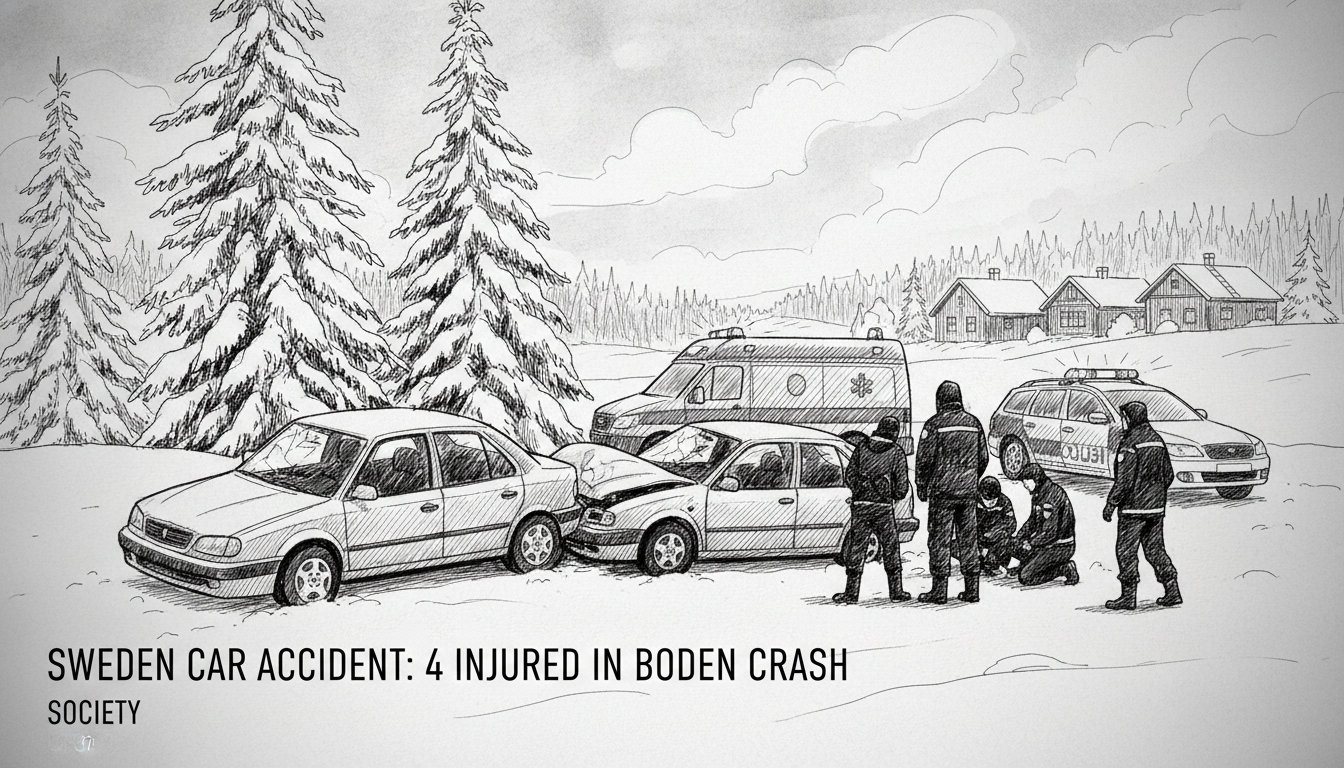
Sweden car accident in Boden sent four people to Sunderby Hospital on Thursday evening. The collision, involving multiple vehicles, occurred just after 6:15 PM. Emergency services rushed to the scene, closing the road completely during the initial rescue operation. As night fell in Norrbotten County, the focus shifted from extraction to investigation and recovery.
"Four people were taken to Sunderby Hospital by ambulance," an inner ambulance commander said shortly before 8 PM. The statement was brief, professional, and pointed to a serious but stabilized situation. For the families involved, the wait for updates began. The road has since partially reopened, but debris remains. One emergency service unit stayed on site into the night.
A Thursday Evening Shattered
In a small community like Boden, an accident like this resonates deeply. It's not just a traffic report; it's a neighbor, a coworker, or a friend's relative. Thursday evenings in Swedish towns often mean a relaxed drive home, perhaps after a visit to the local ICA supermarket or a sports practice. This routine was violently interrupted. The sound of sirens cutting through the quiet northern air likely drew concerned glances from nearby homes. The efficient, coordinated response from Räddningstjänsten, the rescue service, is a standard Swedes rely on but hope never to need.
I've reported from accident scenes before. There's a chilling stillness after the chaos subsides. The flashing blue lights paint the surrounding snow or asphalt in an eerie glow. The focus of the responders is absolute. In Sweden, this response is built on a foundation called Vision Zero. It's a philosophy, not just a policy.
The Vision Zero Context
This accident in Boden occurs against the backdrop of Sweden's world-leading road safety ambition. Adopted in the 1990s, Vision Zero rejects the idea that serious traffic accidents are inevitable. Instead, it argues that the system—roads, vehicle design, speed limits—must be designed to forgive human error. The goal is not just to reduce accidents, but to eliminate fatalities and serious injuries altogether.
The statistics show its impact. In 2022, Sweden recorded 240 road traffic fatalities. While each one is a tragedy, this number is among the lowest per capita in the world. It represents a dramatic decline over decades. The investment is in concrete measures: median barriers on highways, lower urban speed limits, and pedestrian-first city planning. The approach is analytical, viewing every accident as a system failure to be corrected.
Yet, as experts would note, the human element remains. "Every accident requires a thorough investigation to understand the chain of events," a road safety analyst explained to me recently. "Was it driver fatigue on a long, dark northern road? A moment of distraction? An unexpected patch of black ice? Or a combination? The answer informs future prevention." The quick emergency response in Boden is the final, critical link in the Vision Zero chain—minimizing harm when prevention fails.
Life in the North
To understand the full picture, you need to understand Boden. It's a historic garrison town in Swedish Lapland, with a strong sense of community. Distances are vast. The weather can be extreme, with winter darkness and challenging driving conditions. The road network is a lifeline. An accident that closes a main route disrupts more than traffic; it isolates. People check in on one another. News travels quickly, often through personal networks before it hits the media.
The injured were taken to Sunderby Hospital in Luleå, about a 40-minute drive under normal conditions. Sunderby is the central hospital for Norrbotten County, serving a huge, sparsely populated area. Its staff are specialists in trauma care, often dealing with accidents related to long-distance travel, forestry, and winter sports. The quality of care there is a point of regional pride, a necessary reassurance for those living far from major cities.
The Long Road Ahead
For the four individuals transported to the hospital, Thursday night marked a brutal turning point. Their immediate medical journey is clear. The longer road to recovery—physical and psychological—is just beginning. Swedish society has a strong safety net to support them, including comprehensive healthcare and rehabilitation services. But the personal ordeal is theirs alone to bear.
Back at the accident site, the investigation will be meticulous. Police traffic investigators will map skid marks, examine vehicle damage, and interview witnesses. They will look for technical malfunctions and review weather data. Their final report will contribute to the national database used to make roads safer. This systemic learning is a hallmark of the Swedish approach. A tragedy is never just a tragedy; it is data to prevent the next one.
A Community's Resilience
As the debris is cleared and traffic slowly returns to normal, the community of Boden will absorb what happened. There's a quiet resilience in these northern towns. People know the risks of the road, especially during the long mörkertid, the period of polar darkness. They prepare their cars with winter tires, check their lights, and drive with heightened awareness. Yet, sometimes, it's not enough.
This accident is a stark reminder that safety is a shared, continuous project. It relies on well-designed cars, maintained roads, appropriate laws, and attentive driving. It also relies on the swift, skilled response of ambulance crews and firefighters who answered the call at 6:15 PM. Their work, often thankless, is what stands between a crash and a catastrophe.
Sweden's roads are among the safest in the world. But the goal is zero. Every accident, like the one in Boden, is measured against that ultimate ambition. It prompts difficult questions. Could the road design have prevented this? Were the speed limits right for the conditions? The search for answers is what drives progress. For the four people in Sunderby Hospital tonight, and for everyone who travels Sweden's roads, that relentless search must continue. How much closer to zero can we get?