
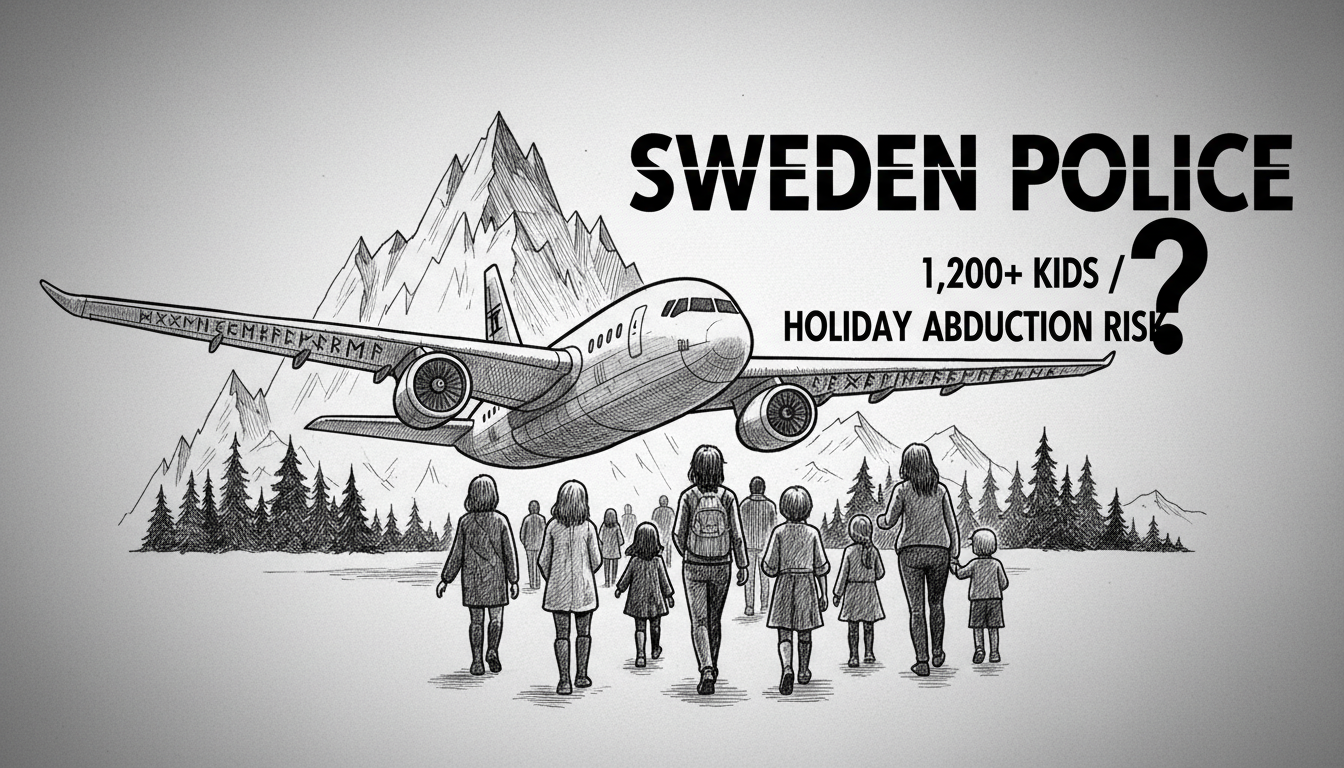
Sweden police are warning that over 1,200 children living under threat of honor-based violence face increased risk of forced travel abroad this Christmas. The school holidays provide cover for families to take children for forced marriages or other abuse, authorities say. As Stockholm's festive lights glow over Gamla Stan and families gather for glögg, a stark warning cuts through the seasonal cheer. For some children, the Christmas break is not about presents and pepparkakor, but about fear.
The Hidden Danger Behind Holiday Travel
Åsa Wallinder, a police inspector with the National Operations Department (NOA), puts it plainly. "Every single child is one too many," she says. The police do not have exact numbers. The hidden figure is believed to be large. Authorities think the number of cases remains fairly constant year to year. But the risk spikes during long school breaks. Lengthy trips abroad do not raise the same red flags as they would during the academic term. This period from mid-December to early January is a critical window.
The trips can have various cruel purposes. They might involve forcing a child into marriage. Other aims include so-called 'upbringing journeys,' where a child is sent to a parent's country of origin for religious re-education or stricter social control. Some travels are for female genital mutilation (FGM). The common thread is control. It is about enforcing family honor against a child's will.
Understanding Honor-Based Pressure
Honor-based violence is a complex issue in Swedish society. It involves control and violence, often against girls and young women. The pressure comes from perceptions of bringing shame to the family. This could be for having a boyfriend, choosing one's own clothes, or rejecting an arranged marriage. Swedish law is clear. Forced marriage and child marriage are illegal. It is a crime to force someone into marriage, both in Sweden and abroad. The government has action plans and supports numerous NGOs working on the ground.
Yet the systems struggle to reach everyone. Malin Enström, a social worker with over 15 years in Stockholm's southern suburbs, explains the challenge. "The holiday season is a perfect storm," she tells me over coffee in Södermalm. "Families are expected to travel. Communities are less observant. A child missing from the local playground in January is noticed. In December, people assume they're just on vacation." She stresses that boys can also be targets, often for 'correction' of their behavior or identity.
Spotting the Signs and Taking Action
The police and support organizations are urging everyone to be vigilant. They ask teachers, friends, healthcare workers, and neighbors to watch for warning signs. Is a child suddenly talking about a long 'holiday' to a country the family rarely visits? Have they become withdrawn or fearful as the break approaches? Perhaps they've hinted at an upcoming family wedding. Maybe they've confided about a passport being arranged without their consent.
"The most important thing is to listen and to act on your concern," says Wallinder. If you suspect a child is at risk, you can contact social services or the police. Specific NGOs like GAPF (National Association for Aid to Women and Girls at Risk) and Terrafem offer confidential helplines. Schools in municipalities with higher known risk often have specific protocols. They involve dialogues with pupils about their holiday plans long before the term ends.
A Cultural Tightrope in a Progressive Society
This issue sits at a difficult intersection in modern Sweden. It pits fundamental values of individual freedom and children's rights against certain traditional family structures. Sweden has been a leader in legislation against forced marriage and honor crimes. But implementation requires cultural sensitivity and trust-building. Many in affected communities are allies in this fight. They work tirelessly to change norms from within.
Imam Hassan from a mosque in Botkyrka speaks openly about the religious stance. "There is no honor in oppression," he states firmly. "Forcing a marriage is a sin. Taking a child against their will to cause them harm is a grave injustice. We must educate our communities that these acts are not only illegal in Sweden but are forbidden by our faith's principles of consent and mercy." This internal advocacy is seen as crucial for prevention.
Analysis: Gaps in the Safety Net
Experts point to several systemic challenges. First is the sheer difficulty of data collection. Due to fear and shame, many cases are never reported. A child taken abroad may simply not return. They may be cut off from all friends and support networks in Sweden. Second, legal jurisdiction is a major hurdle. Once a child is in another country, Swedish authorities have very limited power to intervene. Prevention inside Sweden's borders is the only reliable strategy.
Third, there is the challenge of early intervention. Social services often need concrete evidence to act. The threshold for removing a child from a family is extremely high, as it should be. This can leave at-risk children in a dangerous limbo. Professor Anna Kaldal, a legal expert on children's rights, argues for more proactive tools. "We need better risk assessment models used by all agencies—schools, healthcare, youth centers," she says. "And we must empower children with knowledge. They should know their rights and where to turn for help, in confidence."
The economic aspect cannot be ignored. Long-distance travel is expensive. The fact that families invest significant funds in these trips underscores the perceived importance of the mission. It is not a casual decision. This complicates prevention, as families may go to great lengths to conceal their true intentions from extended family and authorities.
Looking Beyond the Holiday Season
The Christmas warning is part of a year-round struggle. Risks also increase during the summer break and other school holidays. The work continues every day. Support shelters remain open. Helplines operate around the clock. Community outreach programs in cities like Malmö, Gothenburg, and Stockholm try to shift deep-seated attitudes.
The ultimate goal is a future where no child dreads the school holidays. Where the Christmas season is solely a time of joy, not a period of heightened danger. As the Swedish winter darkness sets in early, the message from authorities is one of collective responsibility. It asks all of us to look out for the most vulnerable. To ensure that the promise of a safe childhood, guaranteed under Swedish law, is a reality for every child, not just a festive ideal.
Will this Christmas be different? The answer depends on vigilance, courage, and the willingness to see the story behind a planned family trip.