
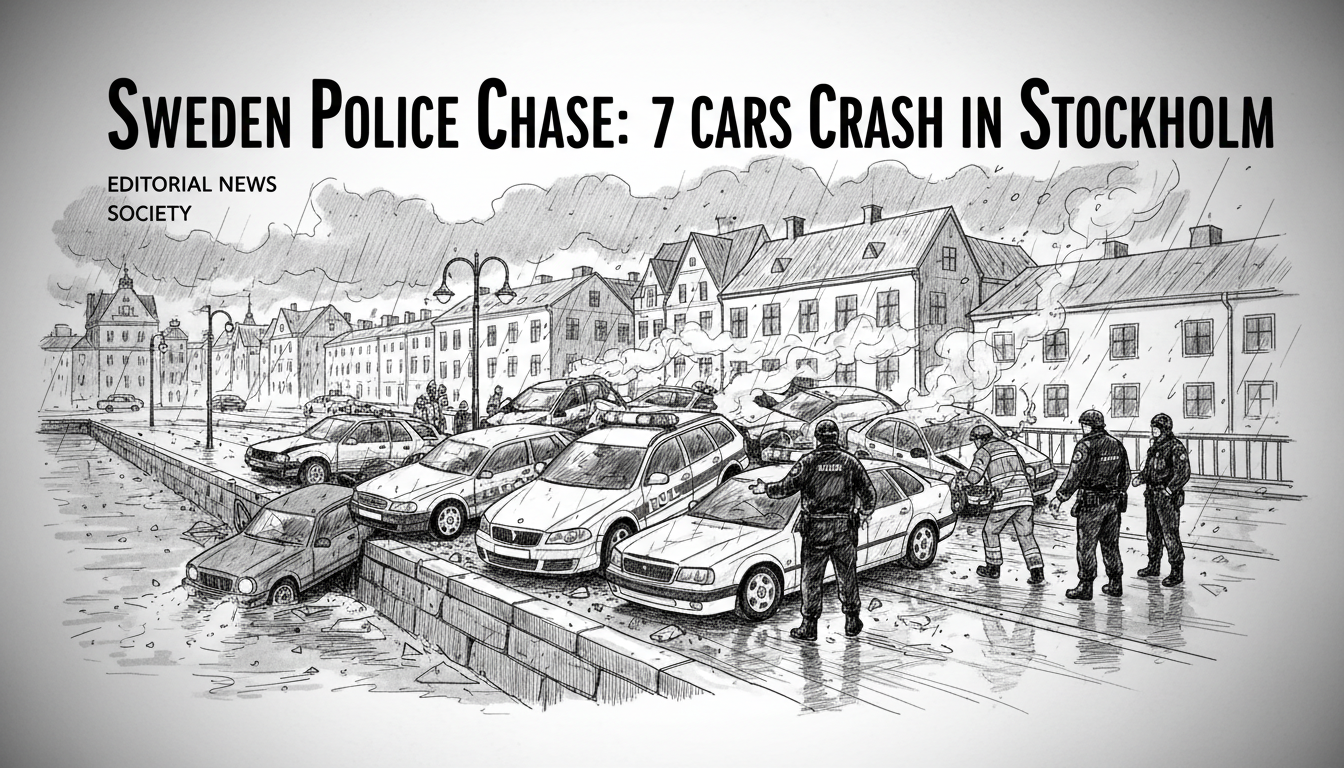
Sweden police pursuit tactics are under scrutiny after a dramatic car chase through Stockholm left seven patrol cars wrecked. The incident began just after 9:30 PM on Friday in the suburb of Västertorp. A driver, a man in his 20s, refused to stop for police. What followed was a high-speed pursuit that snaked across the capital, ending in Bromma after multiple attempts to halt the vehicle.
Residents reported the roar of engines and screeching tires cutting through the typical Friday night calm. The chase moved at extreme speeds north onto the E4 highway, west toward Järva, south through Spånga, and finally into western Stockholm's Bromma district. Police spokesperson Daniel Wikdahl confirmed the extensive damage. "It was after several boxing-in maneuvers along the way. Spike strips were also deployed," Wikdahl said.
The suspect now faces multiple serious charges. The immediate cost is clear: seven police vehicles requiring recovery. The broader conversation about risk, public safety, and policing in Swedish cities is just beginning.
A Chase Through the Capital's Veins
The route was not a straight line. It traced a frantic path through Stockholm's diverse neighborhoods. From the residential streets of Västertorp in the southwest, the pursuit accelerated onto the major E4 artery. This brought the danger into high-speed traffic. It then veered into the Järva area, a region often in the news for social challenges, before cutting south through Spånga. The final act played out in Bromma, a more mixed area of suburbs and airport grounds.
This geographical spread is significant. It shows how quickly a localized incident can escalate into a city-wide event. The police response required coordinating multiple patrols across districts. Their strategy involved classic Swedish police tactics: the 'prejningsförsök' (boxing-in maneuvers) and spike strips. These are designed to minimize high-speed pursuit. Yet in this case, they preceded significant collisions.
The High-Stakes Calculus of Pursuit
Swedish police operate under strict regulations governing pursuits. Public safety is the paramount principle. Officers must constantly weigh the necessity of apprehending a suspect against the potential danger of a high-speed chase to other road users and the public. The decision to initiate and continue a pursuit is a heavy responsibility.
"Every chase is a risk assessment in real time," says Lars Brännström, a former police inspector and now a security analyst. "The rules are clear on paper: de-escalate, contain, avoid unnecessary risk. But on a fast-moving highway at night, those decisions are made in seconds. The fact that spike strips and boxing maneuvers were used shows they were trying to end it proactively."
The suspect's initial offense—failing to stop—raises a critical question. What prompted such a desperate flight? While police have not released details on possible prior crimes, the escalation suggests the driver feared more than a traffic ticket. This dynamic often turns a simple stop into a major incident.
The Aftermath: Metal, Money, and Morale
The immediate aftermath in Bromma was a scene of tangled metal. Seven damaged police cars represent a substantial operational and financial blow. A single new patrol car in Sweden can cost over 700,000 SEK. While these vehicles may be repaired, the cost in kronor and out-of-service time is considerable.
Beyond the budget sheet, such events impact officer morale and public perception. For the police, it's a violent reminder of the job's physical dangers. For Stockholm residents, it can feel like a breach of the city's generally orderly fabric. Social media threads filled with concern, not just about the chase, but about what it signifies.
"You hear sirens often, but this sounded like a war zone last night," said Anette, a resident living near the end of the chase route in Bromma. "It's frightening to think this can happen here. I'm glad no one in the public seems to have been hurt, but it's a wake-up call."
A Broader Pattern in Swedish Society?
While dramatic, this chase is not an isolated event. It taps into ongoing debates in Swedish society about crime, policing, and social order. Police resources are stretched. High-profile vehicle crimes, including car burnings and reckless driving, have become more frequent topics in news reports and political discussions.
This incident will likely fuel those debates. Some will argue for even more restrictive pursuit policies to absolutely guarantee civilian safety. Others will contend that failing to pursue emboldens criminals and erodes law enforcement's authority. The balance is delicate and emotionally charged.
Experts like Brännström caution against overreaction. "One incident is not a trend. Swedish police are highly trained in de-escalation. This appears to be a case where a determined individual forced a dangerous situation. The system worked to contain it, albeit with costly damage. The review process will be thorough."
That review is standard procedure. The Swedish Police Authority will examine every decision point in the chase. They will assess whether protocols were followed and if the response was proportionate. The findings, though not fully public, will inform future training and tactics.
The Human Factor at the Wheel
At the center of the chaos is a young man in his twenties. His identity and motives are unknown to the public. His actions, however, set off a chain reaction that tied up police resources, risked lives, and damaged public property. He sits in custody, facing serious legal consequences.
His story is the missing piece. Was it panic, a moment of irrational decision-making? Or was he fleeing from something more serious? The judicial process will seek those answers. For now, he is a symbol of the unpredictable human element that can shatter an ordinary evening.
The chase ended without reported civilian injuries, a small mercy for which police are likely grateful. The suspect was apprehended. By some measures, the operation was a success. Yet the image of seven wrecked police cars tells a more complex story of a victory that came at a high price.
As Stockholm's streets quieted down, the questions remained. How do you protect a city from a single speeding vehicle? When does the cure become more dangerous than the disease? The crumpled blue and yellow patrol cars in a Bromma lot are silent, expensive monuments to those very Swedish dilemmas.