
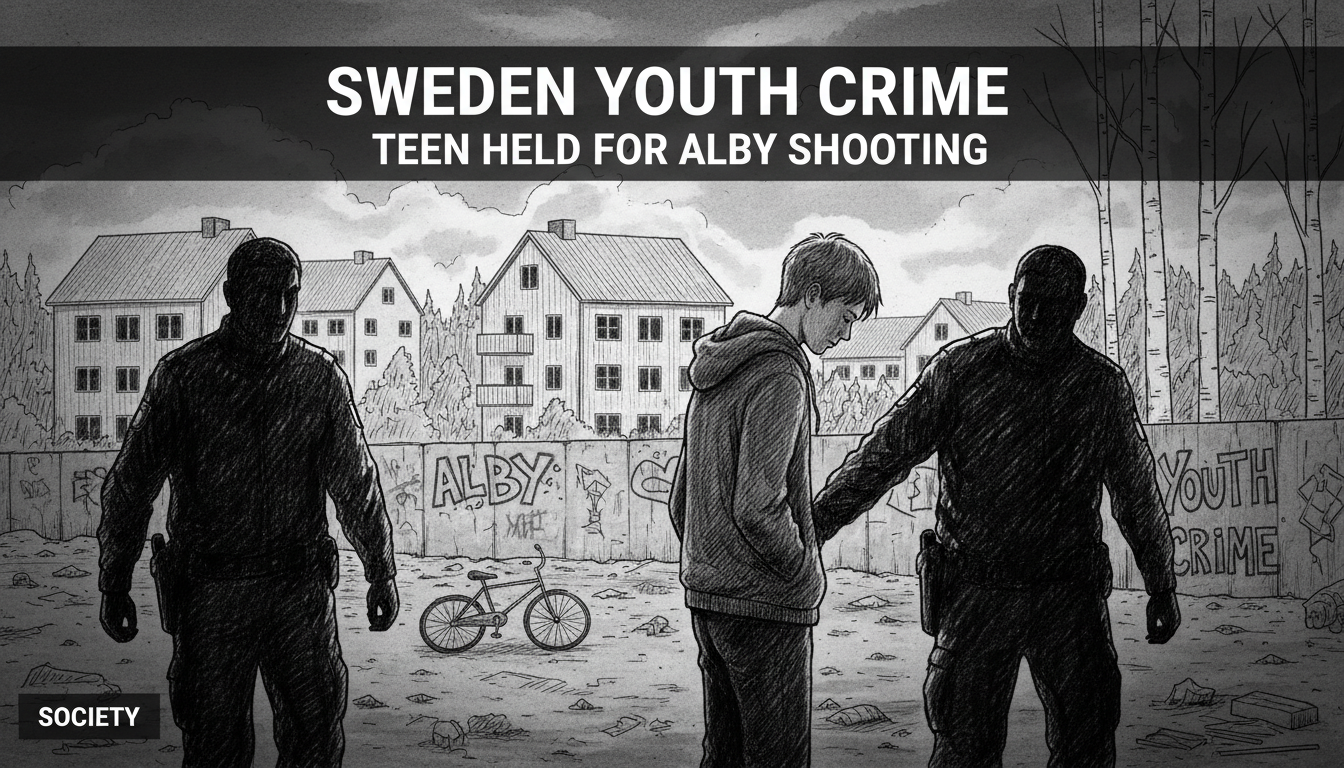
Sweden crime news this week is dominated by a violent incident in a Stockholm suburb. A teenage boy, under 18, has been formally detained on suspicion of attempted murder. The arrest follows a Saturday afternoon shooting in a stairwell in Alby, Botkyrka. A man was found with gunshot wounds and taken to hospital. A woman was also reportedly targeted but escaped physical injury. Police were called to the multi-family house after reports of screams and gunshots. The suspect remained at the scene and was arrested immediately. On Tuesday, Södertörn District Court ordered the boy held in custody. The court found 'sannolika skäl' – probable cause – for the serious charge. The prosecutor has until January 13 to formally file charges.
A Saturday Afternoon Shattered
The call came into police just after 2 p.m. last Saturday. Residents in an Alby apartment block reported hearing shouts, then the unmistakable crack of gunfire inside a stairwell. The scene that greeted officers was one of sudden violence in a mundane space. A man lay injured from gunshots. He was conscious and able to speak when emergency services arrived and rushed him to hospital. A woman was also involved in the incident, though she was not physically harmed. The swift police response meant the alleged perpetrator, a boy not yet an adult, was still there. He was taken into custody without a chase. For the families living in the building, a routine weekend was irrevocably broken. Alby, a suburb south of Stockholm, is now the focal point of another discussion about youth violence and public safety.
The Legal Path for a Juvenile Suspect
The detention hearing at Södertörn District Court this Tuesday followed a specific legal process. The court's decision to hold the boy was based on 'sannolika skäl.' This Swedish legal term signifies a relatively high degree of suspicion, necessary for pre-trial detention, but a lower threshold than what's required for a conviction. The system now treats him as a juvenile suspect, which carries significant differences from adult proceedings. Swedish law emphasizes rehabilitation for offenders under 18. The focus is on corrective measures and reintegration, even for serious crimes. This approach is rooted in a societal belief in the potential for change in young people. "The system is designed to protect society while acknowledging that a teenager's brain and circumstances are different from an adult's," explains a Stockholm-based legal scholar familiar with youth justice. "The process is more shielded, and the sentencing framework prioritizes interventions over lengthy prison terms, especially for a first-time offender." The prosecutor now has weeks to build a case, interview witnesses, and decide on the final charges.
Alby's Complex Reality
To understand this story, one must look at Alby itself. It is part of Botkyrka municipality, a suburban area with a mix of residential neighborhoods, green spaces, and industrial zones. Like several suburbs in Greater Stockholm, Botkyrka faces well-documented socio-economic challenges. These include higher-than-average unemployment rates and areas of social exclusion. Crime statistics often show higher reports of certain violent crimes in these post-war residential areas compared to inner-city Stockholm. This creates a complex reality. Alby is home to thousands of people living ordinary lives, working, and raising families. Yet, it also experiences incidents that fuel a negative national narrative. "It's a place of contradiction," says a community worker from nearby Fittja. "You have strong community networks and active associations here. But you also have young people who feel disconnected from the broader Swedish society. When opportunities seem limited, the pull of other paths can be strong." The backdrop to any violent incident here is often a tangled web of social factors, including gang rivalries that can trap teenagers in cycles of retaliation.
A National Conversation Reignited
Each incident like the Alby shooting reignites a fierce national debate in Sweden. The discussion pivots between calls for tougher sentencing and demands for more investment in social prevention. Sweden's crime rate, particularly regarding gun violence and gang-related activity, has become a top political issue. Youth crime statistics are scrutinized. While the vast majority of young Swedens never commit a serious offense, the average age of first-time offenders for serious violent crimes has been a point of concern for authorities. Criminologists point to a combination of factors in areas experiencing persistent issues. These include segregation, both residential and in schools, lack of access to the labor market, and the presence of organized criminal networks that recruit young people. "We see a pattern where criminal gangs offer a sense of belonging, identity, and quick money that mainstream society fails to provide for some vulnerable youths," a criminology researcher at Stockholm University notes. "The solution is never just policing or just social programs. It has to be a sustained, coordinated effort on all fronts, and that is incredibly difficult to achieve."
Life in the Suburbs Beyond the Headlines
For residents of Alby and similar suburbs, news reports can feel reductive. Their neighborhoods become shorthand for problems, overshadowing daily life. Just a short pendeltåg (commuter train) ride from Stockholm Central, Alby has its own rhythm. It has shopping centers, sports fields, and a diverse population. During summer, the local park is filled with families grilling. In winter, kids sled down snowy hills. The cultural fabric is rich, woven from the many backgrounds of its inhabitants. Yet, the fear sparked by a stairwell shooting is real and pervasive. It erodes the sense of security that a home should provide. Community leaders often express frustration. They feel their areas are only covered by media when something goes wrong, ignoring grassroots efforts to create positive change. "We have after-school programs, mentorship initiatives, and local heroes working every day," says a youth coach in Alby. "One incident defines us for the outside world, but it doesn't define the community we are building."
What Happens Next?
The immediate future is in the hands of the justice system. The teenage suspect will remain in custody while the investigation continues. The injured man's recovery will be closely watched. The prosecutor's office will meticulously review evidence before the January deadline. In the wider sphere, the incident will be cited in political debates about crime policy. It will feed into ongoing discussions about the effectiveness of Sweden's juvenile justice model when confronted with severe violence. For the people of Alby, the hope is for calm. There is a collective dread of retaliation or escalating tensions. The true test will be whether this violent event becomes just another statistic or a catalyst for deeper, more sustained engagement with the root causes that lead a teenager to such a moment in a stairwell on a Saturday afternoon. The path forward requires looking beyond the shocking headline to the harder, slower work of building a society where such headlines are no longer written.