
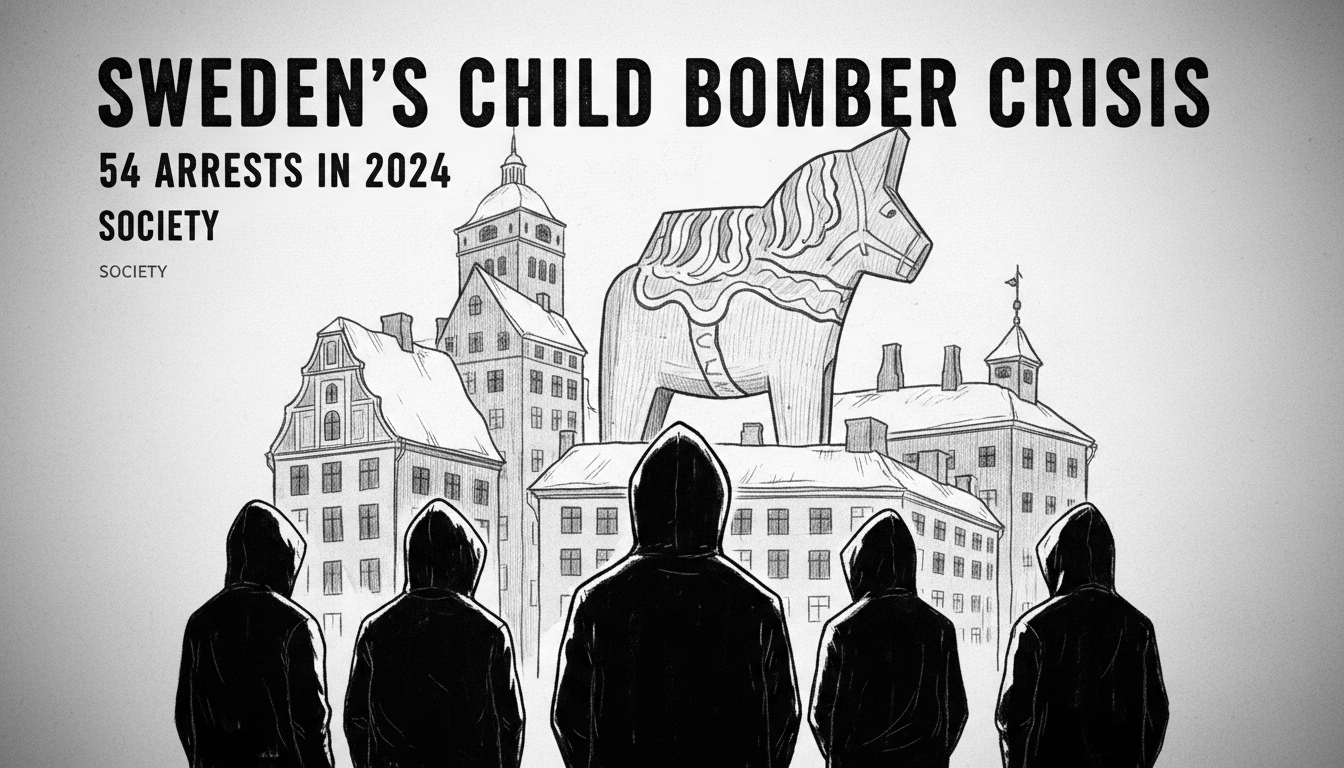
Sweden youth crime has reached a chilling new milestone with 54 children arrested this year on suspicion of involvement in bombings. This figure represents an almost threefold increase compared to 2023, a statistic that has sent shockwaves through the Nordic region and forced a painful reckoning with the nature of gang recruitment. For a society built on principles of child welfare and protection, the image of minors handling explosives is a profound societal failure. As a reporter covering integration in Copenhagen, I see this as a stark warning signal for the entire region, where social fractures can have devastating consequences.
A Disturbing Statistical Surge
The raw numbers tell a grim story. Swedish authorities report that 54 individuals classified as children have been detained in connection with bomb plots or explosions in 2024. This sharp rise from last year's total is not an isolated spike but part of a sustained trend of younger individuals being drawn into Sweden gang violence. The crimes range from planting explosive devices to acting as lookouts or couriers for established gang members. Under Swedish law, children under 15 cannot be formally charged with crimes, creating a complex legal and ethical dilemma for law enforcement. This legal framework means many of these children enter a cycle of arrest and release without facing traditional prosecution, a reality that frustrates police and terrifies communities.
Experts point to a calculated strategy by criminal networks. "Gangs are exploiting legal loopholes and societal vulnerabilities with cold precision," says Lars Andersson, a criminologist specializing in organized crime in Stockholm. "They know a child under 15 faces minimal legal risk, making them perfect, disposable assets for high-risk tasks like transporting bombs." This tactic reflects a brutal evolution in gang methodology, moving beyond simple intimidation to leveraging the most vulnerable members of society as shields and weapons. The increase parallels a broader rise in the use of homemade explosives and grenades in Swedish criminal conflicts over the past five years.
The Roots of Recruitment in Marginalized Communities
To understand this crisis, one must look at the fertile ground in which gangs sow recruitment. Analysts consistently link the surge in Sweden child bomber arrests to deep-seated issues of socioeconomic inequality, segregation, and failed integration. Many of the children involved come from marginalized suburbs of major cities like Stockholm, Malmö, and Gothenburg—areas often characterized by high unemployment, lower educational outcomes, and a palpable sense of alienation from mainstream society. These are not random children making poor choices; they are often systematically targeted.
Criminal gangs offer a twisted alternative to a system that has left them behind. They provide a sense of identity, quick money, and perceived respect that schools and social services struggle to match. "When the state is absent or perceived as an oppressor, gangs fill the vacuum," explains Aisha Mohamed, a community leader working with at-risk youth in Malmö. "For a 13-year-old boy who feels invisible, being handed a mission and a phone by a powerful older gang member can feel like empowerment. They don't see the bomb; they see status and belonging." This recruitment often happens through older siblings, friends, or social media, making prevention extraordinarily difficult for authorities and parents alike.
A Policy Quagmire: Welfare vs. Security
The Swedish response finds itself trapped between its foundational welfare ethos and a pressing security crisis. The traditional model, focused on social care and rehabilitation for young offenders, appears ill-equipped to handle the scale and severity of this new threat. Police operations can arrest children, but social services often lack the secure facilities or mandated programs to deal with individuals involved in such serious, organized violence. This gap creates a revolving door that erodes public trust and emboldens gang leaders.
In recent months, the political debate has grown increasingly heated. Some parties advocate for lowering the age of criminal responsibility or creating new legal categories for serious crimes committed by minors. Others argue this would criminalize a generation and exacerbate the problem, calling instead for massive investment in social programs, schools, and youth outreach in vulnerable areas. "We cannot arrest our way out of this," argues Social Policy Analyst Erik Lundgren. "Every child holding a bomb is a testament to a dozen missed opportunities for intervention—in school, in the family, in the neighborhood. The solution must be upstream, focusing on inclusion, education, and economic hope."
The government has announced new funding for police and tougher penalties for adults who recruit minors into crime. Yet critics say these measures address symptoms, not causes. The core challenge remains: how to rebuild the social contract in neighborhoods where gangs have become the dominant authority. This involves not just more social workers, but also addressing discrimination in the housing and labor markets that perpetuates segregation.
A Nordic Warning and the Path Forward
From my perspective in Denmark, Sweden's crisis serves as a sobering case study. While Denmark faces its own challenges with gang violence, the systematic use of children as bombers represents an alarming escalation that has not yet crossed the Øresund. The underlying conditions—segregated urban areas, integration challenges, and gang presence—exist in Copenhagen and other Danish cities as well. The difference may be one of degree, not kind.
The Swedish experience underscores that child welfare systems designed for a different era are not prepared for networked, militarized gang recruitment. It highlights the urgent need for cross-sector cooperation between police, schools, social services, and community organizations, sharing information and intervening early. Some Swedish municipalities are now experimenting with mandatory participation in intervention programs for children suspected of serious crimes, even if they cannot be charged.
The road ahead is long and fraught. Reversing this trend requires a dual strategy: immediate, effective measures to disrupt gang operations and protect communities, coupled with a generational commitment to inclusive social policy. It demands honest conversations about integration, opportunity, and what it means to belong in a modern Nordic society. The 54 children arrested this year are both perpetrators and victims, a living indictment of a broken social compact. Their stories ask a piercing question that echoes across the region: when a child becomes a weapon, what does that say about the society that created the conditions for it to happen?