
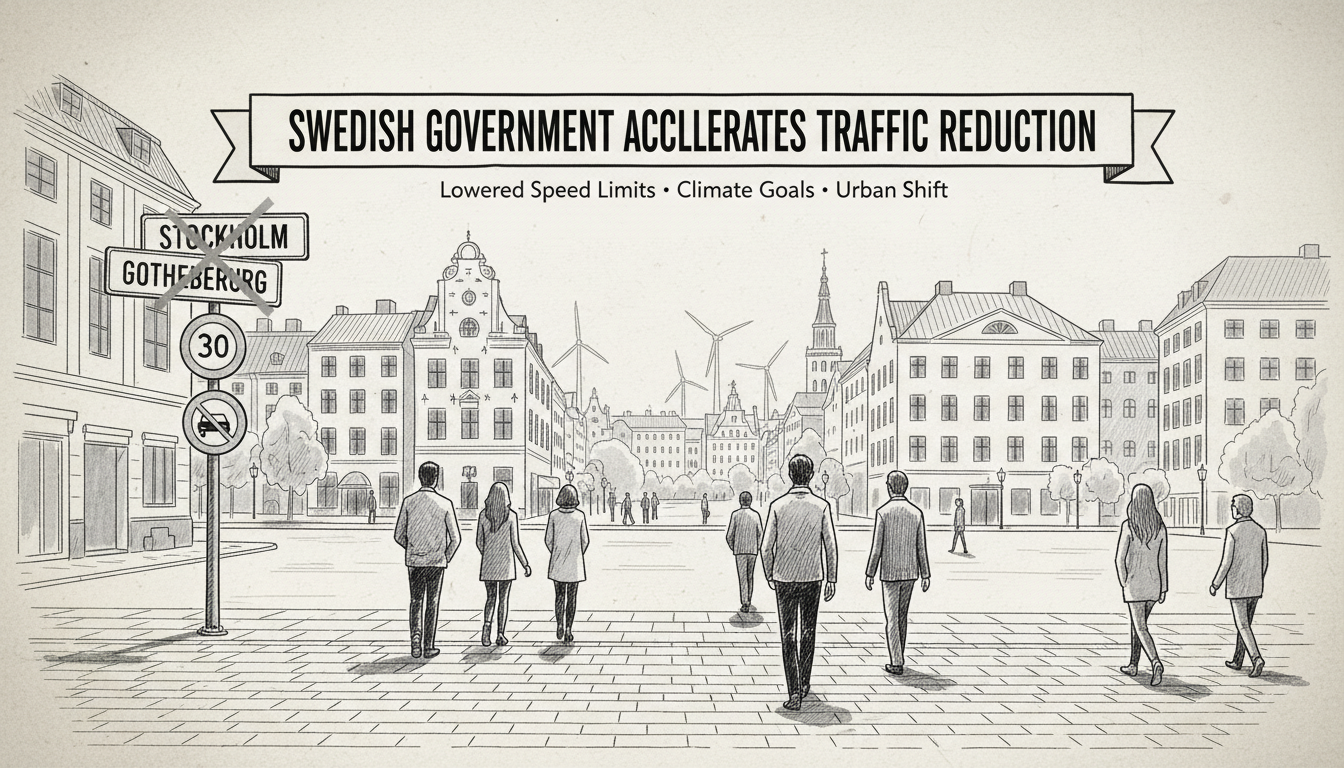
The Swedish government is implementing a new strategy to curb private vehicle use in urban centers. This policy shift responds directly to missed environmental targets and declining public transport ridership. Stockholm and Gothenburg will see lower speed limits as a primary tool to discourage car traffic.
Emma Josefsson, a senior official with the city environment administration, confirmed the accelerated timeline. She said the new organizational structure allows for faster implementation of traffic-calming measures. The statement came during a briefing on updated municipal climate action plans.
This move aligns with broader Riksdag decisions on national climate frameworks. The Swedish Parliament has mandated stricter adherence to emission reduction goals. Government policy in Sweden now explicitly links urban planning with environmental outcomes.
Analysts view this as a significant tactical change. Previous administrations focused more on incentives for public transport use. The current approach uses direct disincentives for private car travel. Speed reductions are a clear example of this more assertive policy.
The bureaucratic process involves coordination between national and municipal levels. Proposals originate in city districts but require alignment with national transport agencies. Final approval often involves the Ministry of Climate and Enterprise.
Historical context shows a gradual shift in Swedish urban policy. For decades, car infrastructure received priority funding in development plans. The reversal began with congestion charges in Stockholm but is now expanding to physical traffic management.
International observers note Sweden's traditionally high car ownership rates. The country has excellent roads but faces pressure from European Union climate directives. Domestic politics also play a role, with coalition agreements emphasizing green transitions.
The practical implications for residents are immediate. Lower speed limits will affect daily commutes and local traffic patterns. Municipalities plan to reallocate road space to bicycles and pedestrians. Public transport routes may receive priority lanes as part of the same initiative.
This policy faces predictable criticism from motorist organizations. They argue it penalizes drivers without providing adequate alternatives. Proponents counter that behavioral change requires both carrot and stick approaches.
The real test will come during the next election cycle. Voters in suburban districts may react negatively to increased commute times. Urban core residents generally support measures that reduce noise and pollution. The political calculus at Rosenbad must balance these competing interests.
Similar measures exist in other Nordic capitals but Sweden's approach is notably systematic. The integration of traffic policy with climate targets creates a legally binding framework. This differs from the more voluntary systems used in some neighboring countries.
What happens next depends on implementation speed and public acceptance. Monitoring will track changes in modal share and emission levels. The Riksdag could mandate further reductions if targets remain out of reach. The government has signaled willingness to use all available policy tools.
For international readers, this demonstrates Sweden's methodical approach to environmental challenges. Policy connects directly to measurable outcomes through legislation. The system allows for adjustment based on performance data rather than political cycles alone.