
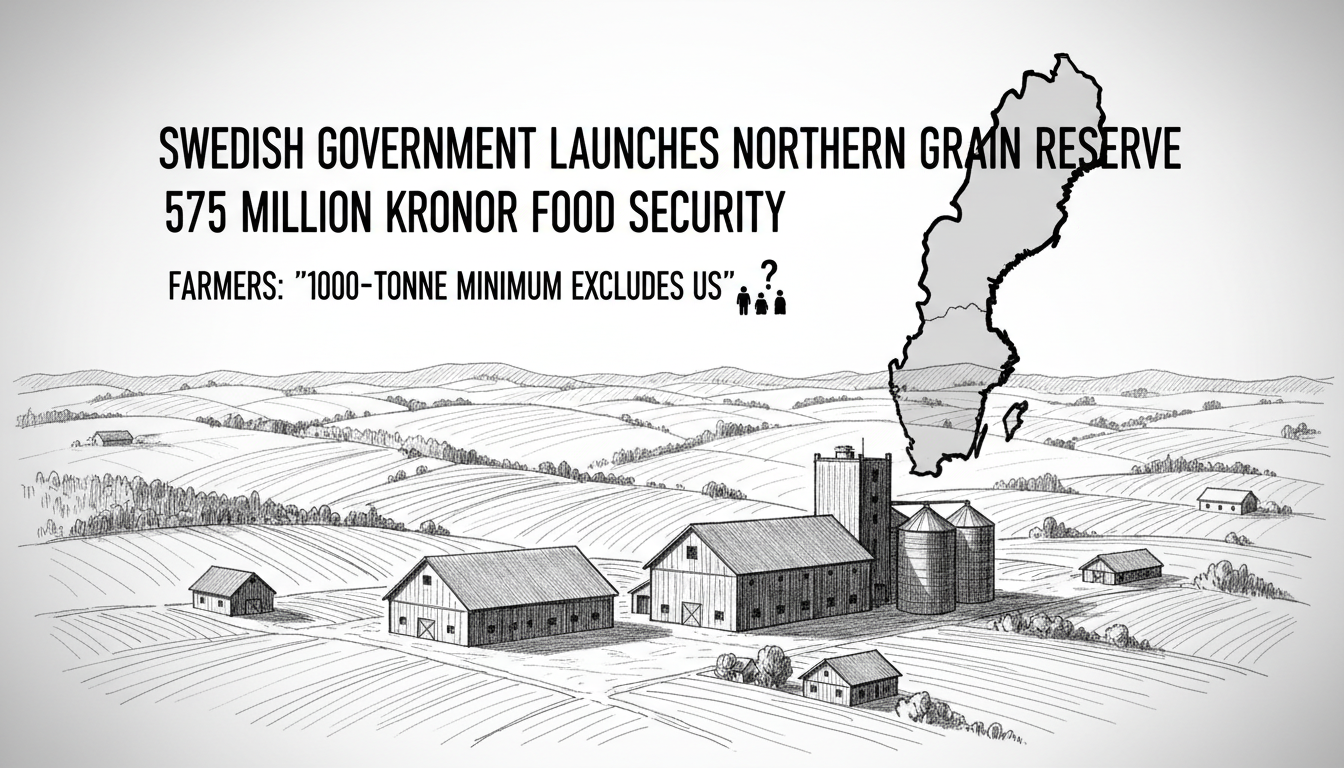
The Swedish government has directed the Swedish Board of Agriculture to strengthen national grain production. A strategic reserve, primarily for wheat, will be established. The state has allocated 575 million kronor for the project, with implementation targeted for the third quarter of 2026. The four northernmost counties of Sweden will be the first to develop storage plans for food-grade wheat. This policy, emerging from discussions at Rosenbad, represents a significant shift in national food security strategy.
The operational model requires the state to purchase a set quantity of grain from participating farmers. These farmers must then ensure the grain is stored and that a minimum quantity remains constantly available. Farmers can participate by submitting a bid. A central requirement mandates that each bidder must be capable of delivering and storing at least 1,000 tonnes of wheat. This threshold has sparked immediate criticism from agricultural representatives in the north.
Several farmers argue the volume requirement is prohibitively high. The chairman of the Farmers' National Federation in Västerbotten stated the rule could exclude smaller operators in northern Sweden. Farmer Erik Bäckström from Stöcke, near Umeå, voiced a common concern. He said authorities should not set requirements that make the goals impossible to achieve. This tension highlights a classic conflict between bureaucratic efficiency and regional economic inclusion.
The Swedish Board of Agriculture defends the 1,000-tonne minimum. Officials state the limit ensures reserves are of a substantial size. Smaller reserves are reportedly more difficult to manage and mobilize during a heightened state of readiness. Saranda Daka, a preparedness officer at the Board, explained the rationale. She said small farms may struggle with these requirements. The agency aimed to create a model cost-effective in both peacetime and wartime. For the state, managing numerous small storage sites incurs much higher administrative costs, according to the official statement.
This initiative must be understood within Sweden's broader civil defense overhaul. Recent Riksdag decisions have consistently funneled resources into total defense, encompassing both military and societal resilience. Building domestic grain reserves reduces dependency on vulnerable maritime supply lines. The focus on the north is strategic. It leverages geographical dispersal, moving critical supplies away from more exposed southern regions. The policy also indirectly supports northern agriculture, a sector often facing economic challenges.
Yet, the critique from northern farmers is valid and exposes a policy flaw. By setting a high entry bar, the Swedish government risks consolidating the reserve system with a few large agribusinesses. This could undermine the goal of a resilient, distributed network. It also contradicts political rhetoric about supporting rural communities and small businesses. The government must now demonstrate whether its priority is pure administrative convenience or building a genuinely robust, geographically diverse security buffer. The success of this Riksdag-backed measure will depend on its final implementation and potential adjustments to accommodate regional realities.