
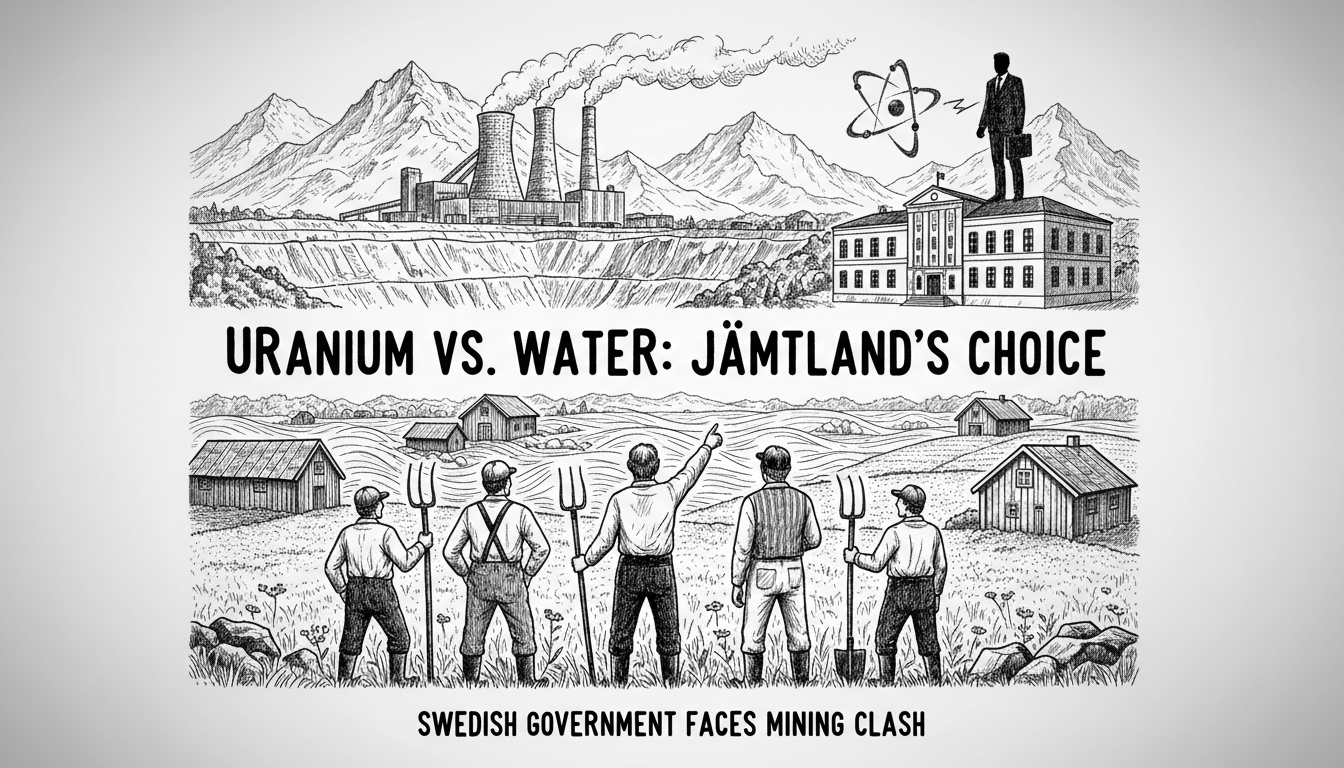
The Swedish government's push for domestic critical minerals is colliding with fierce local opposition in Jämtland County. Plans by foreign firms Aura Energy and District Metals to mine uranium and vanadium in the Åre municipality have sparked a cross-party protest. Farmers, municipalities, and environmental groups warn of irreversible damage to agricultural land and a crucial water source for 50,000 people. This conflict tests the Riksdag's recent decisions to lift the uranium extraction ban and highlights a core tension in Stockholm politics: balancing energy security with environmental protection.
Fourth-generation farmer Marléne Ljungdahl tends 85 goats on land targeted for mining. She argues Swedish agricultural land is being sacrificed for foreign corporate profit. The metals extracted would be sold on a global market, not reserved for Sweden. Her farm lies in the Oviksbygden area, where prospecting has occurred for years. Ljungdahl states the current government's pro-mining stance makes the plans feel more real than ever. She questions if policymakers in the Riksdag building truly understand the long-term consequences for the region.
The core legal battle revolves around the Swedish Mining Inspectorate's assessment of whether mining constitutes suitable land use. Simultaneously, EU directives demand greater European self-sufficiency in critical raw materials like uranium. This uranium is also touted as fuel for Sweden's planned new nuclear reactors. Energy and Industry Minister Ebba Busch of the Christian Democrats expressed trust in Sweden's strict environmental laws during a visit to Östersund. She acknowledged the unique risks of alum shale, the rock formation containing the uranium, but emphasized regulatory confidence.
Opposition is formidable and organized. Municipalities including Åre, Berg, Krokom, and Östersund have formally objected. They cite the 'riksintresse' or national interest status of the Minnesgärdet surface water intake in Lake Storsjön. This lake supplies drinking water to three municipalities. The local farming federation LRF also opposes alum shale extraction. Critics and several researchers point to a lack of proven, safe extraction technology for this specific geology. The fear is that mining could poison both the lake and surrounding farmland, devastating the local dairy and cheese production industry.
In official statements to the Mining Inspectorate, the municipalities of Åre and Berg demanded Aura Energy supplement its concession application with detailed environmental risk management plans. They stressed that good water quality is vital for animal husbandry and milk production. Aura Energy responded that its planned operation is roughly six kilometers from Lake Storsjön and should not directly impact the water intake. The company acknowledged the need for expanded sampling and more comprehensive investigations within a future potential environmental permit application.
This standoff is a classic Swedish policy dilemma, playing out far from the government offices in Rosenbad. It pits national energy strategy and economic interests against the principle of local self-determination and environmental precaution. The Swedish Parliament's legislative shift has created the conditions for this conflict. The government policy in Sweden now actively encourages mining for critical materials. Yet, the final decision rests with an independent agency weighing complex technical data against powerful local and environmental concerns. The outcome will set a precedent for similar conflicts across the Nordic region, where the green transition's demand for minerals increasingly meets protected landscapes and traditional industries.