
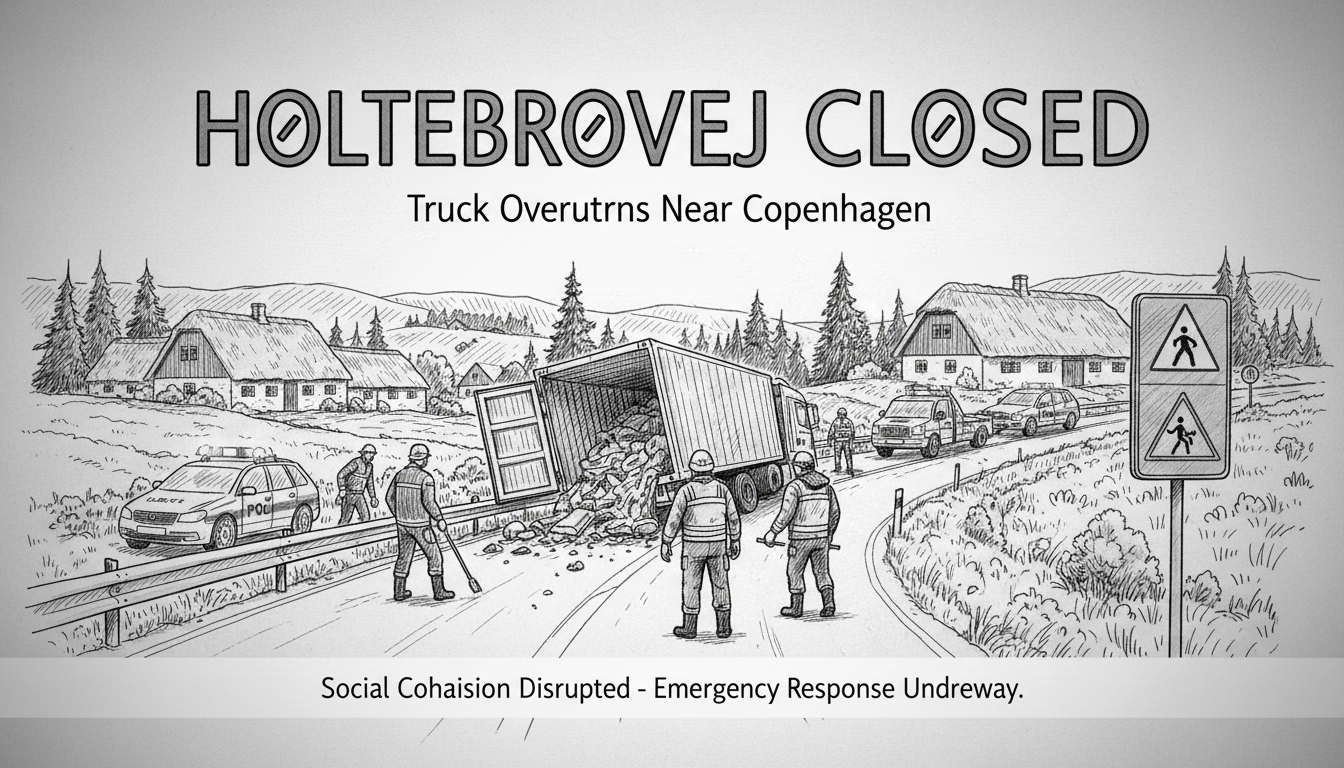
A truck overturned earlier today on Holtebrovej, a key road connecting the towns of Finderup and Hanning in North Jutland. Police and emergency services from Falck are on the scene managing the incident. Crews are working to remove the vehicle, but the road remains closed in both directions for the time being. This disruption highlights the immediate logistical challenges such accidents pose to regional transport networks.
While this is a traffic incident, it serves as a tangible entry point to discuss the infrastructure that supports Danish society. Denmark's extensive and well-maintained road network is a critical component of its welfare model. It connects rural areas like those around Holtebrovej to urban centers, ensuring equal access to services, education, and employment. A closure here is not just an inconvenience. It can delay deliveries, impact commuters, and strain local emergency response protocols, testing the system's resilience.
From my perspective covering Danish society, these moments reveal the interconnectedness of policy and daily life. The efficiency of the police and Falck's response is underpinned by municipal planning and national regulations. Denmark's social policy often focuses on integration and community cohesion in urban centers like Copenhagen. Yet, reliable infrastructure in all regions is a prerequisite for that social stability. It allows for the mobility required for jobs, family connections, and cultural participation, which are all pillars of successful integration.
Consider the data. Municipalities across Denmark, including those in North Jutland, report that access to transportation is a key factor in employment rates for both native Danes and new residents. When a main artery like Holtebrovej is blocked, it doesn't just stop traffic. It can momentarily isolate communities and remind us how fragile the connections we rely on can be. Social centers and community programs depend on these physical links to function.
What happens next? Officials will clear the wreckage, investigate the cause, and reopen the road. The process is typically swift, a testament to Denmark's operational efficiency. But for a few hours, residents experience a small rupture in the predictable flow of Danish life. It is a reminder that the much-discussed Danish welfare system and its integration policies are built upon a physical foundation of roads, rails, and reliable services. When one link falters, however briefly, we see the entire system's dependency on its most concrete elements.