
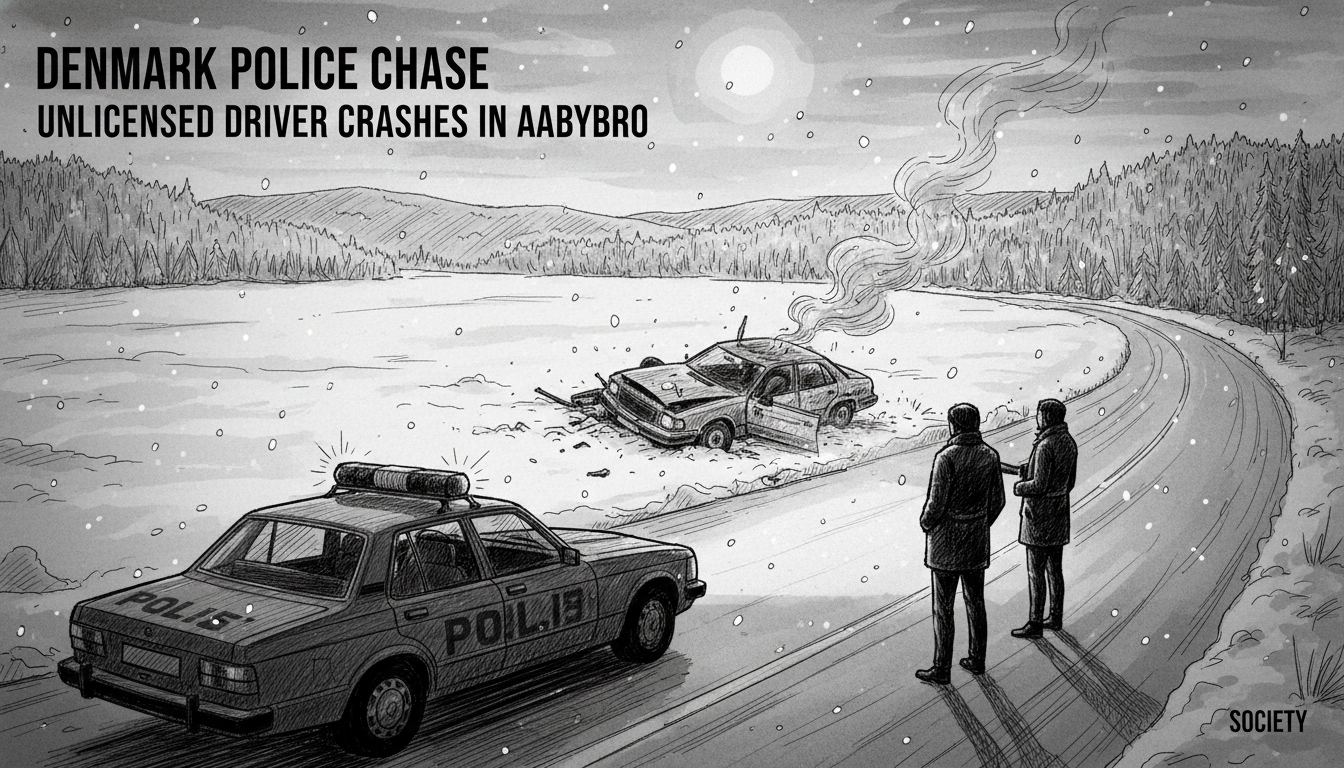
Denmark police pursuits and unlicensed driving incidents are a persistent challenge for law enforcement, as seen in a recent crash in North Jutland. A man in his 30s lost control of his vehicle and crashed in Aabybro on Wednesday afternoon after attempting to flee from police. The brief pursuit ended without serious injury, but the driver now faces multiple charges for evading officers and driving without a valid license. This single incident highlights a broader national issue of road safety and illegal driving that Danish authorities confront regularly.
Vagtchef Torben Arendrup from North Jutland Police provided a straightforward account of the events. "We had a very short pursuit of the man into town, as he would not stop and instead accelerated," Arendrup said. "The man subsequently lost control of the car and crashed. He was not seriously injured, but he was taken for checks at the hospital." According to the police chief, the incident will result in several charges against the man, primarily for fleeing police and for operating a vehicle without the required driving credentials.
The Immediate Aftermath and Legal Repercussions
The driver's decision to accelerate away from police initiated a chain of events that could have ended far worse. Aabybro, a town in the Brønderslev Municipality with a population just over 5,000, became the scene of a sudden police intervention. The crash, occurring around 3 PM, disrupted the ordinary afternoon but resulted in no other casualties or significant property damage beyond the driver's own vehicle. The man's non-life-threatening injuries meant he could be transported to the hospital for assessment before facing the legal consequences of his actions.
Danish police guidelines for pursuits emphasize minimizing risk to the public above all else. Officers must continuously assess whether the danger of continuing a chase outweighs the necessity of apprehending a suspect immediately. In this case, the pursuit was described as "very short," suggesting police may have been preparing to terminate it when the driver lost control independently. The charges he faces are not minor. Fleeing from police ("Flugt fra politiet") is a serious offense under Danish traffic law, often resulting in substantial fines and a mandatory driver's license suspension for those who hold one.
A Persistent Problem in Danish Traffic Safety
This incident in Aabybro is not an isolated case but part of a recurring pattern across Denmark. In 2022 alone, Danish police registered over 5,000 cases of driving without a license. This figure represents thousands of individuals who, for various reasons, choose to operate vehicles illegally on public roads. The motivations can range from prior license revocation due to DUIs or speeding, to individuals who have never obtained a license, or to those whose residency status does not permit them to drive legally in Denmark.
"Every instance of an unlicensed driver on the road represents a preventable risk," says Lars Jensen, a senior advisor with the Danish Road Safety Council. "These drivers have not been vetted for competency, they are often uninsured, and the decision to drive illegally is frequently coupled with other risky behaviors, like fleeing from police. It creates a perfect storm for accidents." The social cost is significant, involving emergency service responses, potential medical care, and long-term impacts on victims of crashes caused by unlicensed drivers.
The Human and Social Factors Behind the Wheel
While the legal and safety aspects are clear, the reasons people drive without licenses often touch on deeper social issues. For some, it is a matter of economic necessity in regions with limited public transport, like parts of North Jutland. Losing a license can mean losing a job, creating a desperate incentive to continue driving. For others, it stems from systematic exclusion or difficulties navigating the Danish system for license conversion from foreign credentials.
Community social workers in municipalities across Jutland note that transportation barriers are a common theme. "Access to reliable transport is a cornerstone of integration and employment," says Anika Berg, a social counselor in a nearby municipality who asked not to be directly affiliated with the case. "When that legal avenue is closed due to a revoked license or bureaucratic hurdles, some see illegal driving as their only option to maintain their livelihood or family responsibilities. This doesn't excuse the behavior, but it explains why the problem persists despite stiff penalties." Solving it, she suggests, requires more than just policing; it needs parallel support systems for alternative transport and legal pathways to relicensing.
Police Protocol and Public Safety Balancing Act
The North Jutland Police's handling of the Aabybro incident reflects national protocols designed for high-stakes decisions. Danish police officers receive specific training on pursuit driving and risk assessment. The overriding principle is always the safety of the general public. Pursuits are typically authorized only for suspected serious crimes, and they must be called off if the speed or manner of driving creates an unacceptable danger to other road users, pedestrians, or the officers themselves.
A former police traffic coordinator, who spoke on condition of anonymity, explained the calculus. "The officer in the moment is weighing the immediate offense—like a traffic violation or suspicion of no license—against the potential for a high-speed crash in a populated area. In a small town like Aabybro, with its streets and potential for pedestrians, the threshold to disengage is lower than on a deserted highway. The fact this was a short pursuit indicates they were likely following that protocol." The ultimate goal is to identify the vehicle and driver for later apprehension, rather than engage in a dangerous chase for a non-violent crime.
Penalties and Prevention Strategies
The legal consequences for the Aabybro driver will be determined by the courts, but the framework is well-established. Driving without a license can lead to a fine of several thousand kroner. The penalty for fleeing police is more severe and often includes a prison sentence, typically in the range of a few months, especially if the flight endangered others. The court will also consider any previous traffic offenses. Beyond punishment, Danish authorities also focus on prevention through vehicle impoundment. Police have the authority to seize and, eventually, sell the cars used in serious traffic offenses, including repeated unlicensed driving, which acts as a significant financial deterrent.
Municipalities and police districts also run targeted campaigns. These include checkpoints and increased patrols in areas known for traffic violations, as well as public information efforts about the severe penalties and risks. "Enforcement is crucial, but so is the message that getting caught is a near certainty," says the former coordinator. "Modern automatic number plate recognition (ANPR) systems in patrol cars make it easier to flag vehicles linked to unregistered owners or suspended licenses, even without a chase."
A Local Incident with National Implications
The crash in Aabybro will soon fade from local headlines, but the issues it represents will not. Every year, thousands of similar violations occur across Denmark, each carrying the potential for tragedy. They strain police resources, burden the healthcare and legal systems, and undermine overall road safety. For the residents of Aabybro, it was a startling afternoon event. For policymakers and law enforcement, it is another data point in an ongoing struggle to ensure that only qualified, licensed, and insured individuals operate vehicles on Danish roads.
The solution lies in a combined approach: consistent enforcement of clear laws, continued refinement of safe police pursuit policies, and a societal look at the underlying reasons individuals choose to drive illegally. As Denmark continues to prioritize road safety, incidents like the one in Aabybro serve as sharp reminders that legal compliance behind the wheel is not just a bureaucratic formality, but a fundamental component of public security. The next driver who considers fleeing or driving without a permit must understand that the risks—of a crash, of severe legal fallout, and of causing irreparable harm—far outweigh any perceived short-term benefit.