
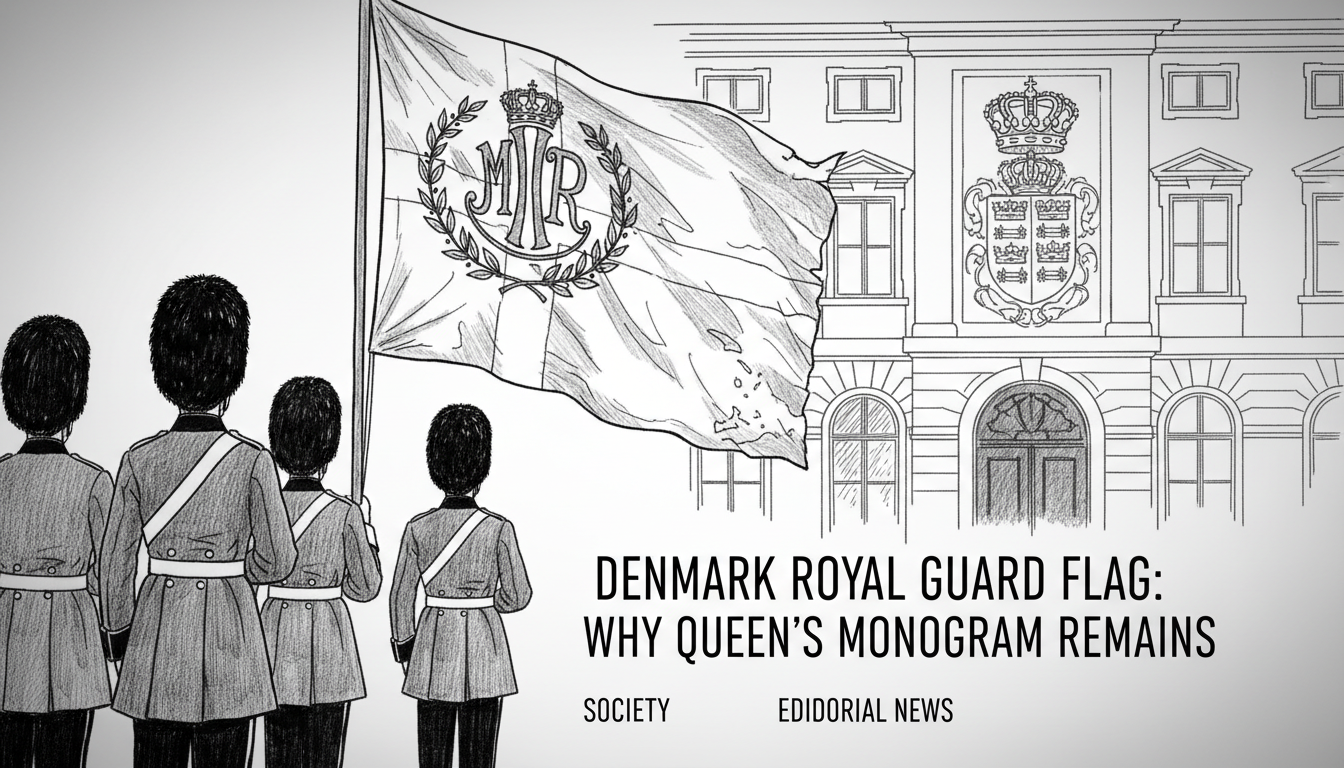
Danish Royal Guard traditions were thrust into the spotlight this New Year’s Eve when viewers spotted a familiar monogram. As King Frederik X delivered his first national address from Amalienborg, the ceremonial flag behind him bore the distinct ‘MR’ of his mother, Queen Margrethe II. This detail sparked immediate public curiosity across Denmark, with many questioning the protocol. The explanation reveals a deep-seated military tradition where battalion flags are eternal symbols of a monarch's personal bond with their troops.
The Monogram That Started a National Conversation
TV screens across the nation focused on the King, but sharp-eyed Danes focused on the flag. The banner held by the Royal Life Guards’ 4th Battalion clearly displayed Queen Margrethe’s interlaced ‘M’ and ‘R’. Some observers even noted an apparent hole in the fabric. This visual anomaly during a historic moment—the new King’s first New Year’s speech—prompted a wave of questions. The public’s attention shifted briefly from the sovereign’s words to the symbol at his side. It was a rare moment where ceremonial detail became national news.
The Royal Life Guards swiftly clarified there was no error. Press Officer Thomas Helbro Reimann explained the flag’s enduring significance. “This is the 4th Battalion’s flag, which was originally consecrated by Queen Margrethe and therefore will always bear her monogram,” he stated. This rule applies to all battalion flags within the Danish armed forces. Each flag is personally consecrated by the reigning monarch at the time of the battalion's creation. The sovereign hammers the first nail into the flagpole, creating a permanent link. That monarch’s cipher remains on the battalion flag forever, a permanent record of its origin.
A Tradition Forged in History and Nails
This practice separates battalion flags from regimental flags, which follow different rules. Regimental flags are updated after each succession to bear the new monarch’s monogram. Battalion flags, however, are considered historical documents in cloth. They are only retired if the battalion itself is disbanded. “Some of our flags also carry the monograms of King Christian X and King Frederik VIII,” Reimann noted, illustrating the tradition's longevity. The flag is a physical chronicle of the battalion’s service through different reigns.
The potential wear and tear, including holes like the one spotted by viewers, is part of its story. The original flag cloth can be replaced if it becomes too damaged, but even a new duplicate will carry the original consecrating monarch’s monogram. This ensures historical continuity outweighs material condition. The tradition underscores that the bond between the monarch and a specific military unit is fixed at its founding moment. It is a powerful statement that some ties, once forged, are not altered by the passage of time or change in personnel.
Expert Perspective: Symbols of Continuity in a Modern Monarchy
Military historians see this as a core element of the Danish monarchy’s institutional strength. “The battalion flag tradition is a masterclass in balancing change and constancy,” says Dr. Lars B. Hansen, a historian specializing in Nordic monarchies. “The public sees a new King, but the military displays an unbroken lineage. The flag tells soldiers they are part of a legacy that predates and will outlast any single sovereign.” This creates dual layers of loyalty for the guards—to the institution of the monarchy and to their specific unit’s history.
The visual distinction between regimental and battalion flags is intentional. Regimental flags, which change, represent the guards’ service to the current Crown. The permanent battalion flags represent the Crown’s enduring commitment to that specific group of soldiers. It is a subtle, woven expression of mutual obligation. Experts argue this system prevents the military from becoming overly personalized to one ruler. Instead, it roots loyalty in the enduring office and the unit’s own proud history. The hole in the fabric, far from being an embarrassment, becomes a badge of honor—evidence of the flag’s active ceremonial life.
The Guard’s Role as Living Heritage
The Royal Life Guards, established in 1658, are more than a ceremonial unit. They are an active infantry battalion with operational roles, making their traditions a living part of Danish defense. Their iconic uniform and daily Changing of the Guard at Amalienborg are major tourist attractions. Yet, they are also combat-trained soldiers. This blend of frontline duty and unwavering tradition is uniquely Danish. The flag protocol bridges these two identities, connecting today’s serving soldiers to centuries of precedent.
The use of Queen Margrethe’s flag during King Frederik’s speech was a perfect demonstration of this principle. It visually honored the former Queen’s 52-year reign and her role as the battalion’s consecrator. Simultaneously, it showed the new King assuming his position as commander-in-chief of a military that respects its own history. For the guardsmen holding the flag, it was a routine duty. For observers, it was a lesson in unspoken protocol. The incident highlights how Denmark’s monarchy communicates stability through nuanced, consistent rituals.
What the Flag Reveals About Danish Values
This seemingly small detail offers a window into broader Danish societal values. It reflects a profound respect for tradition, rules, and institutional continuity. The system is practical; flags are not replaced without need, reflecting a sensible approach to resources. It is also deeply symbolic, emphasizing that the whole is greater than any individual part. In an age of rapid change, the monarchy offers a visual language of permanence. The flag’s continued use, hole and all, signals that integrity and history are more important than flawless appearance.
The public’s curiosity and the Guard’s clear explanation also show a healthy dynamic. Danes feel entitled to understand their national symbols, and institutions are prepared to explain them. This transparency strengthens public trust. The story ultimately reassures that procedures are followed, even when they are not immediately obvious to the public eye. King Frederik will get his own monogram on future battalion flags he consecrates. But for now, his mother’s flag stands correctly by his side, weaving the past and present into a single, sturdy fabric. The next time a royal ceremony unfolds, Danes will now understand the silent stories told by the banners in the frame.