
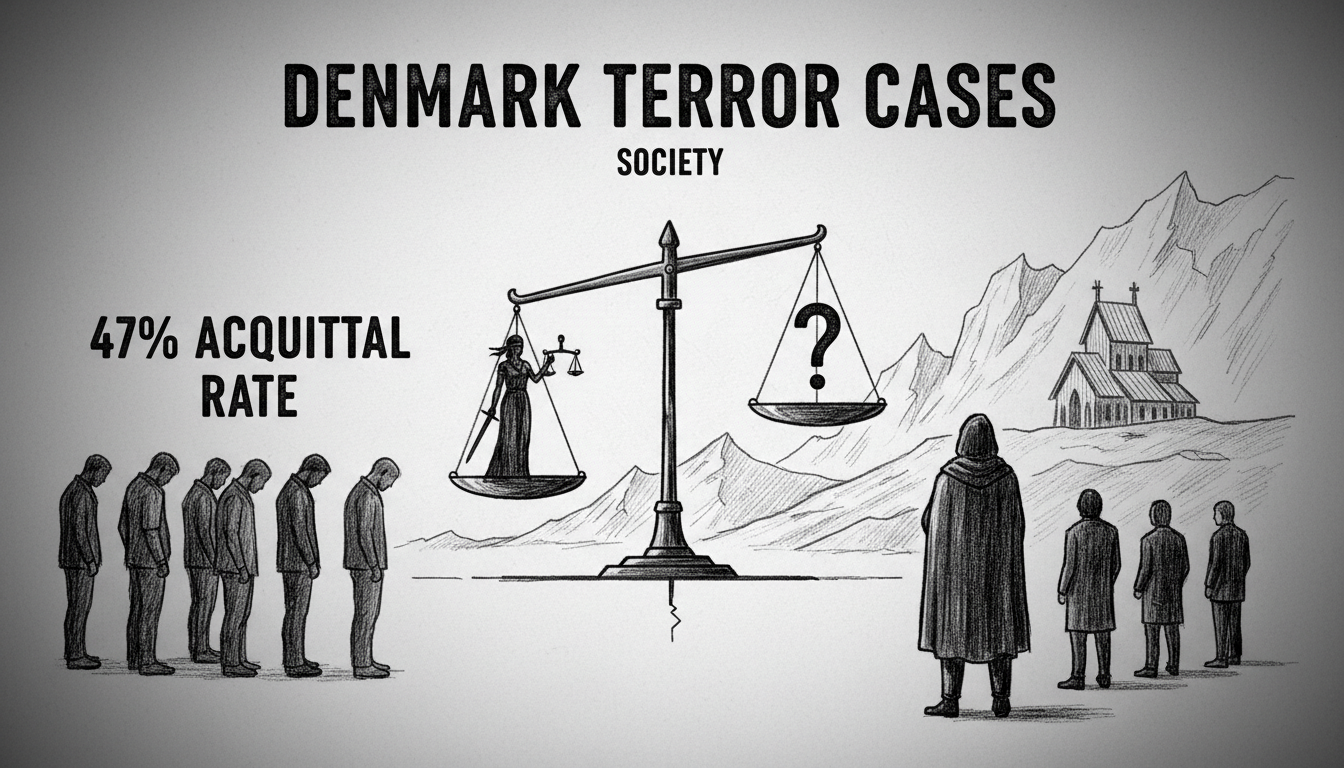
Denmark has seen nearly half of all defendants in terrorism cases acquitted over the past quarter-century. This striking statistic emerges from a recent statement by the head of the Danish Security and Intelligence Service (PET). While Denmark has faced numerous terrorism-related incidents and threats, its courts have consistently demanded high standards of proof. 'We should be happy about that,' a senior official stated, framing the acquittal rate as a sign of judicial strength.
This high rate of not-guilty verdicts presents a complex picture of Denmark's counter-terrorism efforts. It underscores the tension between proactive security investigations and the rigorous demands of the courtroom. For a nation frequently cited for its strong social trust and rule of law, these figures prompt a deeper examination of justice and security.
A Deliberate Legal Threshold
The 47% acquittal rate is not an accident of the Danish legal system. It is a designed feature. Experts point to the principle of 'in dubio pro reo'—in doubt, for the accused. This principle is deeply embedded in Danish jurisprudence. Prosecutors must prove guilt beyond a reasonable doubt, a standard that becomes particularly challenging in terrorism cases.
These cases often rely on intelligence, intercepted communications, and evidence of intent rather than completed acts. 'Proving someone's mindset and future plans to a criminal standard is one of the hardest tasks in law,' explains a Copenhagen-based legal scholar specializing in security law. The courts act as a critical filter, ensuring that suspicion does not automatically translate to conviction.
PET's Proactive Stance and Legal Scrutiny
The Danish Security and Intelligence Service, PET, operates with a mandate to prevent attacks before they occur. Established in 1951, its counter-terrorism role has expanded significantly since the early 2000s. Their work is inherently forward-looking, focusing on disrupting plots in their earliest stages. This preventative approach can sometimes lead to charges based on preparatory acts or conspiracy.
When these cases move from PET's intelligence realm to the judicial sphere, evidence faces intense scrutiny. Intelligence reports may be classified, and methods must be disclosed to the defense within limits. 'There is a natural gap between the intelligence picture and the evidence required for a criminal conviction,' a former PET analyst notes. This gap is where many cases encounter judicial obstacles.
Societal Trust and the Presumption of Innocence
The high acquittal rate reflects a societal choice. Denmark maintains a strong commitment to the presumption of innocence, even in emotionally charged security cases. This commitment reinforces public trust in state institutions. Citizens can see that the system includes checks against overreach by police and intelligence services.
This dynamic is observed closely in integration circles. Community leaders in neighborhoods like Nørrebro or Vollsmose emphasize its importance. 'When people see that the courts are independent and fair, it strengthens the social contract,' says a social worker in Aarhus. It signals that everyone, regardless of background or the severity of allegations, is entitled to a rigorous defense.
The International Context
How does Denmark's experience compare to other nations? Direct comparisons are difficult due to differing legal definitions and counter-terrorism strategies. However, analysts suggest that Denmark's acquittal rate appears high relative to some allies. Countries with broader terrorism statutes or different rules of evidence often secure more convictions.
Denmark's approach balances its international security obligations with its domestic legal traditions. The country has amended its counter-terrorism legislation several times to address evolving threats, including foreign fighter networks and lone actor attacks. Yet the core judicial safeguards remain firmly in place, acting as a counterweight to legislative expansion.
The Human Impact Beyond the Courtroom
An acquittal does not erase the experience of prosecution. Defendants and their families endure immense personal strain, media exposure, and social stigma. Even when cleared, reintegration into society can be a long and difficult process. The psychological and social fallout of a terrorism trial lingers long after a verdict.
This human cost is a critical part of the equation. It justifies the high burden of proof. The state's power to accuse someone of terrorism is profound. The legal system acknowledges this by setting the conviction bar exceptionally high. It is a protective measure for individual rights against the immense weight of the state's security apparatus.
A Model of Restraint or a Security Gap?
Perspectives on the acquittal rate diverge. Some security policy experts express concern. They argue it could indicate that legally watertight cases are not being built, potentially allowing dangerous individuals to avoid consequence. They call for closer alignment between investigative techniques and evidentiary standards.
Conversely, civil liberties advocates and legal experts champion the statistic. They view it as a healthy indicator of a functioning democracy. It demonstrates that courts are not simply rubber-stamping security agency requests. In an era where security powers have expanded globally, Denmark's judiciary shows notable independence.
Looking Ahead: Prevention vs. Prosecution
The central challenge for Danish authorities lies in bridging the prevention-prosecution divide. PET's mission is to stop plots, not necessarily to build court cases. Yet for the system to maintain legitimacy, successful prevention should ideally be followed by successful prosecution. This requires continuous dialogue and procedural adaptation between intelligence agencies, police, and the judiciary.
Future trends may test this balance further. The threats from cyber-enabled terrorism, extremist propaganda networks, and complex international plots present new evidentiary hurdles. Danish law will continue to evolve, but the core tension between security and liberty will persist. The 47% acquittal rate is a quantifiable expression of that ongoing national conversation.
Ultimately, the figure is more than a legal statistic. It is a reflection of Danish societal values. In a world where terrorism seeks to undermine open societies, Denmark's response includes an unwavering commitment to its own legal principles. The courts ensure that the fight against terrorism does not compromise the fundamental rights it aims to protect. This is the delicate, and perhaps fortunate, balance that Denmark continues to navigate.