
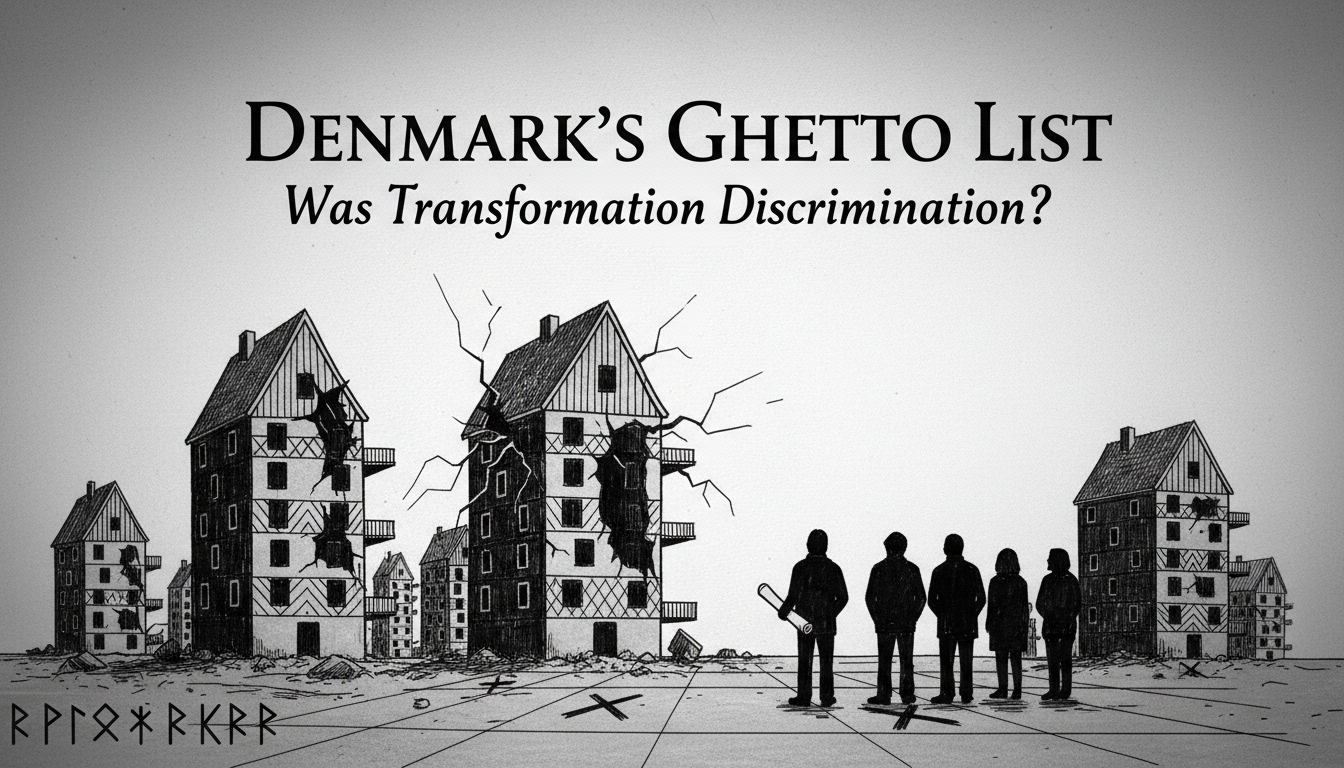
Denmark’s controversial 'ghetto list' has directly impacted over 100,000 residents since 2010. In the Copenhagen district of Nørrebro, the transformation of Mjølnerparken stands as the policy’s most prominent test case. A legal challenge now questions whether efforts to dismantle a 'parallel society' crossed into unlawful discrimination, with a landmark decision pending.
For residents like Amina Hassan, the changes arrived with official letters and construction fences. The social housing complex she called home for fifteen years was slated for physical renovation and social remixing. "They said they were making it better, more mixed," she tells me at a community center nearby. "But the message was clear: our community was the problem. We were the problem." Her story underscores the human reality behind a Danish social policy born from deep-seated concerns about integration.
The 'ghetto list,' formally known as 'parallel society areas,' was established to identify and transform neighborhoods. To be listed, an area must meet at least two of four criteria: over 40% unemployment, over 50% of residents with non-Western backgrounds, crime rates 300% above the regional average, and low education or income levels. Inclusion triggers a series of mandatory interventions, including mandatory daycare for children over one and potential demolition or sale of up to 60% of housing units to force demographic change.
A Policy with Physical Consequences
Mjølnerparken, built in the 1980s, became a fixture on the list. Its planned transformation aimed to break up the concentration of residents with immigrant backgrounds. Copenhagen Municipality and the housing association launched the 'Metropol' project. It involved renovating buildings, changing the housing mix, and selling off apartments to private owners. The goal was explicit: to ensure no more than 40% of residents in any building had a non-Western background.
This demographic target lies at the heart of the legal dispute. Critics argue it constitutes ethnic profiling and discrimination, treating citizens differently based on their origin. A group of residents, supported by the Danish Institute for Human Rights, took their case to the Danish Board of Equal Treatment. They argue the policy violates the Danish Anti-Discrimination Act and the EU's Racial Equality Directive.
"When you design a policy where the key metric is a person's ethnic background, you are on dangerous ground," says legal scholar Karsten Lauritzen. "The intention to promote integration may be legitimate. But the method of setting a maximum percentage for a specific group is highly problematic in a legal sense." The Board's ruling, expected soon, could force a fundamental rethink of Denmark's approach.
The Integration Paradox
Proponents of the policy frame it as tough but necessary social engineering. They cite decades of challenges in areas like Mjølnerparken: higher school dropout rates, lower workforce attachment, and gang recruitment. "We cannot accept parallel societies where the basic Danish norms and opportunities are not in effect," a former Integration Minister once stated. The policy enjoys broad cross-party political support, reflecting widespread Danish anxiety about failed integration.
Yet, many sociologists argue the list itself creates a self-fulfilling prophecy. "Labeling an area a 'ghetto' stigmatizes every person who lives there," explains Professor Ida Jensen, who studies urban policy. "It tells the outside world to be wary and tells residents they are failures. This makes it harder for them to find jobs and integrate. The tool designed to solve a problem actually perpetuates it." Her research points to falling property values and increased social isolation following an area's designation.
The physical transformation also risks displacing the very communities it aims to help. While some residents may buy their newly privatized apartments, many are relocated to other social housing areas. This simply moves the challenge elsewhere without solving the underlying issues of education, language skills, and labor market access.
Expert Analysis: A Flawed Tool?
The debate exposes a central tension in Danish society. Denmark is proud of its extensive welfare system and egalitarian ideals. However, its approach to immigration has grown increasingly strict. The 'ghetto list' policy tries to use the tools of the welfare state—housing regulation, social planning—to engineer a specific social outcome.
"The policy confuses correlation with causation," argues Jens Thorhauge, a former city planner. "Poverty, unemployment, and crime are the real issues. These affect disadvantaged areas globally, regardless of ethnicity. By focusing so heavily on residents' origins, Denmark risks addressing symptoms while missing the root causes. It also alienates the communities whose cooperation is essential for successful integration."
Data from other transformed areas shows mixed results. Some report decreased crime but also fractured community networks. There is little conclusive evidence that forced demographic mixing alone improves life outcomes. Successful integration, experts note, is a long-term process built on language education, job training, and social trust—not just housing quotas.
Awaiting a Legal Reckoning
The impending decision from the Board of Equal Treatment carries significant weight. A finding of discrimination could invalidate the core mechanism of the 'ghetto list' policy. It would force legislators back to the drawing board. At minimum, it would require a radical redesign of how transformation goals are set and measured.
Regardless of the verdict, Mjølnerparken's story highlights a painful learning process. It questions how a society dedicated to equality defines and achieves it when communities become segregated. The bricks and mortar are changing in Nørrebro. The deeper question is whether Denmark's approach builds bridges or deeper divides. As Amina Hassan puts it, "Integration is a two-way street. But here, it feels like a one-way order." The nation now waits to see if its highest legal authorities on equality agree.