
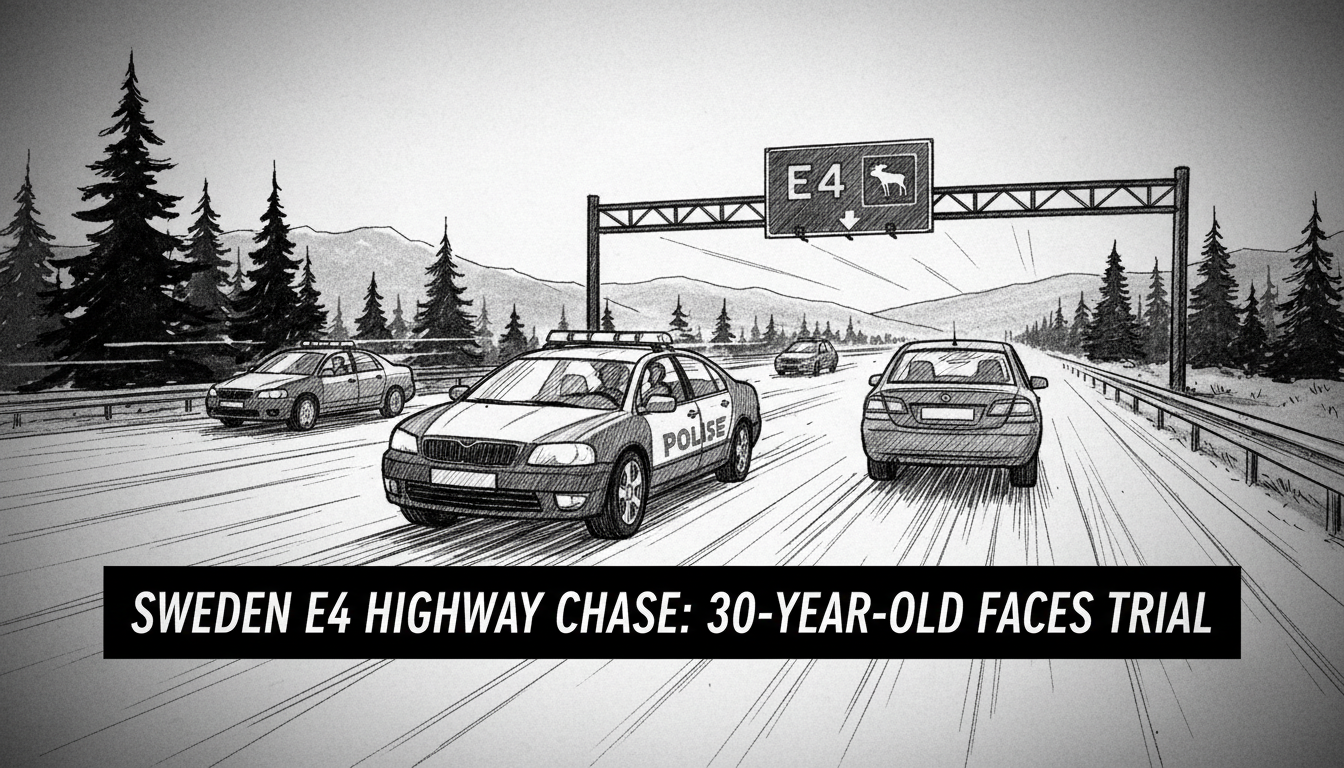
Sweden's E4 highway became the scene of a dangerous high-speed pursuit last summer, ending in a violent crash. A 30-year-old man is now on trial for gross negligence in traffic and causing bodily injury after a nighttime chase from Örnsköldsvik to Härnösand. The driver claims he was in a state of psychosis and on a military mission during the incident.
Prosecutors state the events began when the man, driving from Skellefteå towards Sundsvall, committed serious traffic violations. Police in Örnsköldsvik initiated a pursuit after observing extremely high speeds and red-light running. The chase continued south along the major arterial E4 route for approximately 100 kilometers.
It concluded catastrophically in Härnösand with a head-on collision between the man's car and a truck. The driver has admitted to the sequence of events and the charge of gross negligence. His stance on the charge of causing bodily injury to the truck driver remains unclear as legal proceedings advance.
A Dangerous Pursuit on a Vital Artery
The E4 highway is Sweden's primary north-south transport corridor, stretching over 1,590 kilometers. Incidents on this road have significant repercussions for national logistics and regional safety. High-speed chases on such a vital route are treated with utmost severity by Swedish authorities due to the immense risk they pose.
This particular pursuit underscores the challenges police face when a driver exhibits unpredictable, dangerous behavior. The decision to continue a chase over such a long distance involves constant risk assessment. Officers must balance the immediate danger posed by the fleeing vehicle against the risks of a prolonged pursuit on public roads.
Traffic safety analysts point to the inherent volatility of these situations. "A high-speed chase transforms a public highway into a potential crime scene," explains a senior road safety consultant. "The kinetic energy involved at such speeds means any loss of control can have devastating, irreversible consequences for all road users."
The Legal Reckoning and Mental State Defense
The 30-year-old defendant now faces the Swedish judicial system with a complex defense. By admitting to gross negligence but citing psychosis, his case enters a nuanced area of Swedish traffic and criminal law. The court must separate the objective act of dangerous driving from the subjective mental state of the driver.
Gross negligence in traffic, or grov vårdslöshet i trafik, is a serious charge in Sweden. It implies a conscious disregard for the safety of others that goes far beyond simple error. Convictions often lead to lengthy driving bans and potential imprisonment, reflecting the gravity of the offense.
The additional charge of causing bodily injury, vållande till kroppsskada, adds another layer. This requires prosecutors to prove a direct causal link between the driver's actions and the physical harm suffered by the other party. The outcome hinges on medical reports and accident reconstruction analysis.
"The claim of psychosis introduces a forensic psychiatric evaluation as a central component," notes a legal analyst familiar with similar cases. "The court will need to determine if this mental state negates criminal intent, which can significantly affect sentencing, even if liability for the act remains."
Policing Tactics and Public Safety Dilemmas
The incident raises persistent questions about police pursuit protocols. Swedish police guidelines emphasize de-escalation and minimizing public risk during chases. Tactics can include deploying spike strips, strategic roadblocks, or, in some cases, discontinuing a pursuit if the public danger becomes too great.
In this case, the use of spike strips, or spikmattor, was ultimately successful in stopping the vehicle. This tactic aims to safely deflate a car's tires and gradually bring it to a halt. However, its deployment requires precise timing and suitable road conditions to avoid causing a sudden, uncontrolled crash.
Experts in police methodology often debate the effectiveness of different approaches. "The goal is always to resolve the situation with the minimum possible harm," states a former police tactics instructor. "Every chase is dynamic. Officers on the ground and commanders in contact must continuously weigh the immediate threat of the fleeing driver against the risk of the pursuit itself."
This balance is particularly delicate on a highway like the E4, where speeds are high and traffic can include heavy goods vehicles. A collision involving a truck, as occurred here, dramatically increases the potential for severe injury or fatality.
The Aftermath and Broader Implications
The crash in Härnösand left more than just damaged vehicles; it resulted in bodily injury and likely profound psychological impact. For the injured truck driver, the event represents a traumatic violation of the ordinary risks of the road. Such incidents can lead to long-term physical and mental health consequences for victims.
Beyond the immediate victims, events like this affect community perception of road safety. High-profile chases can erode public confidence, making citizens feel vulnerable on major transport routes. They also trigger reviews of police procedures and legal frameworks governing traffic enforcement.
Sweden has long championed its Vision Zero policy, aiming to eliminate road fatalities and serious injuries. Single events contradict this ambition, highlighting the difficulty of accounting for extreme human behavior. They test systems designed for rational actors, not individuals experiencing psychosis or other crises.
The case also touches on societal issues of mental health and intervention. It prompts difficult questions about identifying individuals in crisis before they reach the point of endangering others. The driver's reported belief in a military mission suggests a severe break from reality that, in an ideal system, might have been addressed earlier.
A Case Study in Risk and Responsibility
As the trial proceeds, it will dissect a summer night where multiple systems—legal, medical, and policing—intersected with tragic results. The court's findings will contribute to the ongoing evolution of how Sweden manages extreme risks on its roads.
The fundamental tension lies in balancing accountability with understanding. The driver must answer for the tangible harm caused, regardless of his claimed mental state. Simultaneously, the case may reveal gaps in how society supports individuals experiencing severe psychological distress, potentially preventing future tragedies.
This incident on the E4 serves as a stark reminder. Public infrastructure is only as safe as the most unpredictable user upon it. The legal outcome will define responsibility for this event, but the broader challenge of ensuring safety amidst human complexity remains an ongoing journey for Swedish society.
Will this case lead to changes in how police handle pursuits of potentially mentally ill individuals, or will it reinforce existing protocols focused on immediate threat neutralization? The answers will shape responses to the next crisis on Sweden's highways.