
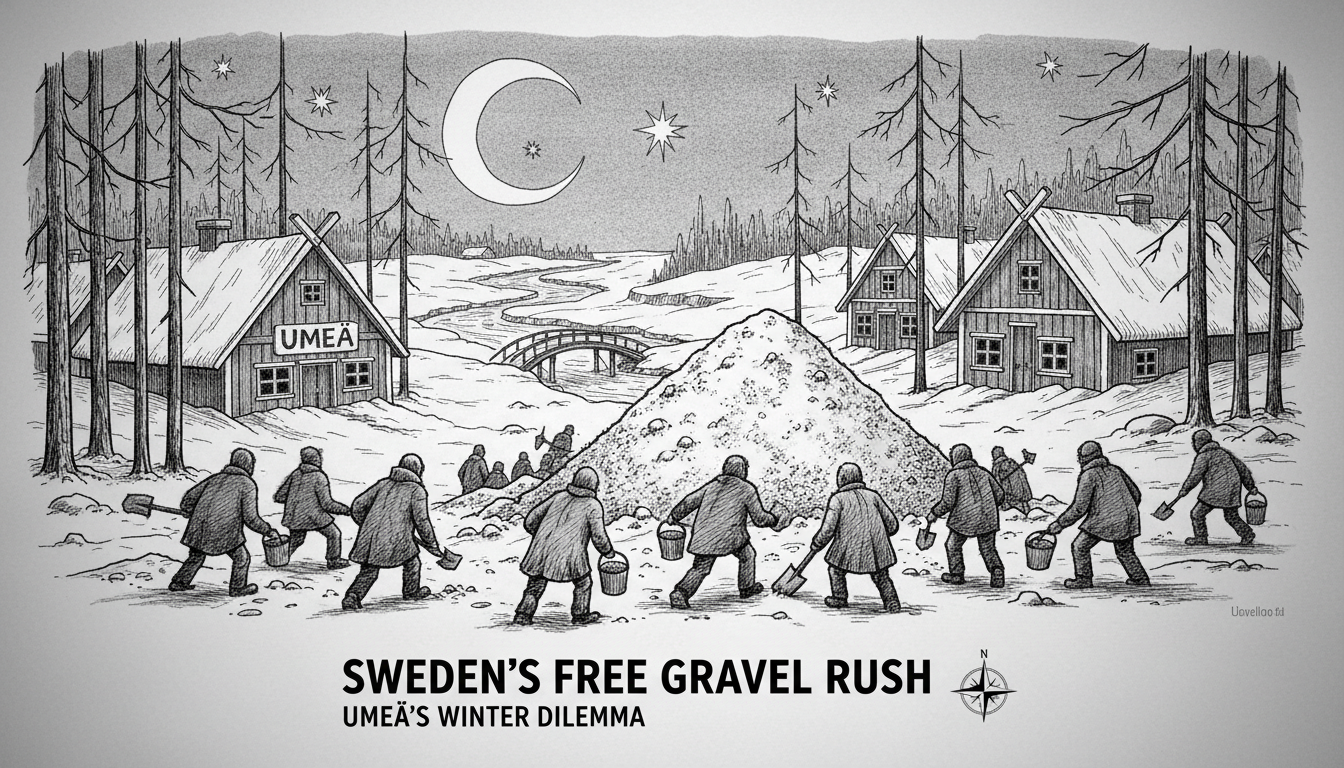
Sweden's winter ice creates a public safety challenge that municipalities like Umeå tackle with a simple solution: free gravel. The city provides property owners up to 100 liters per person each season to spread on icy paths and driveways. This system, designed to prevent slips and falls, is now under strain. Municipal officials report widespread abuse, with individuals and companies allegedly taking far more than their allotted share.
"It's been a terribly slippery winter," said Rickard Strinnholm, a Umeå resident, highlighting the genuine need. Videos show queues forming at gravel distribution points. The scene illustrates a paradox of public trust. A service meant to ensure community safety during harsh Nordic winters is being exploited, forcing a reevaluation of a long-standing civic practice.
The Mechanics of a Municipal Safety Net
Providing free winter traction material is common across Swedish municipalities. It is a cost-effective public health measure. Preventing accidents reduces burdens on healthcare and social services. Umeå's model operates on an honor system. Residents are expected to self-regulate, taking only what they need for their private property within the 100-liter limit. This approach minimizes administrative costs and speeds up access. For decades, this low-tech solution has worked. Harsh winters demand communal responsibility, and the gravel piles symbolize that social contract.
However, the social contract appears frayed. Officials note a significant increase in demand that outpaces the severity of the winter. The suspicion is that some are taking gravel for commercial use or to avoid purchasing it for large properties. This strains municipal budgets and risks leaving genuine residents without a crucial resource during peak icy periods. The problem isn't just volume; it's equity. When a few take too much, the many may go without.
Balancing Trust with Accountability
Urban planning experts see Umeå's situation as a classic case study in resource management. "Free access public goods are always vulnerable to overconsumption," explains Professor Lena Karlsson, a specialist in municipal services at Uppsala University. "The challenge is designing a system that maintains ease of access for those who need it while deterring exploitation. Adding too many barriers can defeat the original purpose of a rapid-response safety service."
Alternatives exist but come with trade-offs. The municipality could switch to a voucher or registration system. This would add bureaucracy and potentially slow down access during sudden cold snaps. They could invest in more aggressive public snow and ice clearing, shifting the responsibility entirely from the individual to the city. This would be significantly more expensive and may still not cover every private walkway. Another option is providing a different material, like salted sand, which is less desirable for secondary uses like construction or landscaping.
A Microcosm of Broader Societal Shifts
The gravel rush in Umeå reflects a broader conversation in Sweden about the sustainability of welfare models built on high trust. From healthcare to unemployment benefits, systems rely on honest self-reporting. Incidents of misuse, even on a small scale like this, fuel debates about tightening controls. Critics argue that abuse by a minority forces intrusive measures on the majority, eroding the very trust that makes the system efficient.
Local politicians are now in a difficult position. They must respond to the misuse without appearing to punish all residents for the actions of a few. Possible solutions include increased monitoring of distribution sites, clearer signage with rules, or public awareness campaigns. A more drastic step would be to require proof of address, linking gravel access directly to a specific property. Each measure adds a layer of complexity to what was once a simple transaction.
The Human Cost of Icy Conditions
Behind the policy debate is a real safety issue. Winter falls are a serious public health concern in Sweden, particularly for the elderly. Each year, slippery conditions lead to injuries ranging from fractures to head trauma, resulting in emergency room visits and long recovery times. The free gravel is a first line of defense. It empowers individuals to immediately address hazards outside their homes. For an aging population in a city like Umeå, this autonomy is crucial. Ensuring reliable access to this material isn't just about saving money; it's about preventing human suffering.
Residents like Strinnholm represent the intended beneficiaries. Their concern is genuine traction, not taking advantage. The system's failure occurs when their local pile is empty because someone else filled a trailer. This creates a direct conflict between communal need and individual greed, playing out at gravel depots across the city.
Looking Ahead: Winter's Annual Test
Umeå's municipal government will likely review its gravel policy before next winter. The decision will signal their priority: Is it preserving an efficient, trust-based system, or is it preventing all possible abuse? There is no perfect answer. A hybrid model may emerge, perhaps with a core free allowance supplemented by a low-cost option for larger needs.
The situation also invites technological solutions. Could a digital check-in via a municipal app log collections? Could distribution be more decentralized, with smaller piles in more neighborhoods to serve immediate local needs? These ideas cost money to develop and implement, funds that must be weighed against the value of the gravel itself.
Ultimately, the piles of free gravel are more than just crushed rock. They are a symbol of a society that looks out for its members during difficult seasons. The rush to take them reveals both the system's success—people know and use the service—and its vulnerability. As climate patterns shift, bringing potentially more volatile winter weather, the reliability of such basic services becomes even more critical. Umeå's challenge is to secure its gravel supply without fencing in the community spirit it was meant to foster. The solution will require not just new rules, but a renewed public conversation about shared responsibility in the face of a long, cold winter.