
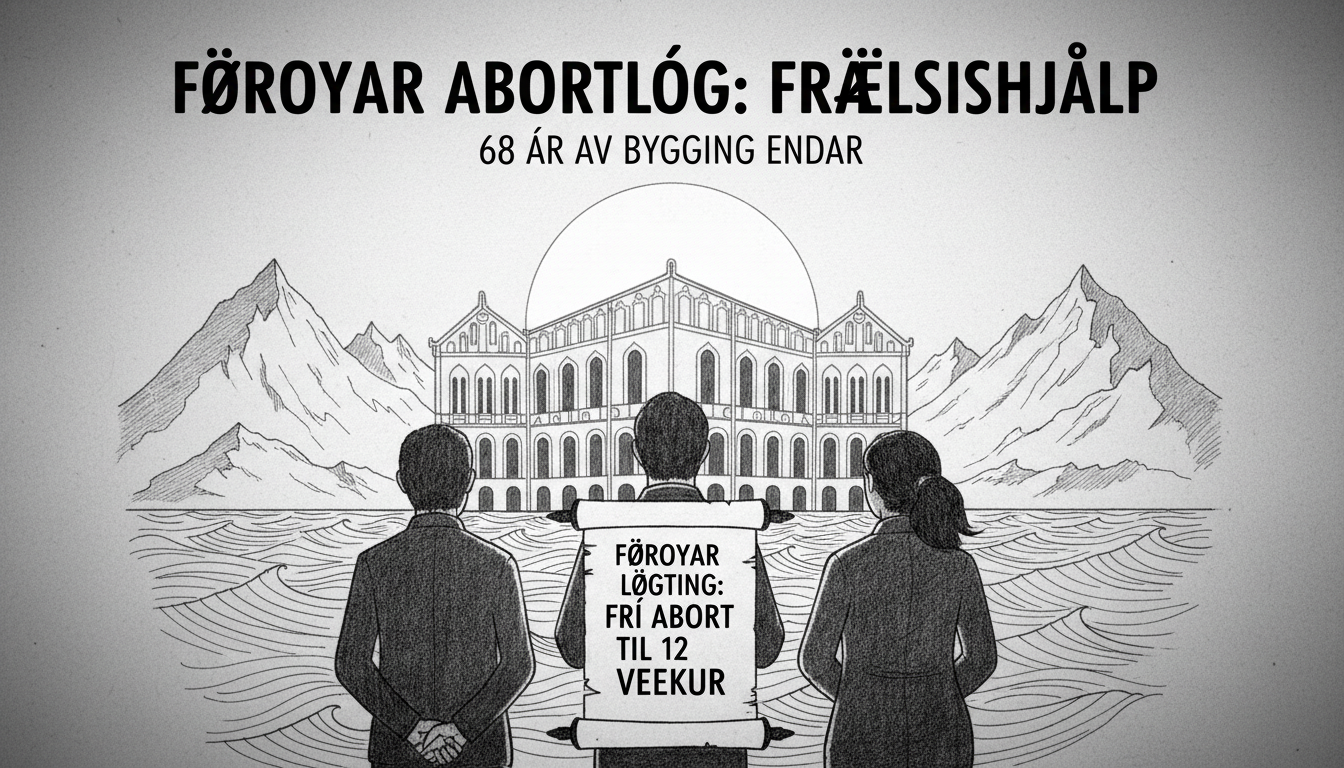
The Faroese Parliament has approved a significant liberalization of abortion laws, marking the first change to the territory's strict regulations in nearly seven decades. Lawmakers voted by a narrow margin of 17 to 16 on Thursday to allow abortions up to the end of the 12th week of pregnancy without requiring women to meet specific, restrictive criteria. This shift ends a policy framework that had remained unchanged since its introduction in 1956, placing the Faroe Islands, a self-governing territory within the Kingdom of Denmark, at the center of renewed debates on reproductive rights in the Nordic region.
Under the previous law, obtaining a legal abortion was exceptionally difficult. Women had to prove their pregnancy resulted from rape or incest, that the fetus had an incurable illness, that the woman's life was in serious danger, or that she had been declared unfit to care for a child. Both the woman's own doctor and the National Hospital were required to assess if she met one of these conditions. Crucially, both the woman and her doctor risked prison sentences if the legal conditions were not fully met. This framework had drawn sustained criticism from human rights organizations for years, arguing it violated women's bodily autonomy and placed undue psychological and legal burdens on those seeking care.
Hervør Pálsdóttir, a member of the Republic Party and one of the four parliamentarians who proposed the new law, called the vote a historic moment. She said in a statement that she was pleased the proposal passed. 'This is a major and historic moment, that Faroese women now have the right to decide for themselves,' Pálsdóttir stated. 'Many women have fought for many years for these rights, and I believe many women now feel more respected by their country.' Her comments highlight the long-standing advocacy by women's groups in the islands, a society with strong traditional and religious influences where such policy changes often face considerable debate.
The change brings the Faroe Islands closer to the legal standards of mainland Denmark, where abortion on request is permitted up to the 12th week of pregnancy. However, the narrowness of the vote—a single vote decided the outcome—reveals a deeply divided parliament and society on this issue. It reflects a classic tension in Nordic societies between progressive social policies and conservative community values, particularly in more remote or insular regions. The decision is likely to have practical implications for healthcare provision and could reduce the number of women traveling to Denmark or elsewhere for procedures.
From a broader Danish society news perspective, this development underscores the complex, layered nature of governance within the Kingdom of Denmark. While Denmark proper is often seen as a leader in liberal social policy, its autonomous territories—Greenland and the Faroe Islands—set their own laws in areas like social policy. This decentralization means integration into Danish norms is not automatic. The vote represents a notable step in aligning Faroese law with contemporary Nordic values on gender equality and individual rights, but the fierce debate preceding it shows that such evolution is neither swift nor unanimous. The real test will be in the law's implementation and its acceptance across Faroese communities in the coming years.