
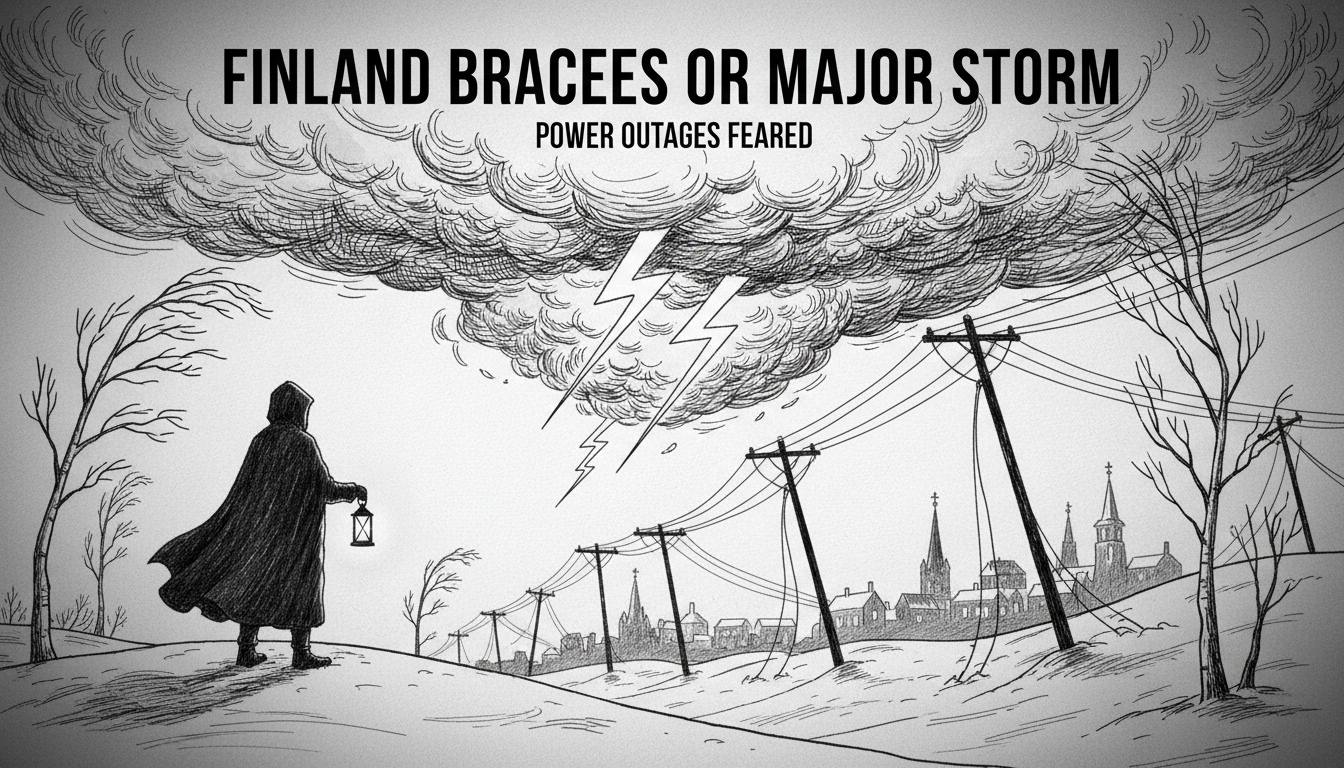
Finland's western coast is preparing for a severe storm set to hit on Saturday, with rescue services and energy companies warning of potential power outages and damage, particularly in rural areas. The Finnish Meteorological Institute has issued warnings for strong winds across the entire western coastline, with the Pohjanmaa region expected to bear the brunt of the strongest gusts.
"We have a good picture of the situation, and tomorrow we will have so-called enhanced monitoring and we will react according to the situation," said Thomas Nyqvist, the on-duty fire chief at the Pohjanmaa Rescue Department. He confirmed that rescue services have been coordinating with other authorities and are prepared for storm damage mitigation tasks, such as clearing fallen trees from roads and power lines.
The Rural Risk Factor
The storm's impact is predicted to be unevenly distributed, highlighting a critical infrastructure divide in Finland. While densely populated urban areas have largely buried their power cables, rural and sparsely populated regions remain vulnerable. Olli Kujanperä, the grid operations manager for energy company Oulun Energia, confirmed this disparity. His company's network is 93% underground, but the remaining overhead lines on the periphery of the network and in forested areas are at risk.
"Of course, forestation affects this greatly as well," Kujanperä noted. He pointed to a specific current weather condition that could exacerbate the danger: the lack of deep frost. "The ground isn't currently frozen hard. This means that trees may fall more easily in a storm. On the other hand, the good side is that currently there is no snow load on the trees. That is a mitigating factor."
This analysis underscores a recurring challenge for Finnish infrastructure. The country's vast forests, a national treasure, become a liability during autumn and winter storms when saturated soil and strong winds combine to topple trees onto roads and power lines.
Nightfall Complicates Response Efforts
A significant concern for authorities is the timing of the storm's peak. Forecasts suggest the most powerful winds could hit overnight, complicating repair and rescue efforts. Heikki Paananen, the preparedness manager for grid company Elenia, has previously warned that darkness and strong winds at night could slow down the repair of fault situations.
Fire Chief Nyqvist acknowledged the challenge but expressed confidence in modern equipment. "Although moving around in the dark is slower, the rescue department nowadays has quite good lighting at its disposal," he said. He suggested the impact of darkness would be more keenly felt by technicians from energy companies performing complex repairs.
Kujanperä from Oulun Energia echoed this, stating, "Darkness is a difficult condition, but today's installers have good equipment." However, he emphasized a non-negotiable safety limit: "Of course, the occupational safety side must also be kept in mind. If there is a strong storm, you cannot go to the site if trees are falling there." This protocol means some residents in affected areas may face extended waits for power restoration until conditions are safe for work crews.
A Test of Preparedness
The approaching storm acts as a live stress test for Finland's emergency response and infrastructure resilience. The proactive statements from rescue services and energy companies reflect a well-rehearsed protocol for severe weather. Finland's geographical location makes it prone to such storms, and its systems are built with this in mind.
However, the event also highlights persistent vulnerabilities. The uneven distribution of underground cabling is a direct function of economics and geography; burying lines across thousands of kilometers of forest and marshland is prohibitively expensive. This leaves a portion of the population, often in remote areas, disproportionately exposed to disruption.
Experts consistently advocate for long-term mitigation strategies, such as continued investment in burying key power lines and strategic forest management near critical infrastructure. Public awareness campaigns also play a crucial role in ensuring citizens in risk areas are prepared with emergency supplies, including alternative light sources, ways to stay warm, and supplies of water and food.
The Human Element of a Storm
Beyond the statistics of cable depth and wind speed, the storm's real impact will be felt in the daily lives of residents on the western coast. For urban dwellers in cities like Oulu, the storm may be little more than a windy night. For a family on a remote farm in Pohjanmaa, it could mean days without electricity, a blocked driveway, and isolation.
The advice from authorities in such situations is consistent: secure loose outdoor items, avoid unnecessary travel, especially in forested areas, and prepare for potential outages. Having a battery-powered radio for updates, a power bank for mobile phones, and adequate supplies at home is considered basic preparedness.
As the storm approaches, the coordination between the Finnish Meteorological Institute, regional rescue departments, and private energy companies becomes the frontline of national defense against the elements. Their readiness minimizes risk, but as Olli Kujanperä reminded everyone, the scale of potential damage cannot be accurately predicted in advance. "We cannot estimate the magnitude of the damage beforehand, nor can we estimate whether there will be any damage at all," he said. This uncertainty is the very essence of preparing for nature's power. The systems are in place, the crews are on alert, and Finland's western coast now waits to see what Saturday's winds will bring.