
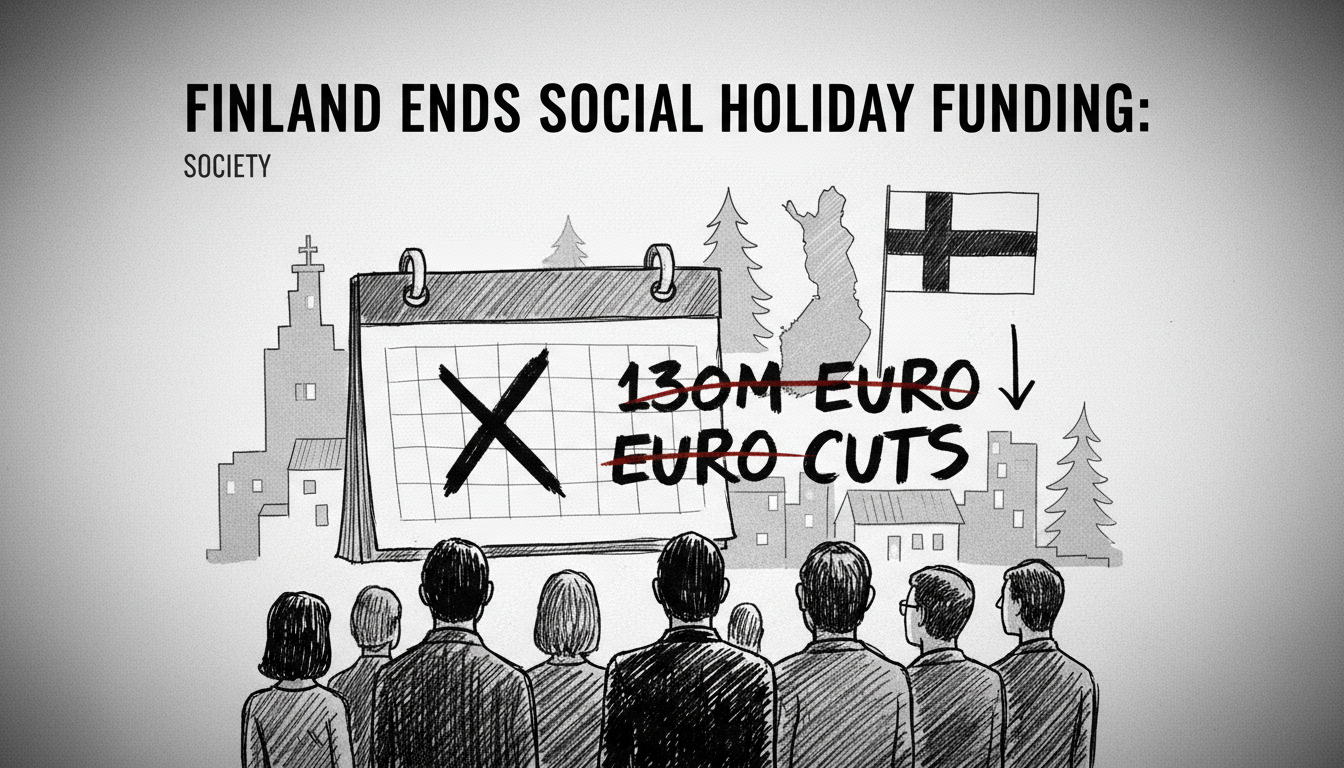
Finland's government will terminate all state funding for subsidized holidays for low-income families after 2026. The decision, announced by the Funding Centre for Social Welfare and Health Organisations (Stea), forms part of broader austerity measures targeting social welfare and health organizations. For thousands of Finns like Anne, a mother from Eastern Finland, this spells the end of a rare opportunity for respite and family time away from home.
"The decision is very sad. It's just awful that supported holidays are being taken away from low-income people," Anne says, her voice heavy with disappointment. Last summer, thanks to the social holiday program, she and her son enjoyed a supported break at Härmä Spa, a trip her family could never have afforded otherwise. "Many people comment, 'What's the point of such a frivolous trip?' and 'You can think of things to do at home too.' It's not always like that. A person needs some experiences. For us, this kind of trip was unique."
The End of a Lifeline for Vulnerable Families
The subsidized holiday, known as tuettu loma, typically lasts four to five days and includes full board: accommodation, meals, and an organized program. Recipients can apply for one holiday at most every three years and are required to pay a small personal contribution. "On our trip, we spent our own money too, but the support covered a large part of the costs," Anne explains, highlighting the program's design to enable participation, not provide a completely free ride.
Anne Ylönen, Managing Director of the Loma ja terveys ry (Holiday and Health association), describes the funding termination as "sad and shocking." Her organization arranges holidays specifically for families with children and adults in need of support. "Social holiday activity is for many the only opportunity to take a breather from daily life and gather strength," Ylönen stated in a press release. "The positive impacts of a supported holiday on the holidaymakers' lives are, according to research, significant."
A Broader Pattern of Austerity in Social Welfare
This specific cut is not an isolated policy but a direct consequence of wider government budget decisions. Early in its term, the ruling coalition decided to cut funding for social welfare and health organizations by approximately 130 million euros by 2027. This spring, during the government's mid-term review, an additional 10 million euros in cuts to Stea grants were confirmed for next year. The end of social holiday funding is a tangible outcome of these high-level fiscal decisions, transferring the abstract concept of "budget savings" into the concrete loss of a valued service.
Social holiday programs have long been a quiet cornerstone of Finland's welfare model, operating on the principle that well-being encompasses more than just basic material needs. The programs aim to prevent social exclusion, reduce stress, and offer positive shared experiences for families under financial strain. For children in low-income households, these holidays can provide memories and experiences comparable to their peers, mitigating the social and experiential gaps that poverty can create.
Expert Warnings and the Human Cost
Social policy experts and organizations are sounding the alarm. They argue that eliminating this funding is short-sighted, potentially leading to higher long-term costs in healthcare and social services. Mental health strain, caregiver burnout, and increased social isolation are measurable risks when vulnerable families lose one of their few avenues for structured respite. The research Ylönen references likely points to studies showing improved mental health, stronger family bonds, and a greater sense of social inclusion among participants.
"It's just awful that supported holidays are being taken away from low-income people," Anne repeats, encapsulating the sense of injustice felt by recipients. Her testimony challenges the notion that such holidays are a luxury. Instead, she frames them as a vital human need—a chance to "gather strength" and create "unique" family memories, commodities that are often scarce in households focused solely on making ends meet. The critique she mentions—that such trips are "frivolous"—reflects a societal debate about what the welfare state should provide and a potential undervaluing of mental and social well-being.
Navigating an Uncertain Future
For now, organizations like Loma ja terveys ry are committed to fulfilling their planned family holidays through 2026. However, the future beyond that point is uncertain. The association and others like it must now explore alternative funding models, private donations, or scaled-back operations, all while demand for their services may increase due to other concurrent social benefit cuts and economic pressures.
The government's decision places Finland at a crossroads regarding its welfare commitments. It raises fundamental questions about the scope of social security: does it end at subsistence, or does it extend to promoting quality of life and preventing the corrosive effects of chronic stress and limited opportunity? The 130 million euros in cuts represent a significant reallocation of resources, with the social holiday program being one visible casualty.
As Anne and her son look back on their holiday at Härmä Spa, it now carries the bittersweet weight of a last experience. The policy shift means that for the foreseeable future, such breaks will remain out of reach for her family and thousands of others. The ending of this funding stream closes a chapter on a distinctive aspect of Finnish social policy, one that quietly acknowledged that everyone, regardless of income, deserves a chance to make happy memories and simply have a break. The long-term impact of this loss—on family cohesion, mental health, and social equity—will unfold in the years after 2026.