
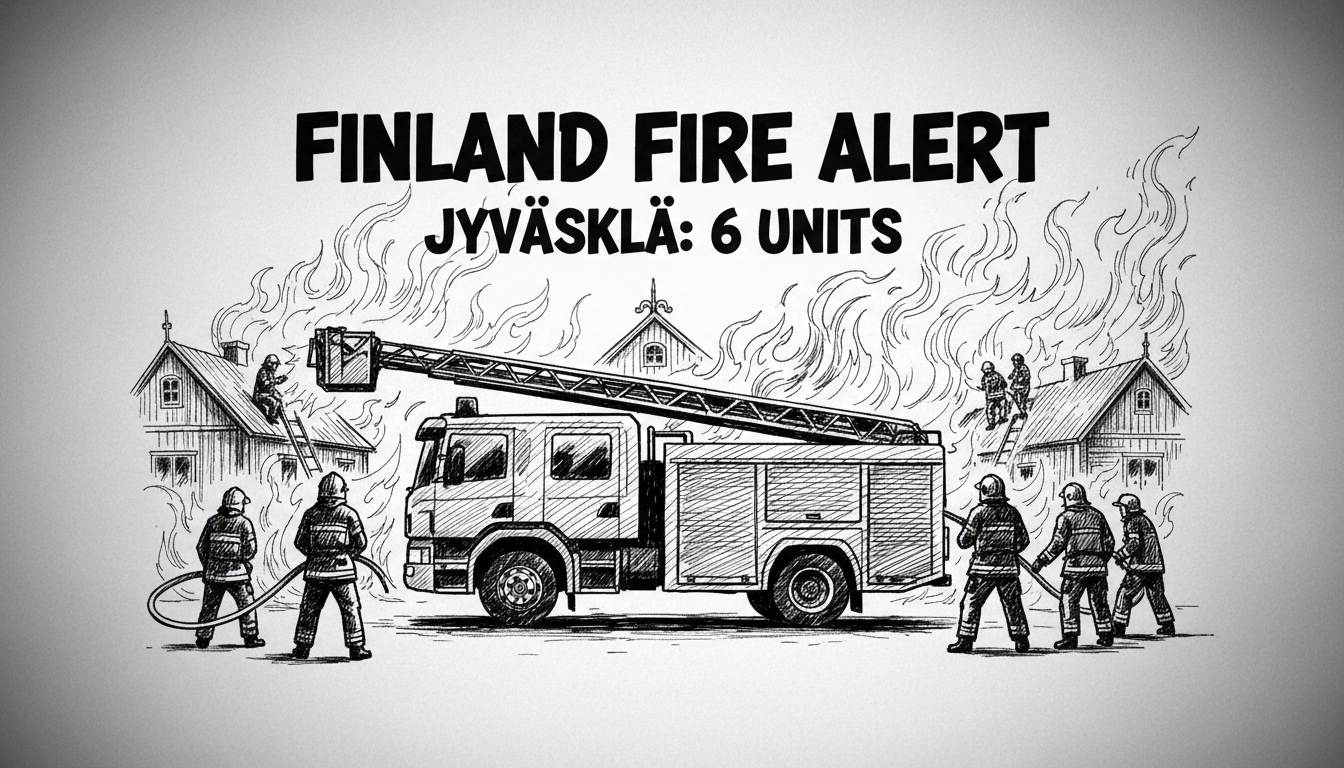
Finland's emergency services dispatched six firefighting units to a central Jyväskylä apartment building Tuesday evening after residents reported a strong smell of smoke in the stairwell and attic. The Keski-Suomen rescue department received the alarm at 8:30 PM for the six-story residential building on Cygnaeuksenkatu, mobilizing a significant response for what was initially feared to be a developing structural fire.
Officials quickly cordoned off the area between Yliopistonkatu and Kauppakatu. Firefighters conducted a thorough search of the premises, focusing on the reported areas. By 9:30 PM, they had not found any visible flames, open fire, or active smoldering, despite the persistent odor that prompted the call.
The incident caused temporary disruption for residents in the building's approximately 30-40 apartments, who were alerted by the emergency response. The quick arrival of multiple units underscored the protocol for potential building fires in densely populated urban areas.
The Evening Alert and Response
A resident's call to emergency number 112 triggered the large-scale response. The caller specifically noted the smell of smoke in the common stairwell and the building's attic space, locations that immediately raise concern for fire crews due to their role in fire spread and ventilation.
‘When we get a report of smoke smell in a multi-story residential building, we must assume it is a fire until we prove otherwise,’ a rescue department spokesperson explained in their initial bulletin. ‘The attic and stairwell are critical areas. A fire there can compromise the entire building’s evacuation routes very quickly.’
The six units included fire engines, a command vehicle, and support staff. Their immediate tasks were to secure the area, investigate the source, and prepare for potential evacuation or firefighting operations. The absence of visible signs did not reduce the initial threat level.
Jyväskylä’s Urban Context and Safety Record
Jyväskylä, a city of 145,000, is a major educational hub in central Finland. Its urban core features many post-war and newer apartment buildings, housing a significant portion of the population. Finnish building codes, updated regularly, mandate strict fire safety standards for such structures.
These standards include fire-resistant materials in stairwells, mandatory smoke detectors in every apartment and common area, and clear evacuation plans. Regular inspections by municipal authorities are required. The design aims to contain a potential fire within a single apartment for a sufficient time to allow evacuation and firefighter intervention.
‘This incident, while ultimately not a fire, tests the system exactly as intended,’ said fire safety expert Dr. Elias Korhonen, who lectures at the University of Jyväskylä. ‘A resident detects an anomaly—a smell—and reports it. The services respond with appropriate force. The outcome—no fire found—is a good one, but it validates the reporting and response chain.’
Finland’s Proactive Fire Safety Framework
The robust response in Jyväskylä reflects a nationwide philosophy. Finland invests heavily in preventative fire safety and rapid emergency response, resulting in one of the lowest rates of fire-related deaths in Europe. This is attributed to public education, technological infrastructure, and a well-funded, professional rescue service system.
Public campaigns consistently remind citizens to call emergency services at the first sign of danger, not to investigate themselves. This public awareness is a cornerstone of the strategy. The widespread use of interconnected smoke alarm systems in newer buildings also automates alerts, though initial reports in this case came from a person.
Building-specific factors also come into play. Attics in older buildings can sometimes harbor electrical faults or become storage spaces for flammable materials. Stairwells, while built to be fire-resistant, can act as chimneys if a fire breaches an apartment door. These factors make the reported locations in the Jyväskylä alert a high priority.
Analysis: The Cost of Prevention Versus Crisis
From a policy perspective, this event highlights the calculus of modern emergency services. Deploying six units and dozens of personnel for a smoke smell that yields no fire is not an overreaction; it is the cost of guaranteed safety. The alternative—a slower, smaller response to a genuine but smoldering fire—could lead to catastrophe.
‘We budget for these scenarios,’ explained a municipal safety official familiar with rescue service planning. ‘A full response to a potential multi-story building fire is the only acceptable standard. The financial cost of the response is always less than the human and societal cost of a major fire.’
Finland’s model, while expensive, proves effective. It relies on a high level of public trust in authorities and a reciprocal trust by authorities in public reports. The Jyväskylä call was treated with utmost seriousness because the system assumes citizens are responsible in their use of emergency lines.
The Aftermath and Ongoing Investigation
As of late Tuesday night, the scene on Cygnaeuksenkatu was being stood down. Residents were allowed to return to their apartments after firefighters confirmed no immediate threat. The investigation into the source of the smoke smell, however, continues.
Possible causes include a minor electrical fault that overheated without igniting, dust burning on a heating element, or smoke drifting from another nearby source into the building’s ventilation. Fire investigators will use thermal imaging cameras and other tools to rule out hidden hotspots within walls or cavities.
The rescue department will likely issue a follow-up report detailing their findings. If a specific hazard is identified—such as a faulty electrical junction box in the attic—the building’s management company will be mandated to carry out repairs immediately under official supervision.
This event serves as a real-world drill for both residents and responders. It reinforces the importance of immediate reporting and showcases the seamless mobilization of Finland’s emergency infrastructure. For the people of the Cygnaeuksenkatu apartment building, it was an unsettling evening that ended with reassurance, a testament to the system working precisely as designed to protect urban life.
‘The smell of smoke is the fire’s first warning siren,’ concluded expert Dr. Korhonen. ‘Tonight in Jyväskylä, that siren was heard, and the system responded. That is the foundation of a safe society.’